Introduction: Why Your Tool Knowledge Closes More Deals (and Prevents Costly Returns)
For distributors and channel partners in the digital cutting machine space, technical product knowledge isn't just a sales advantage — it's a liability shield. When a customer ruins a batch of premium corrugated packaging because the machine was sold with the wrong cutting tool, that's not a product defect call. That's a pre-sales qualification failure, and it lands on the distributor's doorstep.
For a complete breakdown of digital cutting technology and how to choose the right machine, read our complete digital cutting machine guide.
Understanding the oscillating knife vs drag knife distinction is one of the most foundational competencies a CNC digital cutter distributor can possess. These two tool heads represent fundamentally different physical mechanisms, each engineered to interact with material fibers in a distinct way. Confusing their application domains leads to poor cut quality, material waste, excessive blade wear, inflated warranty claims, and damaged customer relationships.
This guide provides a deep technical and commercial breakdown of both cutting tools: the underlying mechanics, the material science behind each tool's optimal use case, a direct side-by-side comparison, and a practical sales framework to match the right tool to every customer's production needs.
The Physics and Mechanics of a Drag Knife
How a Drag Knife Works
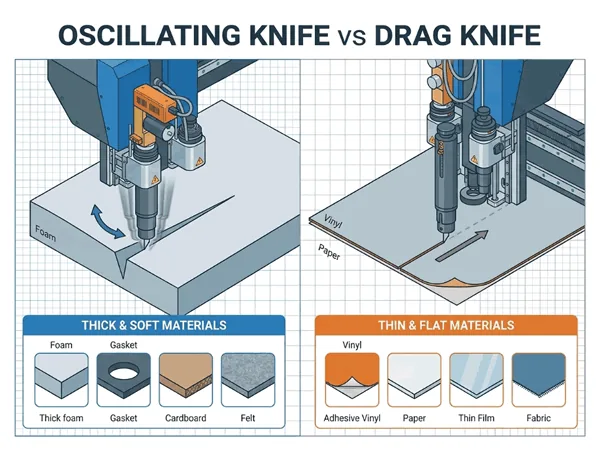
A drag knife operates on a deceptively simple principle: a fixed-offset, freewheeling blade is dragged through the material by the machine's X/Y motion system. The blade is not driven by any actuator; it passively trails behind the tool carrier and relies entirely on the material's resistance to force it into alignment with the direction of travel.
The blade is mounted eccentrically — the cutting edge sits slightly behind the pivot centerline. This offset creates a self-aligning torque: as the cutting head moves in a new direction, the material's lateral resistance rotates the blade so the edge always faces forward. This is passive non-tangential behavior, and it is the core functional mechanism of all basic drag knife systems.
Tangential vs. Non-Tangential Drag Knives
Higher-end implementations add a servo motor to actively rotate the blade to the precise heading angle before the cutting head moves. This is called tangential cutting or a tangential drag knife. The distinction matters considerably in corner cutting:
- Non-tangential drag knife: The blade must physically "swing" through the material to realign at corners, creating a small arc-shaped overcut or a slightly rounded corner. Acceptable for vinyl and soft films; problematic for rigid or thick materials.
- Tangential drag knife (servo-driven): The spindle pre-rotates to the new vector angle, then plunges into the cut. Corners are geometrically precise. This is the correct tool for applications demanding sharp-cornered labels, stickers, and precision-cut soft substrates.
Tangential Cutting: The Third Option Beyond Drag and Oscillating
A tangential cutting tool is a servo-driven blade that rotates to the exact heading angle before each cut — eliminating the swing arc of a passive drag knife. When comparing drag knife vs tangential knife, the difference shows at corners: the tangential knife produces geometrically precise corners, while a non-tangential drag knife leaves a small overcut. For a tangential knife cutter handling labels, stickers, and thin cardstock, this precision avoids the rounded corners that frustrate customers.
When to use tangential cutting: choose it for high-SKU label and sticker work where corner sharpness is non-negotiable, or for thin rigid substrates that a vibrating blade would mark. It does not replace the corrugated work — it complements it. Many LDCUT L8 and L10 configurations offer tangential, drag, and oscillating heads on the same gantry.
Ideal Materials for Drag Knives
The drag knife excels with thin, low-resistance, flexible materials. The physics are straightforward: the blade needs enough lateral resistance to self-align (or servo-align), but not so much that the dragging motion tears, stretches, or displaces the substrate. Optimal applications include:
- Self-adhesive vinyl and heat-transfer vinyl (HTV) — low density, consistent fiber structure, adheres to backing liner that provides controlled resistance
- Thin papers and cardstock (up to ~0.5mm) — uniform, low-friction cutting
- Thin PP and PET films — flexible enough to deflect rather than crack under blade pressure
- Foam-backed vinyl — if foam density is low and thickness is under 1.5mm
Limitations of Drag Knives
The drag knife's passive mechanism becomes a liability as material thickness and density increase:
- Corner geometry degradation: At corners, the blade must swing through an arc. In thick or dense materials, this arc tears fibers laterally rather than severing them cleanly.
- Friction buildup and material displacement: As the blade is dragged, it compresses and displaces material rather than sectioning it. In foams and corrugated boards, this displacement creates crushed edges and delamination.
- Thickness ceiling: Most drag knives are practically limited to materials under 2mm. Beyond this threshold, the blade encounters sufficient resistance that accurate path-following degrades and blade deflection introduces positional error.
- Inappropriate for fibrous composites: Materials with random fiber orientations do not respond predictably to a dragging cut. The blade catches on fibers, causing micro-tears and jagged edges.
For distributors: a drag knife being used on corrugated cardboard or medium-density foam is one of the most common sources of post-sale complaints. Recognizing this misapplication before the sale is a direct path to reducing warranty claims.
The Physics and Mechanics of an Oscillating Knife
How an Oscillating Knife Works
An oscillating knife is an active cutting tool. Unlike the drag knife, it does not rely on passive blade self-alignment; it combines two independent motions:
- Tangential rotation: A servo motor precisely rotates the blade spindle so the cutting edge is always aligned perpendicular to the direction of travel — ahead of each movement vector, not trailing behind it.
- Vertical oscillation: An actuator drives the blade in a high-frequency up-and-down stroking motion, causing it to saw through the material rather than drag through it.
The up-down stroke continuously lifts the blade out of the kerf on each upstroke, eliminating lateral friction buildup. On the downstroke, the blade re-enters cleanly, severing fibers incrementally rather than compressing them. This sawing action produces clean vertical cut walls even in materials over 50mm thick — a physical impossibility for any drag knife.
Electric Oscillating Tool (EOT) vs. Pneumatic Oscillating Tool (POT)
The oscillating knife is not a monolithic category. Industrial CNC digital cutters offer two distinct actuator technologies for the oscillating drive, each with meaningful engineering tradeoffs:
Electric Oscillating Tool (EOT)
- Drive mechanism: Electric motor with eccentric cam or linear actuator
- Stroke amplitude: Fixed or programmable, typically 1mm
- Advantages: Precise frequency control, quieter operation, lower maintenance, easily integrated into digital parameter control systems
- Best for: Medium-density materials, applications requiring variable frequency tuning, facilities without compressed air supply
- Limitations: Higher heat generation at continuous high-frequency operation; may require duty-cycle management for very dense materials
Pneumatic Oscillating Tool (POT)
- Drive mechanism: Compressed air piston
- Stroke amplitude: Typically larger — 10mm, delivering more aggressive material penetration per stroke
- Advantages: Significantly higher power output, superior performance in thick rigid foams, dense rubber, multi-layer composites, and hard gasket materials
- Best for: Materials above 20mm thickness, high-density foams, rubber sheets, carbon fiber pre-pregs, heavy corrugated cardboard
- Limitations: Requires stable compressed air supply; pneumatic line maintenance adds operational complexity
Oscillating Knife Blade Types and Replacement Guide
Blade selection is where cut quality is won or lost. Understanding CNC knife cutting tool types — oscillating, drag, creasing, V-cut, and pen — lets you specify the right head per job.
On oscillating knife blade replacement: expect 50–100 operating hours on an oscillating blade and 100–200 hours on a drag blade, depending on abrasiveness. LDCUT blades use standard interfaces and are widely available as spares, so keep at least three of each on hand.
Ideal Materials for Oscillating Knives
The sawing mechanics of the oscillating knife make it the definitive choice for materials where a drag knife physically cannot produce acceptable results:
- Corrugated cardboard: The oscillating stroke severs the fluted cell walls cleanly without crushing them.
- EVA and PE foams: From soft packaging foam to rigid PVC foam board, the oscillating action prevents compression and tearing.
- Non-woven fabrics and technical textiles: Random fiber orientation demands a knife that severs on the downstroke.
- Automotive and industrial composites: Multi-layer stacks are efficiently cut with a single oscillating pass.
- Honeycomb panels and sandwich composites: The oscillating action navigates through internal cell geometry.
How Oscillating Motion Prevents Material Tearing
When a drag blade contacts a dense material, the blade edge is under continuous lateral stress. Fibers ahead of the blade are compressed and pushed sideways; in sufficiently dense materials, this causes tearing rather than clean severing.
The oscillating blade applies intermittent, vertically-directed shear force on each downstroke — fibers are punched through before significant lateral displacement occurs. The upstroke clears the kerf of friction. The result is cut geometry that relies on vertical shear rather than lateral displacement.
Oscillating Knife vs Drag Knife: The Ultimate Technical Comparison
Side-by-Side Technical Comparison Table
| Parameter | Drag Knife | Oscillating Knife |
|---|---|---|
| Cutting Mechanism | Passive blade dragged / servo-rotated through material | High-frequency vertical oscillation + servo tangential rotation |
| Max Practical Cutting Depth | ~2mm (soft materials); ~5mm with optimal conditions | 10–50mm depending on tool/blade configuration |
| Corner Precision | Good (tangential servo); Moderate (non-tangential) | Excellent — blade pre-aligns before entry |
| Edge Quality on Thin Films | Excellent | Acceptable (overkill — stroke may cause micro-vibration) |
| Edge Quality on Thick Materials | Poor to unacceptable | Excellent — clean vertical walls |
| Best Material Category | Vinyl, thin films, thin paper, HTV | Corrugated board, foam, rubber, composites, gaskets |
| Machine Maintenance Complexity | Very low — no actuator, just blade swap | Low–Moderate; requires motor/air filter service |
| Upfront Tool Head Cost | Low | Moderate–High (EOT); Moderate (POT) |
| Material Tearing Risk | High for materials >2mm | Very low — oscillation prevents fiber displacement |
Best Cutting Tool for Each Material: Quick Reference Guide
Use this quick reference when matching a tool head to a substrate. For best cutting tool for corrugated board, an oscillating knife for corrugated (EOT or POT) is mandatory — the sawing stroke severs flutes without crushing. For best cutting tool for foam board, an oscillating knife (EOT for soft foam, POT for rigid PVC foam) cuts cleanly without compression. For best cutting tool for vinyl, a drag knife for vinyl delivers the fastest, cleanest edge on thin films and HTV.
| Material | Recommended Tool | Max Thickness | Suggested Speed |
|---|---|---|---|
| Corrugated board | Oscillating knife (EOT) | 50 mm | ~500 mm/s |
| Vinyl / films | Drag knife | 2 mm | ~800 mm/s |
| Foam board | Oscillating knife (POT) | 50 mm | ~400 mm/s |
These are merely guidelines—the actual choice of cutting tools and cutting speed will depend on the specific application. Please leave a comment detailing the materials to be cut and your requirements, and our specialists will recommend a cutting solution tailored to your needs.
How Distributors Can Leverage This Knowledge to Boost Sales
Asking the Right Pre-Qualification Questions
The most effective sales methodology in the digital cutting space is needs-based diagnosis. Before specifying a tool head, distributors should standardize a short materials intake conversation with every prospect:
- "What are the primary materials you'll be cutting?" — If the answer includes corrugated, foam, or rubber, the oscillating knife is mandatory. If it's exclusively vinyl and HTV, drag knife suffices.
- "What's the maximum material thickness you'll need to cut?" — Any answer above 3mm immediately routes to oscillating knife.
- "How critical is corner sharpness in your final product?" — For structural packaging and precision gaskets, tangential servo control is non-negotiable.
- "What's your production volume per shift?" — Higher volumes amplify consumable costs and maintenance burdens.
- "Do you have a compressed air supply on your production floor?" — No compressed air means EOT is the practical choice.
The Modular Tool Head Advantage: Your Highest-Value Upsell
Digital flatbed cutters that support interchangeable modular tool heads represent the single most powerful upsell mechanism. When a machine platform accepts both drag knife and oscillating knife modules — swappable in minutes without tools — the distributor can make this argument:
"Your current primary application is vinyl, so the drag knife handles your daily volume. But when a corrugated packaging job comes in next quarter, you don't need a second machine. You swap the tool head and your existing machine handles it."
This argument increases the machine's perceived value, protects long-term relationships, reduces misapplication risk, and generates recurring consumable revenue as customers activate additional tool modules.
How Correct Tool Specification Reduces Warranty Claims
Every misapplication generates downstream costs: delaminated boards, customer frustration, multiple service calls to diagnose a "machine defect" that is actually a tool selection error, and ultimately reputation risk.
Distributors who master cutting tool specification reduce these friction points systematically. One prevented misapplication claim pays for the time invested in proper pre-sale qualification.
Why Partner with LDCUT
Engineered for Global Distribution Channels
LDCUT's digital flatbed cutter series was designed from the ground up with the distributor's commercial reality in mind. The fully modular tool head architecture means every machine is a multi-application platform. Tool heads for drag knife, oscillating knife (both EOT and POT variants), routing spindle, creasing wheel, and pen tools can all be mounted on the same machine frame and switched in under five minutes.
Conclusion
The oscillating knife vs drag knife distinction is the primary application engineering decision that determines whether a digital cutting installation succeeds or fails. Drag knives deliver fast, clean results on thin, flexible materials like vinyl and film. Oscillating knives — whether electric or pneumatic — are the engineering requirement for corrugated board, foam, rubber, and any material with meaningful structural resistance.
For distributors, this knowledge prevents costly misapplications and enables confident upsell conversations about modular tool platforms.
Ready to expand your digital cutting portfolio?
Contact the LDCUT partner team to:
- Request a technical catalog for our full flatbed cutter line
- Schedule a live application demo — we cut your target materials
- Discuss distributor partnership terms and available territories
Frequently Asked Questions
Q1: Can a drag knife cut corrugated cardboard?
Technically, a drag knife can create a scored line through light corrugated materials, but it cannot cut through the full thickness of standard corrugated board without crushing the fluted cell structure and producing delaminated, torn edges. For any production-grade corrugated cutting application, an oscillating knife is the required tool. Using a drag knife on corrugated board is the most common source of post-sale dissatisfaction.
Q2: Which tool head should I recommend for a customer cutting both vinyl graphics and foam packaging?
This is the exact scenario where a modular tool head platform delivers maximum value. Recommend a digital flatbed cutter that supports both drag knife and oscillating knife modules on the same frame. For their vinyl work, the drag knife provides optimal speed and edge quality. For foam packaging, the oscillating knife handles clean cuts without material compression. A single machine investment addresses both production needs.
Q3: What's the difference between EOT and POT oscillating tools?
EOT (Electric Oscillating Tool) uses a motor-driven cam — quieter, lower maintenance, ideal where compressed air isn't available, and best for medium-density materials with tunable frequency. POT (Pneumatic Oscillating Tool) uses compressed air for higher power and a larger stroke, making it the better choice for thick rigid foams, rubber, and heavy corrugated. Both mount on the same LDCUT tool carriage.
Q4: How often should I replace oscillating knife blades?
Plan for 50–100 operating hours on an oscillating blade and 100–200 hours on a drag blade, depending on material abrasiveness. Keep at least three spare blades of each type on hand, and replace at the first sign of burring or edge fuzz rather than pushing a worn blade.