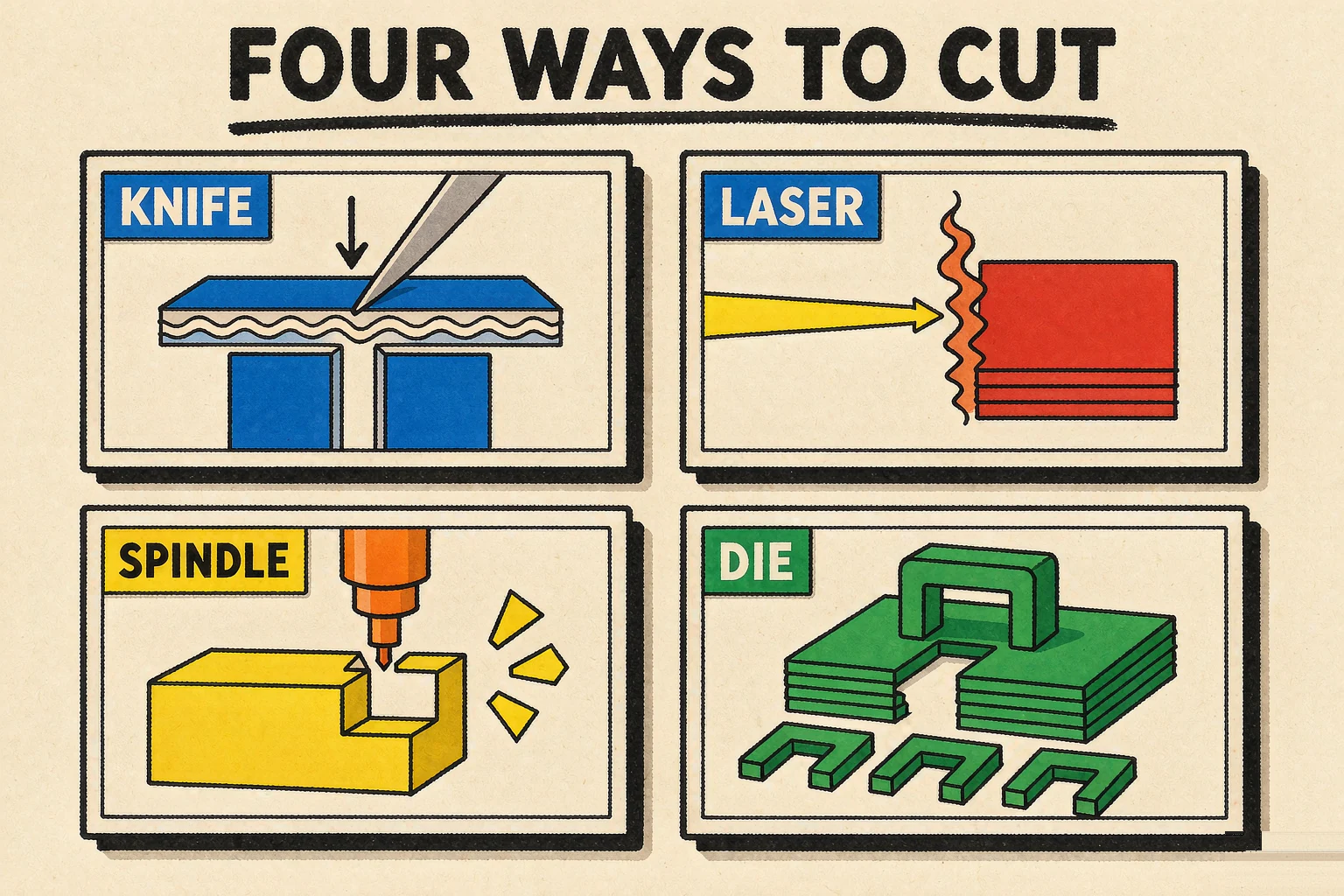
A buyer choosing a cutting machine is usually choosing between five platforms, not five brands: a flatbed knife cutter, a roll-fed cutter, a laser cutter, a CNC router with a spindle, and a steel-rule die. Each one is the right answer for some jobs and the wrong answer for others, and the differences are mechanical — what the tool does to the material — not a matter of which brochure is thicker.
This page compares the platforms on six checks. The right platform is the one whose failure modes you can live with on the materials you actually cut.
1. What material, and what does the tool do to it?
Start with the material list from last quarter's order book, not with the machine catalogue. Then ask what each tool physically does to each material.
A knife works by focusing force along a single edge. Vinyl, foam, paper, corrugated board and foam PVC all yield to a blade: the material gives way as the edge moves through it. It fails in rigid plastics — acrylic, rigid PVC, structural ABS — because the material resists, the blade deflects, and the deeper the cut, the more the wall leans out of square.
A laser removes material with heat. That makes it strong on thin, heat-tolerant stock and on fine detail, and weak wherever heat changes the material: sealed or discoloured edges, and plastics that need material-specific review before they are cut with heat.
A spindle removes material as chips. It is the tool for rigid sheet — acrylic, rigid PVC, composites — where a square edge matters and a knife cannot produce one. It is the wrong tool for thin film, which it tears rather than cuts.
A steel-rule die cuts by pressing a shaped blade through the stack. It is the fastest way to repeat one shape thousands of times, and it is also a fixed cost per design: change the shape and the die must be remade.
2. How thick, and how does thickness change the answer?
Thickness is the fastest way to eliminate platforms. A drag knife handles thin film; an oscillating knife carries through corrugated, foam, and board on a flatbed. A flatbed knife cutter spans 0.1–50 mm only across its five interchangeable heads — no single head or machine covers the whole range; which thicknesses a given machine handles depends on the heads fitted to it. On rigid sheet, thickness is what moves the job from a knife to a spindle: the deeper a blade sits in rigid plastic, the more it deflects.
Ask every supplier the same question in the same words: what is the maximum thickness you cut in this material, on this machine, with a square edge? The answer that names a material and a number is verifiable. The answer that quotes a machine maximum without a material is not.
3. How many, and how often does the design change?
Volume and change frequency decide between tooling and no tooling. A die amortizes its cost over the run: on a long run of one shape it wins outright; under about 5,000 units a year for a single design, the die stays a cost charged per job rather than per piece, so a digital flatbed with no die to make wins instead; past about 25,000 units a year for that design, the die's cost per piece drops far enough to win back. Re-derive the two thresholds from your own order book before using them.
A flatbed or roll-fed digital cutter carries no tooling cost per design, so the first piece costs nearly the same as the fiftieth. A laser carries no tooling either, but its economics turn on the material and the edge it leaves. A die is the opposite: cheap per piece at volume, expensive per change.
4. Which accuracy number is being quoted?
Processing accuracy, repeat positioning accuracy, and camera resolution are three different claims, and every platform quotes the one that flatters it. On LDCUT flatbed cutters they are ±0.01 mm processing accuracy, ±0.02 mm repeat positioning accuracy, and 0.025 mm camera resolution, and those three figures are the same across all five models. Ask any supplier which one it is quoting, and ask for the statement in writing.
Then ask what the number leaves out. A flatbed's accuracy budget is spent on registration at the marks and on holding the sheet flat; near the far edge of a big printed sheet, the sheet itself will have shifted, and no camera can put it back. A roll-fed machine's budget is spent on web tension and tracking. A laser's budget is spent on the heat-affected edge. The specification that matters is the one measured on your material, on your file — which is why before buying, the one test that still counts after the machine arrives is a trial cut on your own material.
5. What does the edge look like, and who finishes it?
Every platform leaves an edge, and every edge needs finishing somewhere. A knife leaves a cut edge that usually needs no finishing on board and foam. A laser leaves a sealed or discoloured edge that may need no finishing on some materials and may be unacceptable on others. A spindle leaves a routed edge that may need cleanup. A die leaves a crushed edge on the exit side of the board.
Ask to see the edge, not the specification. Cut samples shipped to you let you run your own fold test, peel test, or print-adhesion check — and the edge you see on your own material is the edge your customer will see.
6. Who answers when the machine is down?
For a distributor, this is the check that outlives the purchase. Ask for a named contact, a language, a response window, and a parts lead time — for every platform you compare, in the same form. Ask whether the manufacturer keeps spare parts in stock after a model is discontinued, and whether there is a parts warehouse in your region. A platform comparison that stops at cutting speed is unfinished: the machine that cuts fastest and waits longest for parts is the slowest machine you own.
How to use this page
Work through the six checks with your own order book in front of you: the materials from last quarter, typical run size for each shape, how often the job changes in a month, and how many different shapes appear in a year. The platform that survives all six checks on your materials is the shortlist. If more than one survives, a trial cut on your own stock settles it — a single sheet of your own stock, your own file, and the cut parameters and video that come with it.
For the flatbed option in detail — materials, tool heads, and which model fits which job — see the digital cutting machine guide and the LDCUT product range. For corrugated work, see the corrugated box cutting guide. For signage materials, see the signage cutting guide. For how to test any supplier before money moves, see How to Choose a Digital Cutting Machine Manufacturer.