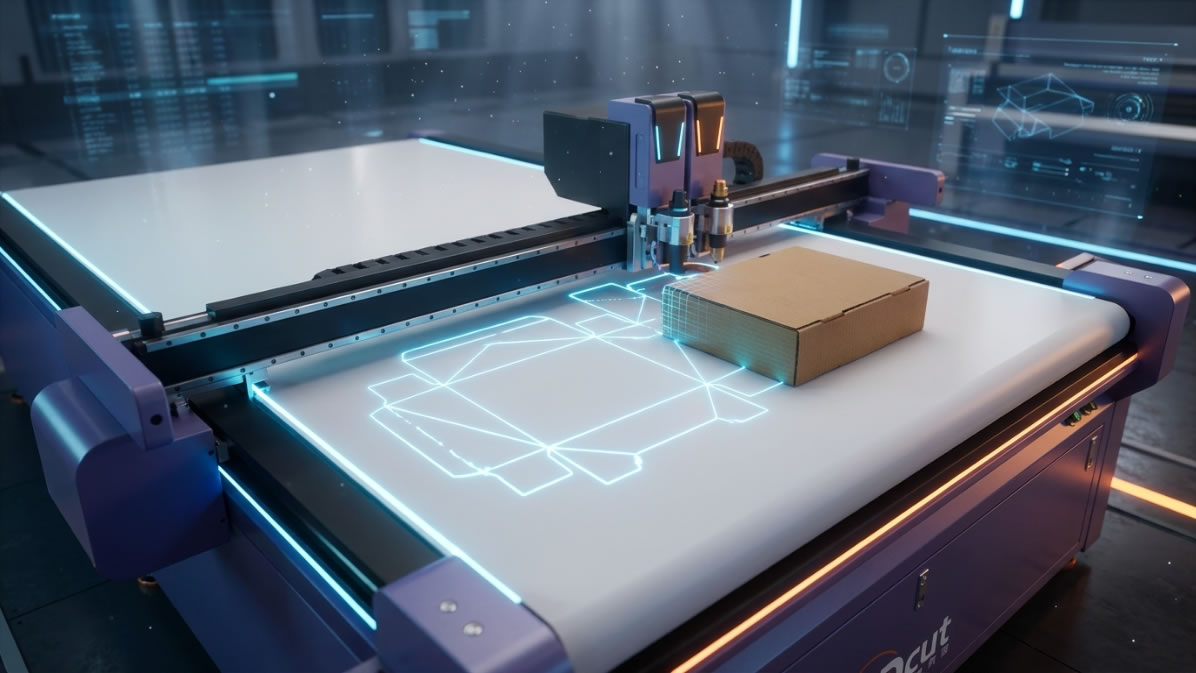
This digital cutting machine guide exists because most packaging and signage factories are still paying for something they don't need: steel dies. Walk onto a typical carton or display floor and you'll find 10–15% of every sheet ending up as scrap, six-week waits for custom tooling, and a line that stalls the moment a die isn't in stock. If you run a converting, printing, or display operation, that waste is your margin walking out the door.
You're a plant manager, procurement lead, or equipment distributor weighing a capital purchase. You've outgrown hand-knife sampling and you're done justifying die costs on short runs. This guide is for the industrial buyer, not the craft hobbyist.
If you came looking for a Cricut or a desktop vinyl plotter, you're in the wrong place. We cover production-class machines that cut corrugated, foam, PVC, and honeycomb by the sheet and by the thousand.
By the end of this digital cutting machine guide you'll have a selection framework, a comparison table covering flatbed, roll-fed, laser, and router platforms, and a downloadable checklist to keep supplier quotes honest. We'll also show where a 22-year manufacturer with 3,000+ enterprises across 80+ countries fits your risk profile.
You already suspect steel dies are a hidden tax on every custom job — and you're right. This guide gives you the criteria to pick a cutter that pays for itself, plus the red flags that signal a bad buy: we define the machine, break down the five tool heads, score ten selection factors, map applications, model real cost and ROI, and put the LDCUT series side by side.
Mini-story #1 — The corrugated plant that cut waste 30% overnight. In early 2024, a 60-person packaging converter in northern Italy ran retail display boxes on a library of 140 steel dies; every new SKU meant a €2,800 die and a three-week wait. After installing a digital flatbed cutter with imported rack-and-pinion drive and auto-nesting, their sheet scrap dropped from 14% to under 8% in one quarter — a 30%+ reduction — and they stopped rejecting orders under 500 units. The machine paid back in 17 months.
The three scenarios below are based on typical outcomes we see across converter and sign-shop installs.
Key Takeaways
- A digital cutting machine replaces steel dies with a software-driven knife, eliminating 6–8 week tooling waits and 10–15% die-related scrap.
- ±0.01 mm accuracy and 120 m/min traverse speed are the industrial baseline for converting, signage, and foam.
- Five tool heads — EOT oscillating, DCT drag, CCT creasing, KCT kiss-cut, VCT V-groove — cover cutting, folding, and half-cutting on one table.
- Die-less cutting lifts effective throughput by up to 300% versus manual die change; CCD vision cuts labor dependence by ~40%.
- Realistic payback is 12–24 months: labor savings of $20K–30K/year plus waste dropping from 10–15% to 3–8%.
Table of Contents
- What Is a Digital Cutting Machine?
- How Does a Digital Cutting Machine Work?
- Types of Digital Cutting Machines
- Digital Cutting Machine Tool Heads Explained
- How to Choose a Digital Cutting Machine: 10 Factors
- Choosing by Application
- 5 Common Mistakes to Avoid When Buying
- FAQ
- Conclusion
What Is a Digital Cutting Machine?
A digital cutting machine is a die-less, CNC-controlled cutting table that uses an oscillating or drag knife to cut sheet materials to ±0.01 mm directly from a vector file — no steel die, no tooling wait. You load a vector file, the software nests the parts, and the gantry drives a tool head across the sheet. No die, no mold, no tooling wait.
Digital vs Traditional Die Cutter
A traditional die cutter presses a custom steel rule through your sheet. It's fast at volume, but every new shape needs a new die: $5,000–$20,000 and 6–8 weeks before the first cut. A digital cutter reads a file and cuts the shape immediately. Change the design and you change the cut.
| Factor | Traditional Die Cutter | Digital Cutting Machine |
|---|---|---|
| Tooling | Custom steel die, $5K–$20K | None (die-less) |
| Lead time for new shape | 6–8 weeks | Minutes (new file) |
| Best run size | 1,000+ units | 1 to 10,000+ |
| Setup / changeover | 30–60 min per die | Under 3 min head swap |
| Material waste | 10–15% (die trim) | 3–8% (nested) |
| Unit cost at low volume | High (die amortization) | Low (no tooling) |
Core Components
Every industrial digital cutting machine shares the same skeleton:
- Motion system — X/Y gantry driven by imported rack-and-pinion and ball screw for repeatable ±0.01 mm accuracy.
- Tool head — the interchangeable cutting module (oscillating knife, drag knife, creasing wheel, etc.).
- Vacuum table — holds thin and rigid sheets flat with no taping or fixtures.
- CCD vision camera — scans printed marks and corrects for skew and stretch.
- Nesting software — arranges parts to maximize material use and adds registration marks.
- Control system — assigns the right head and path to each job.
Industrial vs Hobby
This is where we filter the wrong audience. A hobby cutter (Cricut, Silhouette, desktop plotter) handles cardstock and heat-transfer vinyl at low speed for craft projects. An industrial digital cutting machine cuts corrugated up to 50 mm, foam board, honeycomb, and rigid PVC at 120 m/min on a heavy steel frame built for 24/7 production. If your question is "which machine cuts my Etsy stickers," stop here. If it's "which machine replaces my die library and pays for itself," keep reading.
How Does a Digital Cutting Machine Work?
If you've asked how does a digital cutting machine work, the workflow is simpler than a CNC mill and far more flexible than a die press. Here is the cycle in five steps.
- Prepare the design file. Your operator imports a dxf, plt, jpg, tif into the nesting software, which arranges parts and adds registration marks.
- Load and position the material. Place the sheet on the flatbed; a vacuum table clamps it flat. Roll-fed models auto-feed continuous material.
- Calibrate and select the tool head. The controller assigns the right head per path. Swaps take under three minutes.
- Vision registration (CCD). A CCD camera scans marks and auto-corrects for skew. This is why a digital cutting machine for packaging cuts pre-printed sheets with perfect alignment.
- Execute the cut. The gantry drives the head along X/Y while the knife moves on Z. Oscillation reaches tens of thousands of rpm.
Three axes do the work. The X/Y gantry moves the head at up to 120 m/min. The Z axis controls blade plunge depth for kiss-cutting (it cuts the top layer but spares the liner). The vacuum table is the unsung hero. Without it, thin films lift and drag.
Oscillating Knife vs Drag Knife vs Laser
- Oscillating knife (EOT) vibrates a blade to punch through dense stock (corrugated, foam, honeycomb). It's the workhorse for rigid materials and the signature head of any CNC oscillating knife cutting machine.
- Drag knife (DCT) rotates 360° and drags a blade through thin films (vinyl, PVC, vehicle wrap) following curves without lifting.
- Laser seals acrylic and thin wood but melts foam, releases toxic fumes from PVC, and scorches kraft cardboard, which fails food and retail packaging.
The headline advantage of knife cutting over laser is edge quality on sensitive materials. A knife leaves a clean, odor-free edge on foam, film, and board. That is exactly what a digital cutting machine for packaging demands.
Types of Digital Cutting Machines
Not every platform fits every shop. The table strips the four main types to the factors that hit your margin.
| Type | Best Materials | Precision | Max Thickness | Speed | Typical Scenario |
|---|---|---|---|---|---|
| Flatbed cutter | Corrugated, foam, board, PVC film | ±0.01 mm | ~50 mm | Up to 120 m/min | Rigid & thick sheet, boxes, displays |
| Roll-fed cutter | Vinyl, labels, film, thin substrate | ±0.1 mm | ~3 mm | High (continuous) | Stickers, decals, long flexible runs |
| Laser cutter | Acrylic, wood, thin metal | ±0.05 mm | ~20 mm | High | Acrylic, engraving (not foam/PVC) |
| CNC router | Thick acrylic, PVC, aluminum composite | ±0.02 mm | ~100 mm | Medium | Rigid plastic & non-ferrous profiling |
Flatbed
A flatbed cutter holds rigid sheets on a vacuum table and handles the thickest materials (corrugated to 50 mm, honeycomb, foam board). It is the standard for packaging and display, and the platform most buyers mean by digital flatbed cutter.
Roll-fed
A roll-fed cutter pulls continuous material through the gantry. It shines on labels, vehicle wrap, and any long, thin, flexible substrate where a flat sheet is impractical. Trade-off: limited thickness and lower absolute precision than a flatbed.
Laser
A laser cutter seals and fuses edges on acrylic and wood. It is the wrong tool for foam (melts), PVC (toxic chlorine fumes), and kraft cardboard (scorch). Choose laser only when a sealed edge is required and the material tolerates heat.
CNC Router
A CNC router spins a bit to contour-cut thick acrylic, dense PVC, and aluminum composite, materials a knife head can't reach. The LDCUT G6 for PVC and acrylic is built for this. Router and knife are complementary: the router does rigid plastic, the knife does foam, film, and board.
Digital Cutting Machine Tool Heads Explained
The biggest difference between a commodity cutter and a professional one is the tool-head system. LDCUT ships five purpose-built heads (see tool heads explained for the full breakdown); knowing which you need prevents both overspending and under-cutting. This is also where a CNC oscillating knife cutting machine earns its keep against simpler plotters.
EOT — Oscillating Knife
The EOT oscillating knife is the workhorse for thick stock: corrugated, foam board, and honeycomb up to 50 mm. It vibrates the blade at high frequency to punch through dense material cleanly. If you cut shipping boxes, protective foam, or display stands, this is non-negotiable, and it is the heart of any serious cnc oscillating knife cutting machine.
DCT — Drag Knife
The DCT drag knife handles thin materials from 0.1–3 mm (vehicle wrap, PVC, vinyl, stickers) with 360° rotation that follows curves without lifting. This is the head that makes a digital cutter a sign-maker's best friend.
CCT — Creasing Wheel
The CCT creasing wheel scores and folds cardstock for carton erection and glue-free assembly. Paired with the EOT, it produces a finished, foldable box in one pass, with no separate creasing machine.
KCT — Kiss-Cut & Half-Cut
The KCT half-cut / kiss-cut head cuts only the top layer and spares the backing paper. It's built for adhesive labels, multilayer gaskets, and any job where you must peel, not push through. Precision Z control is everything here.
VCT — V-Groove (V-Cut) Knife
The VCT V-groove knife (also called a V-cut knife) mills a V channel into honeycomb panel and thick board so it bends to a clean right angle. Used for exhibition walls and industrial enclosures, it removes the need for tongue-and-groove joinery.
Why 3-minute tool changes matter to ROI. A cutter that takes 20 minutes to swap heads kills short-run economics. The operator babysits changeovers instead of cutting. LDCUT's under-3-minute swap means a shop can run a corrugated box, then a kiss-cut label, then a creased carton in one uninterrupted shift. That flexibility is a measurable throughput gain, not a spec-sheet nicety.
5 Tool Heads Quick Reference
- EOT oscillating knife → corrugated, foam, board to 50 mm
- DCT drag knife (360°) → vinyl, PVC, vehicle wrap 0.1–3 mm
- KCT kiss-cut / half-cut → labels & multi-layer, cuts top only
- CCT creasing wheel → carton scoring & folding
- VCT V-groove / V-cut → honeycomb & thick board bending
How to Choose a Digital Cutting Machine: 10 Factors
Use this digital cutter buying guide checklist as your scoring model. Rank each factor against your actual weekly workload, not the biggest number on a spec sheet. Every factor lists what to look for and the red flag that signals trouble.
1. Material Thickness
Look for: Max thickness per head: EOT should handle corrugated to ~50 mm; DCT covers 0.1–3 mm film.
2. Cutting Precision (±0.01 mm)
Look for: Industrial baseline of ±0.01 mm cutting tolerance on a flatbed (roll-fed heads hold ±0.1 mm), verified by CCD vision correcting print skew.
3. Speed & Throughput
Look for: Traverse speed up to 120 m/min and high-frequency oscillation for dense stock.
4. Automation & Labor Savings
Look for: CCD vision, auto-nesting, and conveyor or roll feed for unattended runs. Vision alone cuts labor dependence ~40%.
5. Tool Head Flexibility
Look for: At least EOT + DCT + CCT, with KCT and VCT if you do labels or honeycomb. Under-3-minute swaps.
6. Table Size / Working Area
Look for: Match your largest sheet. Common beds run 1.2×0.9 m to 2.5×1.6 m+; bigger beds nest more parts per sheet.
7. Nesting Software
Look for: True auto-nesting that lifts yield 30%+. Open formats (DXF, JPG, TIF, PLT).
8. Vision (CCD) Registration
Look for: A CCD camera that reads printed marks and corrects skew/stretch automatically.
9. Structural Stability
Look for: Imported rack-and-pinion and ball screw, a heavy welded frame, and a 48-hour pre-shipment stability test on every unit.
10. Budget & Total Cost of Ownership (TCO)
Look for: Full TCO: machine, tool heads, training, shipping, spare parts, service. Hidden costs add 10–30%.
Choosing by Production Capacity (Model Pairing)
LDCUT's five models are grouped by production capacity, not arranged as a strict four-tier ladder where each machine serves only one scenario. They work in pairs that cover the same capacity band on different platform configurations:
| Model Pair | Production Profile | Best For | Standout Features |
|---|---|---|---|
| LDCUT K8 & LDCUT L8 | Sampling + medium runs | Prototyping, short-run, small-batch production | EOT standard on every unit; optional one add-on head (DCT, CCT, KCT, or VCT); platform sizes up to 1600×2500mm, idle speed up to 120 m/min |
| LDCUT L10 & LDCUT K10 | Automated production + heavy-duty | Sustained mass production, dense and continuous workloads | Double IR Auto Tool Setter + Auto Lub System + CCD camera standard; EOT standard; built for heavy-duty throughput |
| LDCUT G6 | Rigid substrates | PVC, acrylic, and other dense rigid stock | Spindle (40,000 / 60,000 rpm) paired with an oscillating knife for clean cuts in dense stock |
Bottom line: pick by how much and how automated you need to cut — sampling and medium runs start with the K8/L8 pair, automated and heavy-duty work scales to the L10/K10 pair, and rigid plastic or acrylic routes to the G6. All K/L-series models share the same EOT-standard tool platform; the difference is throughput and automation, not a fixed step-ladder of capability.
Choosing by Application
The fastest route to a shortlist is to start from your industry. The table maps each sector to a recommended configuration.
| Application | Primary Materials | Recommended Heads | Suggested Platform | Why |
|---|---|---|---|---|
| Packaging & corrugated | Carton, corrugated to 50 mm | EOT + CCT + KCT | Flatbed, large bed | Die-less boxes & samples, creased folds |
| Signage & advertising | Foam board, KT, vinyl, PVC | EOT + DCT + VCT | Flatbed + roll option | Contour-cut boards & wrapped film |
| Printing & stickers | Self-adhesive, label stock | KCT + DCT | Roll-fed or flatbed | Kiss-cut labels off the press |
| Foam & honeycomb | EVA foam, honeycomb panel | EOT + VCT | Flatbed | Thick protection & folded walls |
Packaging & Corrugated
A digital cutting machine for packaging turns a file into a physical carton in minutes, so your design team iterates daily instead of monthly. The EOT cuts the box; the CCT scores the folds; the KCT half-cuts any inner window. For sampling and short runs, the LDCUT K8 for sampling and short runs is purpose-built, while higher-volume lines scale to the LDCUT L8 digital flatbed cutter.
Signage & Advertising
A digital cutting machine for signage lives in these shops. Sign shops use the DCT drag knife for vehicle wrap and the EOT for foam-core and KT board. Exhibition builders use the VCT to fold honeycomb walls on site. The LDCUT L10 with Double IR Auto Tool Setter adds infrared auto tool height that speeds mixed-material jobs, ideal for busy sign houses.
Mini-story #2 — The sign shop that won back a picky client with half-cut. A signage firm in Ohio lost a repeat customer over misaligned decal sheets: hand-knife half-cuts drifted 2–3 mm and installers peeled the wrong layer. After moving to a CCD-equipped flatbed with a KCT head, registration tightened to ±0.01 mm and peel errors disappeared. The client returned and tripled their annual order.
Printing & Stickers
Print finishers use the KCT head to die-cut self-adhesive labels and stickers straight off the press, replacing rotary dies for short promotional runs. Roll-fed or flatbed both work; choose by substrate rigidity.
Foam & Honeycomb
Protective foam inserts and honeycomb walls need the EOT for thickness and the VCT for clean folds. The LDCUT K10 heavy-duty cutter is built for exactly this dense, continuous workload.
5 Common Mistakes to Avoid When Buying
- Buying on price alone. The cheapest quote usually omits tool heads, training, or spare parts. By month 13 the "savings" are gone.
- Ignoring thickness per head. A vendor's single max-thickness number hides the fact that thin-film heads and thick-corrugated heads are different tools.
- Skipping CCD vision for printed work. Pre-printed packaging without vision registration misaligns every run. Vision is not optional for print.
- Undersizing the bed. A bed sized to today's biggest job leaves no room to grow, so the next large order forces a panic capacity purchase.
- Forgetting TCO and support. No documented burn-in test, no spare-part policy, no warranty: that's a machine that becomes a liability the day something wears.
Quick Buying Checklist
Eight checks before you request a quote — each one prevents the most common digital-cutter buying mistakes:
- Define your material mix. Corrugated, foam, PVC, and honeycomb each favor different heads — see the material compatibility guide.
- Confirm full tool-head coverage (EOT, CCT, VCT, DCT, KCT). The LDCUT K8 and LDCUT L8 are suitable for sampling and prototyping as well as medium-volume production, and can accommodate various types of cutter head configurations.
- Size the bed to your largest job plus growth headroom. A bed sized only to today's biggest order forces a panic capacity buy on the next large job.
- For rigid sheets (PVC/acrylic), verify the spindle option. The LDCUT G6 pairs a spindle with an oscillating knife for clean cuts in dense stock.
- For high-volume production, prioritize automated maintenance. Double IR Auto Tool Setter and auto oil supply & lubrication give hands-free tool calibration and self-lubrication, cutting downtime between batches. The LDCUT L10 and the LDCUT K10 are built for sustained mass production.
- Require CCD vision for printed work. Pre-printed packaging without registration misaligns every run — vision is not optional for print.
- Verify the accuracy spec (optical positioning ≤0.1 mm). All LDCUT models are documented to this tolerance.
- Validate total cost of ownership — warranty, spare-part policy, training, burn-in test. Compare every model in the LDCUT product line before you request a quote.
FAQ
What materials can a digital cutting machine cut?
Foam, cardboard, corrugated, KT board, PVC film, vinyl, honeycomb, felt, and thin acrylic all cut cleanly with the right head. Dense thick acrylic and metal need a spindle router such as the LDCUT G6 for PVC and acrylic.
Flatbed vs roll cutter — which should I buy?
Choose a flatbed for rigid or thick sheets (boxes, foam, honeycomb, rigid signage). Choose a roll-fed cutter for flexible film or labels by the meter. Packaging and display shops usually start with a flatbed for material range.
What cutting accuracy can I expect?
A professional industrial cutter holds ±0.01 mm, with CCD vision correcting for print skew and material stretch. That's tight enough for gaskets, electronics films, and precision cartons.
How much does a digital cutting machine cost?
China-made units run $10K–60K entry; flatbed $15K–250K; roll-fed $20K–100K. EU/US brands run $80K–200K+. Add 10–30% for freight, duty, heads, and training.
What does a CCD vision system do?
A CCD camera scans printed registration marks and auto-corrects for skew and stretch, so pre-printed sheets cut in perfect alignment without manual setup. It also cuts labor dependence by ~40%.
Oscillating knife vs drag knife — what's the difference?
An oscillating knife vibrates to punch through thick, dense stock (corrugated, foam). A drag knife rotates 360° and drags through thin films (vinyl, PVC, wrap). They serve different materials and are both standard heads.
Can one machine cut, crease, and kiss-cut?
Yes. With EOT (cut), CCT (crease), and KCT (kiss-cut) heads, a single flatbed produces a creased, half-cut carton or label in one pass, no separate machines.
How long does a tool head change take?
On LDCUT machines, under 3 minutes. Fast swaps keep short-run economics viable because the operator spends time cutting, not changing tools.
What file formats are supported?
Standard vector and print formats: DXF, AI, PDF, and PLT. Open formats protect your existing design workflow.
Are Chinese digital cutting machine manufacturers reliable?
Not every Chinese maker is equal. But a 22-year manufacturer with 3,000+ enterprises across 80+ countries, CE & ISO 9001 certification, and a 48-hour pre-shipment test is low-risk — track record beats origin. See 22 years, 3,000+ businesses, 80+ countries.
What is the typical payback period?
12–24 months for a typical industrial install, driven by $20K–30K/year labor savings and waste dropping from 10–15% to 3–8%.
How do I choose the right table size?
Match your largest current sheet, then add 20%+ headroom for growth. Bigger beds nest more parts per sheet, raising material yield. Undersizing forces a second machine later.
Conclusion
A digital cutting machine replaces expensive dies, long lead times, and heat-damaged edges with a software-driven knife table that cuts almost any sheet to ±0.01 mm. You now have the framework: define your materials, score the ten factors, match your application, model the ROI, and use the checklist to keep every quote honest.
The market backs the shift. Converters are retiring die libraries faster every year, and the shops that move first capture the labor savings, the waste reduction, and the short-run business their competitors still turn away.
See it cut your material before you buy. Book a cut test or get a configured quote from a manufacturer with 22 years and 3,000+ enterprises across 80+ countries of track record. Send us your file and your stock, and get back a real cut sample plus a configured recommendation, no tooling, no guesswork.