Introduction
The Cutting Challenges Facing Modern Packaging Manufacturers & Distributors
In the packaging industry, cutting precision directly impacts product quality and customer satisfaction. Many businesses still rely on traditional die cutting methods, which require expensive tooling costs and hours of changeover time. Small-batch orders become cost-prohibitive, and customization demands are difficult to meet.
For a complete breakdown of digital cutting technology and how to choose the right machine, read our complete digital cutting machine guide.
How Inefficient Cutting Erodes Profits and Delays Deliveries
Imagine: A rush order arrives, but die production lead times prevent on-time delivery. Material waste exceeds 15% with no optimization path. Competitors have adopted die-less technology, making your quotes uncompetitive. These issues silently erode your bottom line.
The Production Efficiency Revolution with LDCUT CNC Cutting Machines
LDCUT's Digital Die-less Cutting technology transforms this landscape. No tooling required — prototyping completed in minutes. Intelligent nesting software optimizes material utilization, reducing waste to under 5%. A variety of tools are available, including vibrating knives, creasing wheels, and V-shaped cutting blades; a single machine can perform cutting, creasing, and slotting operations.
At its core, a dieless corrugated cutting machine reads a digital file and cuts box profiles directly — no steel die, no waiting. This is the foundation of modern corrugated box cutting: instant changeovers, zero tooling cost, and the freedom to run one box or ten thousand without re-tooling. For packaging distributors, that flexibility is the difference between winning a rush order and turning it away. For a full cost model, tool breakdown, and model comparison, see our complete dieless cutting machine guide.
Quick Answer: How to Cut Corrugated Boxes Without Dies
A digital flatbed cutter cuts corrugated boxes straight from a DXF or PLT file—no steel die, no tooling cost, no changeover wait. One machine runs cutting, creasing, and V-grooving in a single pass at ±0.01 mm accuracy. Match the board to the head: EOT (oscillating knife) for cutting, CCT (creasing wheel) for fold lines, VCT (V-cut) for box folds. Sampling and short runs use the LDCUT L8; automated daily production uses the LDCUT L10.
Core Principles and Types of Corrugated Board Cutting with Digital Cutting Machines
What is a Digital Cutting Machine?
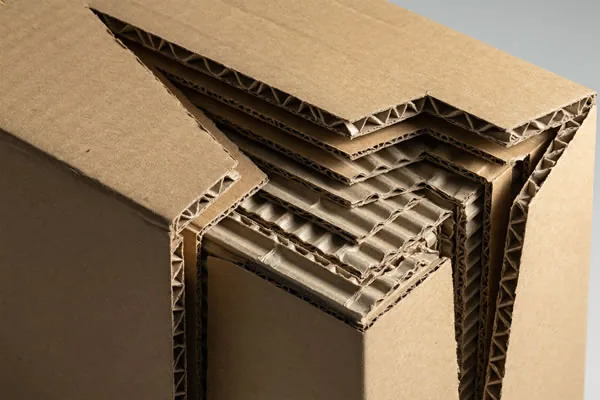
A professional digital cutting machine is more than a "paper cutter." It precisely controls cutting depth, pressure, and speed to ensure clean cuts without damaging the corrugated structure. Modern CNC cutting machines achieve an accuracy of ±0.01 mm through servo control.
Tool Breakdown: The Critical Roles of Oscillating Knife, Creasing Wheel, and V-Cut Tool
Box making requires three essential tool heads:
- Oscillating Knife: Handles contour cutting with tens of thousands of vibrations per minute for clean, tear-free edges
- Creasing Wheel: Creates fold lines to prevent box bursting during assembly
- V-Cut Tool: Creates V-grooves at fold locations for precise folding
How a Corrugated Box Is Actually Made: Cut, Crease, V-Groove
A shippable carton is not one cut—it is three operations that turn a flat sheet into a foldable box:
- Cut the panel and slot profiles with the EOT oscillating knife for clean, tear-free edges.
- Crease the fold lines with the CCT creasing wheel so the board folds without cracking the outer liner.
- V-groove the hinge locations with the VCT V-cut tool for sharp, consistent 90° folds on thicker board and display structures.
For custom box runs—seasonal mailers, branded inserts, short-run cartons—this is where die-less wins: change the file, not the tooling. A distributor can ship a 50-unit prototype and a 5,000-unit reorder from the same machine, on the same day.
Die-less Cutting vs Traditional Die Cutting for Corrugated Board
When packaging teams compare a dieless corrugated cutting machine with a conventional die press, the decisive factor is tooling cost. Traditional die cutting cardboard requires a steel rule die for every unique box shape — typically $200–$600 per SKU with a 2–4 week lead time. For short runs or frequent design changes, those dies sit idle and erode margin. A dieless cardboard cutting machine removes that bottleneck entirely: it cuts directly from DXF or PLT files, so switching from one carton profile to the next takes minutes instead of weeks.
The trade-off is volume. Die cut corrugated on a dedicated press is still cheaper when you produce 100,000+ identical boxes. But most distributors and contract packagers live in the 100–5,000 unit range, where die cut cardboard tooling costs dwarf the savings. Corrugated die cutting also locks you into a fixed geometry until you order a new die. Die cutting corrugated board digitally gives you on-demand flexibility — ideal for prototypes, seasonal packaging, and customized mailer boxes.
LDCUT's K10 and L10 flatbed cutters combine an oscillating knife with a creasing wheel and V-cut tool in a single pass, handling dieless carton cutting machine workflows for boxes, inserts, and POP displays. For a deeper look at how the two methods stack up, see our digital cutter vs die cutting guide.
How to Select the Right Corrugated Cardboard Cutting Machine
Key Selection Factors: Capacity, Precision, and Automation Level
Ask yourself three questions before choosing:
- How many sheets do you process daily? (Capacity needs)
- What is your minimum cutting precision requirement? (Precision needs)
- What level of automation do you want to achieve? (Labor cost considerations)
Distributor Perspective: ROI Analysis Framework
As a distributor, consider the full picture of return on investment:
- Equipment investment vs. tooling cost savings
- Labor cost reduction vs. maintenance expenses
- Incremental revenue from new business opportunities (small-batch custom orders)
Key Insight: For packaging distributors handling diverse SKUs and short-run orders, a digital die-less cutting machine typically delivers a stronger ROI than continuing to invest in die fabrication — especially as order customization demands increase.
Best Practices for Using Corrugated Cardboard Cutting Machines
Software Integration and File Preparation: Optimization for Material Savings
Many overlook software importance, but it directly impacts profitability. Quality nesting software:
- Automatically optimizes layout, improving material utilization by 10–15%
- Supports multiple file formats (DXF, PLT, JPG, PNG)
- Generates production reports and statistical data automatically
Standardized Cutting Process: From Material Preparation to Finished Output
- Material Preparation: Check board moisture (optimal 8–12%), ensure flatness
- File Import: Use software to verify dimensions and tool paths
- Parameter Setting: Select appropriate cutting speed and pressure based on board type
- Test Cutting: Verify with scrap material before full production
- Quality Inspection: Check cut quality, crease depth, and dimensional accuracy
Efficiency Strategies: Changeover Optimization and Capacity Maximization
- Prepare common file templates in advance
- Optimize material placement to reduce loading/unloading time
- Establish standardized operating procedures (SOP)
Industry Trends and Future Outlook
Automation and Intelligence: Emerging Trends in Corrugated Cardboard Cutting
Future cutting equipment will become smarter: automatic material recognition, adaptive parameter adjustment, predictive maintenance alerts. Industry 4.0 is transforming packaging production — manufacturers who adopt intelligent cutting solutions today will lead tomorrow's market.
Sustainability: Eco-Friendly Materials and Energy-Efficient Equipment
Customers increasingly demand sustainable packaging. Equipment supporting water-based inks and recyclable materials opens new market opportunities while meeting environmental requirements. Digital cutting's precise nesting capability directly reduces material waste, supporting your ESG goals.
Global Market Analysis: Growth Opportunities in Emerging Markets
E-commerce and manufacturing in Southeast Asia, the Middle East, and South America are expanding rapidly, driving sustained demand for packaging equipment. Distributors who seize these opportunities gain first-mover advantage in high-growth regional markets.
Recommended Tool Configuration
Corrugated and carton converting usually combines three operations. Match each to the right LDCUT interchangeable head — all swap tool-free on the same gantry:
| Operation | Recommended Tool Head | Use Case |
|---|---|---|
| Cutting | EOT (Oscillating Knife) | Through-cut corrugated, carton, and foam board at high speed |
| Creasing | CCT (Creasing Wheel) | Clean fold lines without cracking the outer liner |
| V-Groove | VCT (V-Cut Tool) | Reveal edges for rigid honeycomb and display structures — see our honeycomb V-grooving guide |
For a full material breakdown, read the digital cutter material compatibility guide, or see the best cutting machines for packaging. Short-run sampling fits the LDCUT L8; high-volume automated lines use the LDCUT L10 conveyor system.
Which LDCUT Model Fits Your Corrugated Box Volume?
| Production Profile | Recommended Model | Why |
|---|---|---|
| Prototypes, samples & small-batch (<500 sheets/day) | LDCUT L8 or K8 | Fast file-to-cut changeovers; zero die cost for short runs |
| Daily automated box production (conveyor feed, high volume) | LDCUT L10 or K10 | Automated feeding + CCD positioning; one-pass cut, crease & V-groove |
All five LDCUT heads (EOT, DCT, CCT, KCT, VCT) swap tool-free on the same gantry, so you only buy the heads your box work needs. See the full LDCUT range.
Industrial vs Craft Cutting: What Distributors Should Know
Digital flatbed cutters and desktop craft cutters solve different problems. A craft cutter is built for thin hobby materials — cardstock, vinyl, and very thin single-layer board — at low daily volumes. An industrial digital cutter such as LDCUT's flatbed series handles corrugated up to 50 mm, rigid plastics, foam, and composites, with nesting software, CCD positioning, and the throughput a packaging converter or sign shop needs. If your orders are short-run, multi-SKU, or production-scale, an industrial cutter — not a craft machine — is the right investment.
Frequently Asked Questions (FAQ)
Q1: How do I evaluate the investment value of a corrugated cardboard cutting machine?
Consider: tooling cost savings, labor cost reduction, improved material utilization, and incremental revenue from new business. Contact LDCUT's professional team for customized analysis tailored to your production needs.
Q2: How do I select the right blade type?
Choose based on board thickness and material:
- Thin boards: Standard Oscillating Knife
- Thick boards: Heavy-duty Oscillating Knife
- Special materials: Application-specific tools
Q3: How do I prevent edge crushing or tearing on corrugated board?
Three key steps:
- Select the appropriate blade angle (typically 30–45 degrees)
- Control cutting speed to avoid excessive speed
- Ensure board flatness with no wrinkles
Pro Tip: Running a test cut on scrap material before each production run is the single most effective way to prevent edge quality issues — especially when switching between board grades or suppliers.
Q4: Can a Cricut cut corrugated cardboard?
A Cricut Maker can technically score and cut very thin corrugated (up to about 2.4 mm, single-layer), but it struggles with standard packaging-grade board and cannot handle double-wall or triple-wall stock. For industrial corrugated cardboard cutting machine work — boxes, POP displays, continuous production — a CNC digital flatbed cutter is the right tool, cutting boards up to 50 mm thick with clean, burr-free edges.
Q5: What's the best digital cutter for corrugated board?
For packaging plants and converters, the LDCUT L10 (high-frequency oscillation, ±0.01 mm accuracy) is our recommended corrugated cardboard cutting machine for daily box production. Use a quick-change oscillating knife plus creasing and V-cut tools for one-pass box making.
Q6: How do I prevent edge crushing when cutting corrugated?
Three controls matter most for corrugated cutting edge quality: select the right blade angle (30° for thin, 45° for thick board), control cutting speed to avoid tearing, and ensure the board lies perfectly flat before loading. Always run a test cut on scrap first — especially when switching board grades or suppliers.
Q7: What's the difference between die cutting and digital cutting for boxes?
Traditional die cutting corrugated board uses a physical steel die — ideal for very high volumes of a single shape, but every new design needs a new die and long lead time. Digital cutting needs no die: you load a file and cut any shape on demand. For small-batch, multi-variety, or customized box runs, digital cutting wins on cost and flexibility.
Conclusion: Upgrade Your Corrugated Box Production Today
Digital CNC cutting technology represents a fundamental shift in how packaging manufacturers approach corrugated box production. By eliminating die tooling, reducing changeover time, and optimizing material utilization, LDCUT machines enable businesses to respond faster to market demands — at lower cost per part.
Ready to modernize your corrugated box cutting operations? Request a personalized consultation with our engineering team to find the ideal cutting solution for your production requirements.