Introduction
A KT board cutting machine is a flatbed digital cutter that slices foam-centered display board — also called display foam core — without crushing the lightweight foam core. LDCUT builds oscillating-knife flatbed cutters that process KT board up to 50 mm thick and score it with a dedicated V-cut head for self-standing POP and exhibition displays.
Here is the problem most display shops hit by Tuesday morning: you printed 40 identical exhibition panels, the booth opens Thursday, and your first attempt at a self-standing base came out with a wavy, compressed edge because the blade dragged through the core instead of cutting it. The panel leans. The logo warps. And you are hand-gluing cardboard stiffeners at midnight.
If you run a signage, advertising, or exhibition business, you have felt that squeeze. KT board is cheap, light, and prints beautifully — which is exactly why it ends up in every POP display, trade-show wall, and school project board. But it punishes the wrong tool.
Key Takeaways
- The LDCUT EOT oscillating knife cuts KT board up to 50 mm without crushing the foam core.
- The VCT V-cut head scores the face sheet for clean folds and self-standing POP structures.
- K8 and L8 suit sampling and short runs; L10 and K10 handle volume display production with automation.
- Every K/L series machine ships standard with EOT and accepts one optional head (DCT, CCT, KCT, or VCT).
- Heads swap in under 3 minutes; cutting accuracy holds at ±0.01 mm.
This guide explains how an LDCUT oscillating-knife cutter turns KT board into clean, self-standing displays — and how to pick the model that matches your volume. We cover the cutting mechanism, why V-cut grooving beats creasing for folds, how KT board differs from foam board, and which LDCUT models fit short runs versus automated display production.
How an Oscillating Knife Cuts KT Board
KT board is a sandwich: a polyfoam core bonded between two thin face sheets, usually paper or plastic film. The core gives it rigidity at almost no weight; the face takes the print. That same core is also the trap — it compresses under pressure, and a damaged core stays damaged.
The LDCUT EOT (Electric Oscillating Tool) avoids that trap by cutting mechanically, not thermally. A high-frequency motor drives the blade in rapid vertical reciprocation — thousands of strokes per minute — while the X/Y gantry moves the cutting head across the sheet. The blade never drags sideways through the material the way a drag knife does, and it never melts the foam the way a laser does.
Why the core stays intact
For KT board specifically, the mechanism decides the result:
- No crushed core. A pressed or dragged edge compresses the foam, leaving a permanent dent and a wavy profile. The oscillating stroke separates fibers cleanly, so the cut wall stays vertical and the core stays intact.
- No heat damage. Lasers melt polyethylene foam and release fumes; the EOT leaves a burr-free edge with no thermal zone and no ventilation burden.
- Thickness headroom. The EOT processes KT board up to 50 mm thick — covering thin 3–5 mm POP stock through thick exhibition panels on one machine.
Motion quality comes from imported ground racks on the X/Y axes and a ground ball screw on Z, holding positioning accuracy at ±0.01 mm. The L and K series reach a max travel speed of 120 m/min, so a sheet of display foam core clears fast even on intricate contour cuts and internal cut-outs.
Because the same gantry carries interchangeable heads, you cut a full KT board sheet and then swap to a creasing or V-cut head without leaving the machine. The head change completes within 3 minutes — so a mixed job (cut plus fold) stays on one cell.
For the full range of heads and how each maps to a material, see the LDCUT cutting tool heads overview.
V-Cut / V-Groove for Self-Standing POP Structures
A flat panel is only half a display. The other half is the fold that makes it stand.
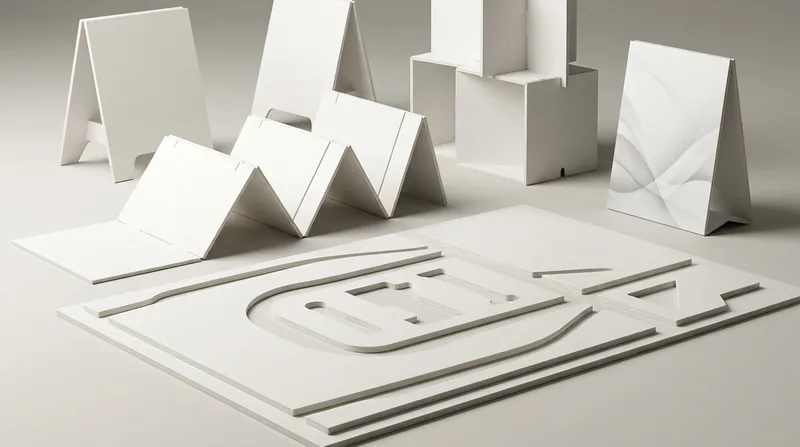
The LDCUT VCT (V-cutting tool) removes a triangular wedge from the face sheet and part of the core along a fold line. Remove material on one side, and the board hinges there instead of resisting. Fold it, and you get a clean crease with no cracking of the printed surface and no glue. That is the trick behind self-standing A-frames, cube displays, countertop standees, and triangular booth headers.
Picture a 5 mm KT board tabletop standee. You V-cut two parallel hinge lines a few centimeters in from each side, then fold the flaps back to form a triangular base. The printed face stays forward; the base holds it upright on a trade-show table. No frame, no adhesive, no secondary substrate — the display ships flat and folds on site.
Depth is adjustable — the VCT handles grooves across the 3–50 mm range — so you set the cut to the board thickness and score only the face, leaving enough core to act as the living hinge. LDCUT's own V-groove section lists KT board among the materials "for grooving and folding," alongside honeycomb and corrugated board.
Why V-cut beats simple creasing on a foam-centered board: the CCT creasing head is built for cardstock and corrugated, where you compress a score line. On KT board, compression just dents the foam. Removing a wedge gives a true corner. For the same V-groove technique applied to honeycomb display board, see the Honeycomb Board V-Grooving guide.
KT Board vs Foam Board — When to Use Which
Both substrates share the same DNA: a foam core between face sheets, cut on an LDCUT with the EOT oscillating knife. The difference is in build and job.
KT board is the lighter, paper-faced display board. It is the default for temporary signage — POP stands, exhibition graphics, retail inserts, classroom project boards — where weight and cost matter more than lifespan. LDCUT cuts it up to 50 mm thick and V-cuts it for folds.
Foam board is the broader family this article's sister page covers in depth. The Foam Board Cutting Solutions article treats KT board as one member of a wider advertising-material set, alongside EVA, PE foam, and thicker rigid panels. If your question is "which foam substrate for which job," start there.
Practical rule of thumb:
- Choose KT board when the display is light, short-run or event-based, and needs to self-stand via folds.
- Move to the wider foam family when you need thicker, more durable, or mixed-material panels in one production cell.
Either way, the EOT does the cutting and the optional VCT does the folding. The Material Compatibility Guide maps every substrate to its head and machine.
Choosing the Right LDCUT Model
LDCUT does not sell KT board cutters in a four-tier ladder. It sells flatbed cutters sized by production capacity, all of which cut KT board with the standard EOT head. Pick the pair by volume and automation.
| Your production profile | Recommended LDCUT models | What you get |
|---|---|---|
| Prototyping, sampling, short runs | K8 and L8 | Standard EOT; add one optional head; servo drive; head swap in 3 min |
| Volume display production, automation | L10 and K10 | Double IR Auto Tool Setter, Auto Lubrication System, CCD camera standard |
Both pairs ship standard with the EOT oscillating knife and accept one optional head — DCT, CCT, KCT, or VCT. For KT board POP work, the VCT is the head you add.
Platform sizes run 900×1200, 1300×1300, 1300×2500, and 1600×2500 mm, so a single machine covers tabletop standees and full booth panels — match the bed to your largest sheet rather than to the material. The L and K series hit 120 m/min max travel speed; the spindle-based LDCUT G6 reaches 100 m/min and is built for rigid PVC and acrylic, not foam-centered board. Keep the G6 in mind when a job mixes KT board with rigid signage on one floor.
Across the L and K series, the standard CCD camera reads printed registration marks, so a pre-printed KT board sheet cuts and V-cuts to the artwork instead of to a guessed origin — useful when display foam core cutting moves from prototype to repeatable volume.
For automated display lines, compare the LDCUT L10 digital cutter and the LDCUT K10 digital cutter. For sampling and short runs, the LDCUT K8 digital cutter and LDCUT L8 digital cutter cover the cell. The Digital Cutting Machine Buying Guide walks the full decision.
Typical Applications
KT board shows up anywhere a message needs to stand up, be seen, and come down just as easily.
- Trade-show booths. Self-standing panel walls, counters, and headers built from V-cut KT board — flat-pack for shipping, fold on site, no carpentry.
- Retail displays. Shelf talkers, countertop POP, end-cap units, and promotional stands produced in short runs that change with the campaign.
- Education. Science-fair backboards, classroom signage, and event displays where cost and weight rule.
- Signage inserts. Poster and directional inserts, event wayfinding, and menu or price-card holders.
Because the EOT cuts to ±0.01 mm and the VCT folds to a true corner, the same file drives one prototype and one thousand units — the difference is the machine pair, not the process. For foam core display cutting at volume, the L10/K10 pair adds the automation that keeps a display cell running between operators. For signage-specific workflows, the Signage & Display Cutting Solutions page expands on these setups.
Related / Learn More
- Material Compatibility Guide — KT board section — every substrate mapped to head and machine
- Foam Board Cutting Solutions — the broader foam-family sister article
- Honeycomb Board V-Grooving — the same V-cut technique on honeycomb
- Signage & Display Cutting Solutions — signage-specific workflows
- Digital Cutting Machine Buying Guide — full model-selection logic
- LDCUT cutting tool heads overview — EOT, VCT, and the optional heads
- Model pages: LDCUT K8 · LDCUT L8 · LDCUT L10 · LDCUT K10 · LDCUT G6 spindle cutter
Frequently Asked Questions (FAQ)
Q1: What is a KT board cutting machine, and how does LDCUT cut KT board?
A: It is a flatbed digital cutter for foam-centered display board, also called display foam core. LDCUT uses the EOT oscillating knife, which reciprocates the blade at high frequency to sever the core and face sheets without crushing the foam. The same machine can carry a VCT V-cut head to score the board for folds.
Q2: How thick can an LDCUT cutter process KT board?
A: The EOT oscillating knife handles KT board up to 50 mm thick, from thin 3 to 5 mm POP stock to thick exhibition panels, with a smooth, burr-free edge.
Q3: Can LDCUT cutters make self-standing POP displays from KT board?
A: Yes. The optional VCT V-cut head scores the face sheet along a fold line so the board bends cleanly and stands on its own, forming A-frames, cubes, and countertop standees with no glue or frame.
Q4: Which LDCUT model fits KT board display production?
A: K8 and L8 suit sampling and short runs; L10 and K10 suit volume production with automation (Double IR Auto Tool Setter, Auto Lubrication System). The CCD camera is standard across the L and K series, reading printed registration marks so pre-printed KT board cuts to the artwork. All cut KT board with the standard EOT head.
Q5: What is the difference between KT board and foam board cutting on LDCUT machines?
A: Both are foam-centered substrates cut with the EOT oscillating knife. KT board is the lighter, paper-faced display board for temporary POP and exhibition work; foam board covers the broader family including thicker rigid panels. See the Foam Board Cutting Solutions sister article for the full comparison.
Conclusion
KT board rewards the right tool and punishes the wrong one. The LDCUT EOT oscillating knife cuts it up to 50 mm without crushing the core, and the VCT V-cut head turns flat sheets into self-standing POP and exhibition displays. Choose K8 or L8 for sampling and short runs, L10 or K10 for automated volume — every machine ships standard with EOT and swaps heads in 3 minutes.
Match your volume to a model in the Digital Cutting Machine Buying Guide, or open the LDCUT L8 digital cutter and LDCUT L10 digital cutter pages to see the capacity that fits your display cell.
For the wider substrate picture, the Foam Board Cutting Solutions sister article places KT board inside the full foam-family workflow, and the Material Compatibility Guide confirms the head and machine for every job you run.