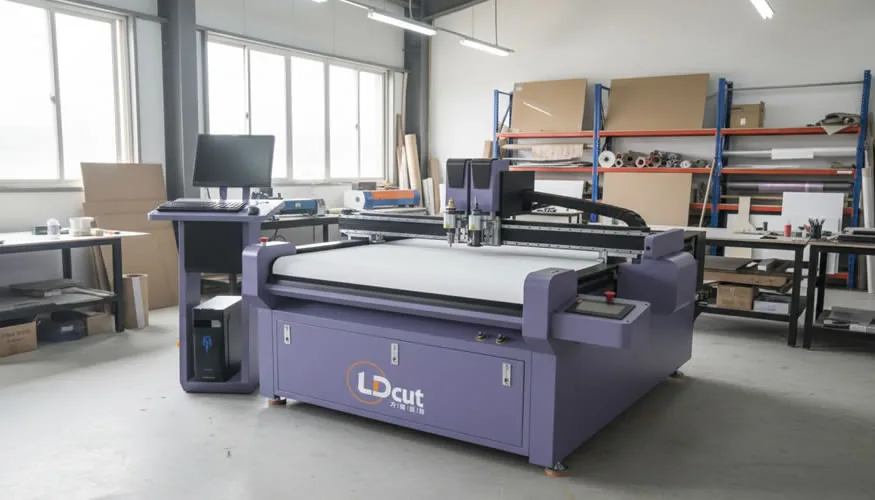
Are You Choosing the Right Digital Cutter for Multiple Materials?
If your production line handles corrugated cardboard, foam, PVC, acrylic, and other materials, you've likely encountered these challenges:
For a complete breakdown of digital cutting technology and how to choose the right machine, read our complete digital cutting machine guide.
- One machine can only cut one type of material, requiring multiple machines to cover all needs
- Inconsistent cutting accuracy leads to 15%-20% material waste
- Heavy reliance on skilled labor, which is increasingly difficult to find and expensive
- Traditional die costs are prohibitively high, making small-batch orders unprofitable
Choosing the wrong digital cutter isn't a minor issue. It directly impacts your production efficiency, product quality, and ultimately your bottom line.
LDCUT delivers a one-stop solution. Our LDCUT digital cutter series supports die-less cutting across multiple materials with precision up to ±0.01mm, 300% efficiency improvement, and 40% reduction in labor dependency.
Digital Cutter Material, Tool & Machine Matrix
Match the material you cut to the right interchangeable tool head and the machine sized for your production volume. Every head swaps tool-free on the same gantry.
| Material | Tool Head (EOT standard + 1 optional) | Machine (by capacity) | Application |
|---|---|---|---|
| Corrugated cardboard / carton | EOT (oscillating) + CCT (creasing) | K8 / L8 / L10 / K10 | Packaging |
| Foam board (EVA, PE) | EOT (oscillating) | K8 / L8 / L10 / K10 | Display |
| Vinyl | EOT (oscillating) + DCT / KCT (kiss cut) | K8 / L8 / L10 / K10 | Signage |
| Honeycomb / Display board | EOT (oscillating) + VCT (V-cut) | K8 / L8 / L10 / K10 | Display |
| Acrylic (rigid) | EOT (oscillating) + Spindle | G6 (Spindle standard); or K/L + optional Spindle (confirm before production) | Signage |
| PVC (rigid) | EOT (oscillating) + Spindle | G6 (Spindle standard); or K/L + optional Spindle (confirm before production) | Signage |
| Cardstock / Grey board | EOT (oscillating) + CCT (creasing) + VCT (V-cut) | K8 / L8 / L10 / K10 | Packaging / Printing |
| ABS sheet (0.1–3 mm) | EOT (oscillating) + DCT (drag-cut) | K8 / L8 / L10 / K10; rigid stock → G6 / K/L + Spindle | Signage |
| KT board / Display foam core | EOT (oscillating) + VCT (V-cut) | K8 / L8 / L10 / K10 | Display |
Not sure which tool head fits your stack? Compare the full range in our LDCUT digital cutter product line, or jump to the digital cutting machine guide.
Platform & tooling note: K8 / K10 / L8 / L10 ship standard with the EOT oscillating tool and accept one optional head (DCT / CCT / KCT / VCT); models are chosen by production capacity, not by material. Rigid sheets (acrylic / PVC) require a Spindle — standard on G6, or optionally added to K/L series, but it must be specified before production (40,000 or 60,000 rpm; it cannot be retrofitted later).
Material Deep Dive: Cardstock, ABS Sheet & KT Board
Beyond the core packaging and signage stacks, three materials drive a large share of LDCUT inquiries. Here is how each maps to tooling and machine capacity — the same principle as the matrix above: choose the series by production volume, choose the head by material.
Cardstock & Grey Board (printing & packaging)
Cardstock and grey board are thick paper stocks used for rigid boxes, book covers, hanging tags and retail display inserts. They cut cleanly with the EOT oscillating knife, but the real value is in folding:
- CCT (creasing) scores cardstock and cardboard so cartons fold without cracking the surface.
- VCT (V-cut) grooves grey board for sharp 90° box edges and standing structures.
- DCT (drag-cut) trims printed sheets and kiss-cuts adhesive-backed layers.
Recommended: K8 / L8 for sampling and short runs, L10 / K10 for automated production. For adhesive-backed paper, see our kiss-cutting technique guide. For rigid boxes and retail tags, see our cardstock & grey board cutting guide.
ABS & Rigid Plastic Sheet (signage)
ABS sheet (0.1–3 mm) is a workhorse for indoor signage, point-of-sale and router-free lettering. The DCT drag-cut head handles thin ABS without melting; the EOT oscillating knife manages thicker trims. For rigid stock beyond the drag-cut window, the G6 spindle (standard) or an optional K/L spindle cuts cleanly — specify the spindle before production, as it cannot be retrofitted.
Recommended: K8 / L8 / L10 / K10 with DCT for thin sheet; route rigid stock above the drag-cut window to G6 or K/L + optional Spindle. Pair with our signage & display solutions. For ABS sheet cutting, see our ABS plastic cutting guide.
KT Board & Display Foam Core (display & POP)
KT board (foam-centered, up to 50 mm) and display foam core are the backbone of exhibition and POP displays. The EOT oscillating knife slices through without crushing the core; VCT (V-cut) scores the face sheet for clean folds and self-standing structures.
Recommended: K8 / L8 for prototyping and short runs, L10 / K10 for volume display production. See foam board cutting solutions and honeycomb V-grooving. For exhibition and POP displays, see our KT board cutting guide.
Digital Cutting Applications & Recommended Machines
Each application below links to a dedicated guide and pairs with machines chosen by capacity — K8 & L8 for sampling and medium runs, L10 & K10 for automated production and heavy-duty work.
| Application | Supporting Articles | Recommended Machines |
|---|---|---|
| Packaging | Best Cutting Machine for Packaging · Corrugated Box Cutting Guide | K8 / L8 (sampling + medium runs) · L10 / K10 (automated production + heavy-duty) |
| Signage | Signage & Display Cutting Solutions · Vinyl Sticker Cutting Machine | Non-rigid: K8/L8 + L10/K10 (by capacity); Rigid (acrylic/PVC): G6 or K/L + optional Spindle |
| Display | Foam Board Cutting Solutions · Honeycomb Board V-Grooving | K8 / L8 (sampling + medium runs) · L10 / K10 (automated production + heavy-duty) |
| Printing | Kiss Cutting Technique · Vinyl Sticker Cutting Machine | K8 / L8 (sampling + medium runs, KCT kiss-cut) |
Explore the full lineup — K8, L8, L10, K10, G6 — or read the digital cutting machine guide.
Step 1: Identify Your Material Types and Cutting Requirements
Material-Specific Requirements for Digital Cutters
LDCUT offers specialized tool heads to match different material requirements:
| Tool Head | Tool Description | Key Features | Suitable Materials |
|---|---|---|---|
| EOT (Oscillating) | High-frequency vibration cutting | Up to 50mm thickness, smooth cut | Corrugated cardboard, Foam, KT Board |
| DCT (Drag Knife) | 360-degree free rotation cutting | 0.1-3mm thin materials | PVC roll, PP paper, Vinyl, ABS Plastic, Reflective materials |
| CCT (Creasing) | Precision creasing tool | No surface damage, improves folding | Cardstock, Corrugated board, Grey board |
| KCT (Kiss Cut) | Precise kiss-cut technology | Cuts surface only, auto peeling | Adhesive labels, Multi-layer materials, Composite film |
| VCT (V-Cut) | V-groove cutting technology | Depth adjustable, 3-50mm thick | Honeycomb board, Corrugated board, Thick boards |
| Spindle | High-speed spindle cutting | 40000-60000rpm, matrix vacuum | PVC board, Acrylic, Plexiglass |
Key Takeaway: Choose the right tool head based on your material type and thickness requirements.
Production Volume Determines Model Selection
Different production scales require different machine configurations:
- Sampling/Small Batch Production: K8 Series is recommended. High-precision servo drive with 4 standard sizes for flexible prototyping needs.
- Medium Batch Production: L8 Series is recommended. Multi-material support with configurable cutting tools based on actual requirements.
- High-Volume Automated Production: L10/K10 Series is recommended. Auto feeding system enables continuous cutting; Double IR Auto Tool Setter ensures consistent precision. Learn more about L10 Series automated production line.
Step 2: Evaluate Core Performance Parameters of Digital Cutters
Balancing Cutting Precision and Speed
Precision and speed are often at odds. However, a superior digital cutter can achieve both:
- LDCUT Precision Standard: ±0.01mm high-precision positioning. X/Y axes use imported ground racks; Z axis uses imported ground ball screws.
- LDCUT Speed Standard: 120m/min max Idle Travel Speed
- Real-World Results: 300% efficiency improvement over traditional equipment while maintaining precision.
Key Takeaway: Don't rely solely on manufacturer specifications—always request on-site testing or sample cuts.
Automation Level and Labor Dependency
Automation directly determines your labor costs:
- Auto feeding system: Supports continuous feeding and cutting, minimizing manual intervention.
- Intelligent vision positioning: Smart vision system enables one-click scanning and automatic cutting.
- Real-World Results: 40% reduction in labor dependency; one operator can manage multiple machines simultaneously.
Key Takeaway: Automation not only saves labor—it ensures consistent quality across every product.
Versatility and Tool Change Efficiency
When handling multiple materials, tool change efficiency is critical:
- Multi-functional cutting heads: Support full-cut, kiss-cut, and other processes.
- Tool Change Time: Tool-free replacement within 3 minutes.
- Material Support: PVC, KT board, cardstock, films, and more.
Key Takeaway: The simpler the tool change process, the faster you can switch orders and minimize machine downtime.
Step 3: Understand Application Scenarios for Different Digital Cutter Types
Flatbed Digital Cutter vs Roll-to-Roll Cutter
Each type has distinct advantages—choose based on your material form:
- Flatbed cutter: Ideal for sheet materials such as corrugated cardboard, PVC board, and acrylic. Stable worktable ensures high cutting precision.
- Roll-to-roll cutter: Ideal for roll materials such as vinyl and other flexible films. Continuous feeding suits long-length materials.
LDCUT Advantage: Our flatbed digital cutters support multiple material types—one machine meets most requirements.
Oscillating Knife vs Laser Cutter vs Waterjet
Each cutting method has pros and cons:
| Cutting Method | Advantages | Disadvantages | Suitable Materials |
|---|---|---|---|
| Oscillating knife | No thermal damage, high precision, multi-material compatibility | Limited thick material capability | Most packaging/signage/textile materials |
| Laser cutter | Extremely high precision, edge sealing | Harmful fumes, material limitations | Thin synthetic materials |
| Waterjet | No thermal damage, cuts thick materials | Slow speed, expensive equipment | Special industrial materials |
Key Takeaway: For most packaging, signage, and textile applications, oscillating knife offers the best cost-performance ratio.
Die-less Cutting vs Traditional Die Cutting
This is a critical decision point:
- Traditional die cutting: Requires custom dies with high costs (thousands to tens of thousands per set) and long changeover times (hours).
- Die-less cutting: No dies needed—computer-controlled cutting paths with changeover times of just minutes.
LDCUT Advantage: Our die-less digital cutting technology eliminates die costs, especially suited for small-batch, multi-product production. Material waste reduced by 30%.
Step 4: LDCUT Digital Cutter Product Line Recommendations
L8 Series - Multi-Material High-Precision Solution
The L8 Series is LDCUT's flagship model, ideal for most SMEs:
- 4 standard sizes available
- High-precision servo drive system
- Multi-material support (corrugated cardboard, foam, PVC, and more.)
- Applications: Packaging, signage, printing, and other multi-industry general cutting
Typical Users: Mid-sized packaging factories, advertising signage companies, printing enterprises.
L10 Series - Automated Production Line Choice
The L10 Series offers the highest level of automation:
- Double IR Auto Tool Setter
- Automatic oil supply and lubrication
- Auto feeding system for continuous cutting
- Applications: High-volume automated production
Typical Users: Large packaging groups, scale textile enterprises, automated factories.
K8 Series - Sampling and Short-Run Specialist
The K8 Series is designed specifically for sampling and small-batch production:
- High-precision servo drive
- 4 standard sizes
- Flexible operation for multi-product small batches
- Applications: Sampling, small-batch production
Typical Users: Design studios, sample centers, small-scale processing plants.
K10 Series - Heavy-Duty Industrial Solution
The K10 Series is a heavy-duty model for high-intensity continuous production:
- Double IR Auto Tool Setter
- Heavy-duty frame structure (welding, tempering, quenching treatment)
- Automatic oil supply and lubrication
- Applications: Heavy materials, high-volume production
Typical Users: Heavy packaging enterprises, automotive interior manufacturers, composite material processors.
G6 Series - Rigid Material Cutting Specialist
The G6 Series is engineered for rigid materials:
- High-speed spindle (40000-60000rpm)
- Matrix vacuum-assisted work surface
- Applications: PVC, acrylic, plexiglass, and other rigid materials
Typical Users: Acrylic processors, plastic sheet manufacturers, signage production companies.
Frequently Asked Questions (FAQ)
Q: What materials can a digital cutter handle?
A: LDCUT digital cutters support multiple materials including corrugated cardboard, foam, PVC board, acrylic, KT board, cardstock, films, and more. Different series models are optimized for specific materials.
Q: What precision level can a digital cutter achieve?
A: LDCUT digital cutters use imported ground racks and ball screws, processing accuracy ±0.01mm—meeting most industrial production requirements.
Q: How do I choose the right digital cutter model?
A: Model selection depends on three key factors: 1) Material type and thickness; 2) Production volume (sampling/small batch/large batch); 3) Automation requirements. Contact LDCUT's professional engineering team for a customized solution.
Request Your Custom Solution Today
- One-on-one consultation with our engineering team: Deep understanding of your materials and production requirements
- Free sample cutting service: See LDCUT equipment performance on your materials firsthand
- Precision quotation: Optimal model and configuration based on your needs
- 24-hour response: Fast solution delivery
📞 Phone: +86 190 5951 8798
✉️ Email: Ld@Ldcut.com
🌍 Website: www.ldcut.com