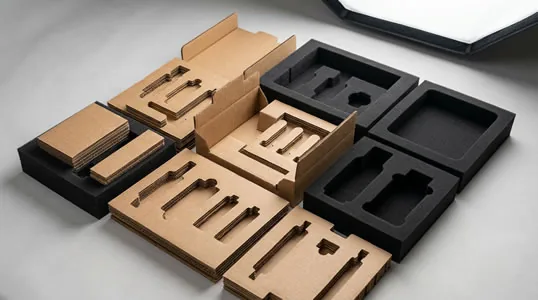
Why 2026 Is the Critical Year to Upgrade Your Cutting Machine
The 4 Fatal Pain Points of Traditional Cutting Equipment Eating Into Your Profits
You've likely felt them by now. Every material waste caused by inaccurate cuts. Every delivery delay from equipment downtime. Every production gap from skilled operator turnover.
For a complete breakdown of digital cutting technology and how to choose the right machine, read our complete digital cutting machine guide.
These aren't minor issues. Data from the European packaging industry shows traditional cutting equipment reduces distributor profits by an average of 20%–35% annually.
This isn't a management problem. It's a technological ceiling issue.
- Insufficient precision: Traditional equipment suffers from unstable cutting accuracy, causing significant material waste. Complex shape cutting often results in deviations that affect packaging quality.
- Low efficiency: Heavily reliant on skilled operators, labor costs are high and efficiency inconsistent, unable to meet rapid delivery requirements.
- Poor adaptability: Single-function equipment cannot handle diverse packaging materials, lacking intelligent automation and limiting production flexibility.
- High maintenance & after-sales risks: Lack of reliable after-sales support, and equipment downtime directly impacts delivery timelines.
Data Speaks: Packaging Industry Technology Upgrade Trend Report (2026)
2026 represents an inflection point.
According to the latest Market Research Future report, die-less digital cutting technology market penetration will jump from 18% in 2025 to 32% in 2026.
Why This Year? Four Reasons:
- Labor costs in Europe and North America continue to rise by 15%+ annually
- Customer demand for customization has grown by 40%
- Short-run production orders now exceed 50% of total volume
- Traditional die costs increase by an average of 8% annually
Your competitors may already be quietly testing new equipment.
Best Cutting Machine for Packaging: Core Selection Criteria
Cutting Precision Requirements: Why ±0.01mm Is the Industry Gold Standard
±0.01mm isn't just a number. It's your profit margin.
High-end packaging customers increasingly demand flawless edge quality. A deviation of 0.1mm means the box won't close properly. A deviation of 0.05mm means labels won't align.
LDCUT achieves ±0.01mm precision. This accuracy is built on imported ground racks and ground ball screws.
Not all machines dare to specify this parameter. Those that do can't always maintain it consistently.
Production Efficiency Evaluation: The Balance Between Speed and Stability
120m/min is LDCUT's max running speed. But that's not everything.
What truly matters: After 8 hours of continuous operation, how much does speed decrease? Does cutting accuracy drift?
What distributors fear most: Perfect performance during testing, but unreliable results during mass production.
LDCUT's heavy-duty bed structure undergoes welding, tempering, and quenching. Single-pass gantry milling ensures high precision, enhanced rigidity, and dependable cutting performance.
Multi-Material Compatibility: How Many Packaging Materials Can One Machine Handle?
Your customers need:
- Corrugated board today
- Cardstock tomorrow
- PVC foam board the next day
- Adhesive labels the day after
If each requires a different machine, your facility, labor, and management costs multiply.
The LDCUT is equipped with a variety of interchangeable cutting tools. Swapping takes under 3 minutes — no tools required, manual operation only.
After-Sales Service System: The 4 Critical Guarantees Distributors Value Most
As a distributor, you're not selling a machine. You're selling a solution.
You need a supplier that provides:
- 24/7 technical support
- Complete installation support
- Full training (from setup to production)
- 1-year warranty (excluding consumables)
LDCUT delivers. They serve 3,000+ enterprises across 80+ countries.
In-Depth Comparison of the Top 5 Cutting Machine Types in 2026
Digital Die Cutting Machine vs. Traditional Die Cutter: The Cost-Efficiency Tradeoff
| Comparison | Traditional Die Cutter | Digital Die Cutting Machine |
|---|---|---|
| Die Requirement | Mandatory custom die per shape | No physical dies needed |
| Design Changes | Requires new tooling (days/weeks) | Software adjustment (minutes) |
| Short-run Orders | Often not profitable | Receive and ship same day |
| Setup Cost per Job | $200–$2,000+ per die | Minimal (blade only) |
Die Cutting Machine for Packaging: When You Still Need Traditional Dies
Despite the rise of digital systems, a conventional die cutting machine for packaging still earns its place for very high volumes of a single carton profile. A die cutting machine for corrugated boxes using a steel rule die can outperform digital cutting on runs above ~100,000 identical parts, where per-unit die amortization becomes negligible. The trade-off is rigidity: every new box size needs a new die and a 2–4 week lead time.
For most distributors, the smarter default is digital die cutting packaging workflows that need no tooling at all. When your orders span many SKUs or short runs, a digital cutting machine for packaging beats any press on flexibility. And for packaging board cutting across cartonboard, corrugated, and E-flute, LDCUT's multi-tool heads switch material in minutes. Even die cut cartonboard jobs that once required a dedicated die cutting machine for packaging can now run die-less on a single LDCUT L10 — see our corrugated box cutting guide for the full workflow.
Oscillating Knife Cutting Machine: The Preferred Solution for Thick Materials
Oscillating knife uses high-frequency vibration.
This technology cuts thick materials (up to 50mm) with smooth, burr-free edges. No secondary processing required. Cuts corrugated board, foam board, honeycomb board, and more.
Flatbed Cutter with Conveyor System: The Optimal Choice for Continuous Production
Conveyor system enables continuous feeding and cutting. No downtime for material loading — 300% more efficient than static tables.
LDCUT's rolling felt conveyor table features zonal vacuum. Materials stay secured, regardless of size.
Laser Cutter vs. Knife Cutter: Which Is Better for Your Packaging Business?
| Comparison | Laser Cutter | Knife Cutter (LDCUT) |
|---|---|---|
| Edge Quality | Burn marks on heat-sensitive materials | Clean edges, no burning |
| Smoke/Fumes | Requires dedicated ventilation | None — environmentally friendly |
| Material Range | Limited (no reflective/thick materials) | Virtually any material |
| Industry Preference | Niche applications | Preferred in 90% of packaging cases |
Ultrasonic vs Knife Cutting for Packaging: A New Comparison
Beyond laser and knife, ultrasonic cutting is emerging for sticky and heat-sensitive packaging materials. Ultrasonic cutting machines for packaging industry use high-frequency vibration to slice through adhesive tapes, double-sided foam, and laminates without the gumming and drag that plague standard blades. Knife cutting remains the broader workhorse — it covers corrugated, foam, leather, and textiles that ultrasonic cannot. For high-mix automatic packaging cutting machine lines, LDCUT standardizes on knife-based tooling for maximum material coverage, with an L10 or K10 handling most daily packaging substrates.
LDCUT: The Packaging Cutting Solution Designed Specifically for Distributors
Die-Less Digital Cutting Technology: Eliminate Expensive Die Costs
Die costs represent a major pain point for many distributors. LDCUT's digital knife cutting system requires no physical dies.
Import dxf, plt, jpg, or tif files directly — cut any shape you need. Optimized motion control supports continuous feeding and cutting. Works for both short-run and mass production.
Multi-Functional Replaceable Cutting Heads: 3-Minute Quick Change for Diverse Requirements
A wide range of tool heads to suit all applications:
- EOT (Oscillating Tool): Precision cutting for thick materials, smooth burr-free edges
- DCT (Drag Cutting Tool): 360-degree free rotation for thin materials
- CCT (Creasing Cutting Tool): Professional creasing for improved packaging form quality
- KCT (Kiss Cut Tool): Cuts only top layer without damaging backing, ideal for labels
- VCT (V-Cutting Tool): V-grooves for thick board folding applications
If you would like to find out about the full range of tools, please leave a message detailing the materials to be cut and your requirements, and our specialists will recommend a cutting solution tailored to your needs.
Tool change? 3 minutes, no tools needed. One machine handles the full spectrum of packaging materials your clients demand.
Intelligent Vision Positioning System: Reduce Labor Dependence by 40%
High-definition camera, one-click scanning, intelligent positioning and edge tracking cutting. Automatic positioning, automatic cutting — no need for skilled operator oversight.
Labor dependence reduced by 40%.
Real-World Case Study: How a Distributor Increased Efficiency by 300% with LDCUT
European Packaging Distributor Equipment Upgrade Journey
A packaging distributor in Munich, Germany, upgraded to LDCUT L10 in 2024.
| Metric | Before Upgrade | After Upgrade |
|---|---|---|
| Machines | 3 traditional machines | 1 LDCUT L10 |
| Operators | 8 skilled operators | 3 operators |
| Daily Output | 500 units | 2,000 units |
| Die Costs | Significant monthly spend | Completely eliminated |
| Material Waste | Baseline | Reduced by 30%+ |
"After switching to LDCUT, we're taking orders we previously couldn't. Short-run, custom designs, rush orders — no problem. We're now the most efficient packaging distributor in our region."
— Munich Packaging Distributor, Germany
Recommended LDCUT Machines for Packaging
Match your production profile to the right LDCUT digital cutter:
| Production Profile | Recommended Model | Why |
|---|---|---|
| Sampling & prototyping / medium-volume production | LDCUT K8 / LDCUT L8 | Compact footprint and fast tool change for sample runs, plus balanced speed and bed size for steady daily packaging output |
| Automated workflow / auto oil supply & lubrication | LDCUT K10 / LDCUT L10 | Conveyor feeding, Double IR Auto Tool Setter and self-lubrication keep mass-production packaging lines running with minimal downtime |
| Rigid PVC / acrylic / composites | LDCUT G6 | Spindle plus oscillating knife for clean cuts in dense, rigid packaging substrates |
For rigid materials such as PVC and acrylic, see the LDCUT G6. Compare all models in our product line, or read the digital cutting machine guide.
Frequently Asked Questions
Q: What's the difference between full-cut and kiss-cut in packaging production?
Full-cut: Cuts completely through the material. Used for boxes, cards, etc.
Kiss-cut: Cuts only the top layer without damaging the backing paper. Used for labels, stickers, etc.
LDCUT's KCT tool head specializes in kiss-cut with 0.01mm precision control.
Q: How to choose the right cutting machine for corrugated board vs. cardstock?
Corrugated board: Select oscillating knife + conveyor system
Cardstock: Select drag knife + creasing tool
LDCUT handles both on a single machine.
Q: What after-sales support should I expect from a reliable cutting machine supplier?
- 24/7 technical support
- Installation support
- Full training
- Warranty service
- Spare parts supply
LDCUT provides all of the above.
Q: Can one cutting machine handle both short-run sampling and mass production?
Yes. LDCUT's die-less technology and quick tool change are designed specifically for this.
Q: What's the typical warranty period for industrial packaging cutting machines?
LDCUT offers 1-year full machine warranty (excluding knife and rolling felt).
Q: What's the best cutting machine for a small packaging business in 2026?
For most small shops, the LDCUT K8/LB is the recommended entry machine — die-free, multi-material, and low-maintenance, typically paying back in 3–6 months.
Q: Can one cutting machine handle both corrugated board and thin carton?
Yes. LDCUT's multi-tool system switches between an oscillating knife (corrugated) and a drag knife (thin carton and cardstock) in about three minutes, with no additional machine required. Creasing and V-cut tools handle fold lines on both materials.
Ready to Find the Best Cutting Machine for Your Packaging Business?
The packaging industry is at a technological inflection point. Die-less digital cutting is no longer a niche solution — it's becoming the standard for forward-thinking distributors worldwide.
Whether you're processing corrugated board, cardstock, foam, or labels, LDCUT offers a precision cutting solution built for real production demands.
Take the next step: Request a personalized consultation with the LDCUT engineering team and discover which model fits your production requirements — at no obligation.