Introduction
Choosing a digital cutting machine for packaging is not a "which brand is cheapest" decision — it is a specification exercise. A digital (knife) cutter replaces steel rule dies with a tool head that follows a digital file, so the right machine is the one whose working area, tooling, camera, and throughput match the boxes, cartons, inserts, and displays you actually run. This guide walks through the selection logic packaging operations use, then maps each requirement to an LDCUT model so you can shortlist before requesting a quote.
Quick Answer
Choose a packaging digital cutter by material, volume, and working size — not by price. Corrugated and carton need an oscillating knife (EOT) plus a creasing wheel (CCT) and V-cut (VCT) for folding; thin films and labels need a drag/kiss-cut tool (DCT/KCT); rigid PVC or acrylic need a spindle. Match volume to model: K8 & L8 for sampling and medium runs, L10 & K10 for automated production and heavy-duty, and G6 for rigid substrates.
What Is a Packaging Digital Cutter?
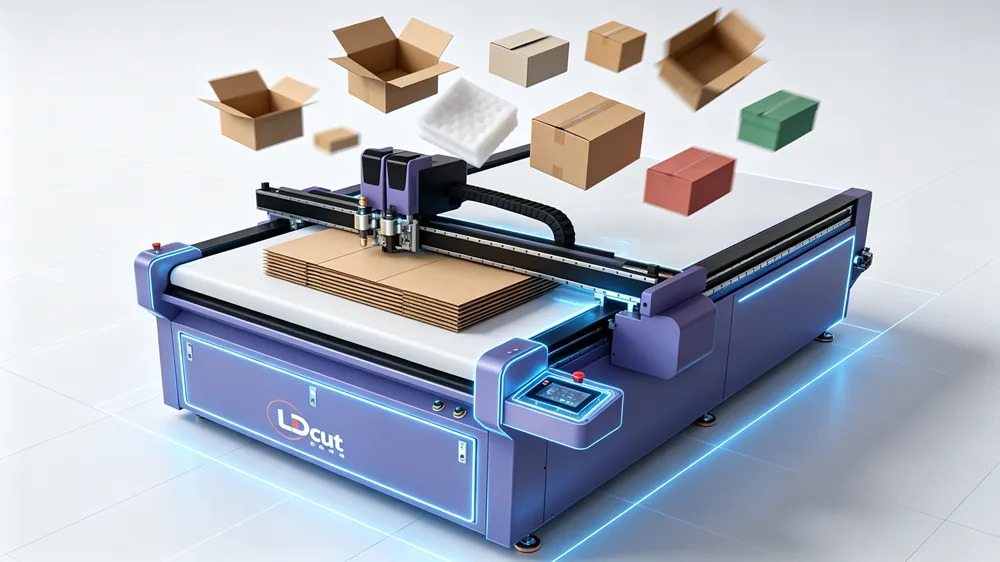
A packaging digital cutter is a flatbed CNC machine that cuts, creases, scores, and kiss-cuts sheet materials with swappable tool heads instead of dies. For packaging teams this removes die-making lead time and cost: a new box structure is a new file, not a new tool. The same table handles corrugated boxes, carton board, foam inserts, and adhesive displays, which is why it fits both short-run customization and variable production.
What Materials Do You Need to Cut?
Your material list defines the tool head, vacuum strength, and whether a spindle module is required. Common packaging substrates and their cutting behavior:
| Material | Typical packaging use | Primary tool |
|---|---|---|
| Corrugated cardboard | Shipping boxes, retail displays | EOT + CCT + VCT |
| Carton / cardstock | Folding cartons, hang tags | DCT or EOT |
| Foam board / EVA / EPE | Protective inserts, padding | EOT |
| Honeycomb | Heavy-duty transit packaging | VCT / EOT |
| Vinyl / adhesive film | Labels, stickers, decals | DCT / KCT |
| Rigid PVC / acrylic | Blister packs, POS displays | Spindle (G6) |
For a full material-to-tool breakdown, see the Digital Cutter Material & Tool Matrix.
What Tool Heads Do You Need?
LDCUT machines carry interchangeable heads, and the head choice is what turns a generic cutter into a packaging solution:
- EOT (Electric Oscillating Tool) — the workhorse for corrugated, foam, and thick board; a reciprocating blade handles variable thickness.
- DCT (Drag/Cutting Knife) — clean, low-pressure cuts for thin carton and cardstock where edge finish matters.
- CCT (Creasing Wheel) — presses a fold line without cutting, so cartons fold cleanly.
- VCT (V-Cut Tool) — scores corrugated for sharp box folding and hinge points.
- KCT (Kiss-Cut Tool) — cuts label face stock to the liner without cutting through it.
- Spindle — required for rigid PVC and acrylic found in blister and POS packaging; this is the domain of the G6.
Production Volume
Volume sets the working area, speed class, and automation level — and therefore the model:
| Your volume | Recommended model | Why |
|---|---|---|
| Sampling, prototypes & medium production | K8 & L8 | Compact for fast setup and iterating box structures; at larger platforms (1300×2500 / 1600×2500 mm) sustains steady output at 120 m/min |
| Automated, multi-shift & heavy-duty | L10 & K10 | Equipped with the Double IR Auto Tool Setter and Auto Lub System for continuous, stable production |
| Rigid PVC / acrylic packaging | G6 | Spindle-based cutting of rigid substrates |
Working Size
Match the table to your largest sheet. LDCUT L/K series offer four platform sizes — 900×1200, 1300×1300, 1300×2500, and 1600×2500 mm — so a corrugated sheet or a doubled-up layout fits without tiling. If your work is mostly small cartons, a 900×1200 mm table saves floor space; if you regularly cut large-format sheets, size up to 1600×2500 mm.
Automation
Automation is where packaging payback comes from. The Double IR Auto Tool Setter and Auto Lub System are standard advantages of the L10 and K10 series, built for continuous, multi-shift running:
- CCD camera — reads printed registration marks so pre-printed cartons cut exactly on the artwork. Essential if you convert printed sheets.
- Double IR Auto Tool Setter — automatically adjusts the tool depth, avoiding errors from manual adjustment.
- Auto Lub System — automatic lubrication and maintenance of guide rails and other accessories.
Packaging Applications
A single LDCUT table serves most packaging departments:
- Mailer & shipping boxes — corrugated cut, creased, and V-cut in one pass.
- Retail & counter displays — corrugated and foam combined into a structural display.
- Protective inserts — foam board and EVA contoured to the product.
- Labels & stickers — kiss-cut vinyl and film on liner.
- Folding cartons & hang tags — drag-knife cuts with creased fold lines.
For a deeper comparison of cutter types in packaging, read Best Cutting Machine for the Packaging Industry (2026).
Machine Recommendations
The shortlist below follows LDCUT's standard packaging mapping. Confirm against your own volume and material mix before quoting:
| Requirement | Model |
|---|---|
| Sampling, prototypes & medium production | K8 & L8 |
| Automated, multi-shift & heavy-duty | L10 & K10 |
| Rigid PVC / acrylic | G6 |
Digital Cutter vs Die Cutting for Packaging
If you already own a platen die cutter, the question is when to add a digital cutter. Die cutting wins on per-piece cost at very high, stable volumes with one fixed structure. A digital cutter wins on short runs, versioning, and time-to-market because there is no die to make or store. Most packaging operations keep both: dies for the million-unit constant, digital for everything else. See the full Digital Cutter vs Die Cutting breakdown.
Frequently Asked Questions
Which LDCUT model is best for packaging?
It depends on volume and material. For sampling and medium runs, choose the K8 or L8; for automated, multi-shift and heavy-duty board, choose the L10 or K10. Rigid PVC or acrylic packaging points to the G6 spindle cutter. Start from your daily sheet count, not a budget line.
Can one machine handle both corrugated and thin carton board?
Yes. The same flatbed switches between an oscillating knife (EOT) for corrugated and a drag knife (DCT) for carton, with a creasing wheel (CCT) for fold lines. Tool changes are fast, so a single L8 or L10 runs both substrate families in one shift.
Is a CCD camera standard on LDCUT packaging cutters?
Yes. The CCD camera is standard equipment on LDCUT packaging cutters — it reads printed registration marks so pre-printed cartons, displays, and labels cut exactly on the artwork, with no optional upgrade required. On unprinted work the camera still runs but the registration step is simply skipped.
How do I choose between K8, L8, L10, and K10 for my packaging volume?
Group them by capacity, not as a single ladder. The K8 and L8 cover sampling through medium daily runs; the L10 and K10 cover automated, multi-shift and heavy-duty board, with the Double IR Auto Tool Setter and Auto Lub System for continuous running. The Digital Cutting Machine Buying Guide has the full checklist, and cutting machine cost explains how configuration drives price.
Conclusion: Specify First, Then Quote
The right packaging digital cutter is the one matched to your materials, volume, and sheet size — not the one with the lowest sticker. LDCUT's L, K, and G series cover sampling tables through automated production lines, and a sample cutting test on your actual substrates is the fastest way to confirm the configuration before you request a quote.
Ready to shortlist your packaging cutter?