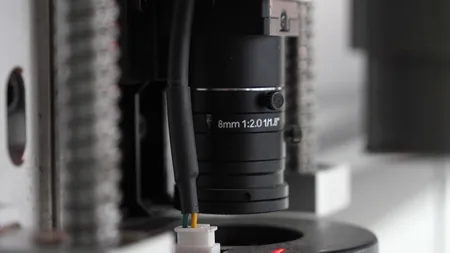
What Is CCD Vision Registration?
CCD vision registration is the camera-based alignment system on a digital flatbed cutter that lets the machine read printed marks on a sheet and cut to the artwork instead of to a guessed origin. "CCD" refers to the charge-coupled device camera; "registration" is the act of matching the cut path to the printed graphic. On a digital cutter, the camera is not a decoration - it is what makes pre-printed work repeatable.
Without vision, an operator loads a printed sheet by eye, and every sheet that shifted a millimeter during printing cuts a millimeter off the artwork. With CCD registration, the camera finds the marks, measures the shift, and the software moves the tool path to match. That is the entire job of the system.
How CCD Vision Registration Works
The system pairs a high-resolution camera with the cutter's control software (LDCUT uses ICUT). The camera sits over the bed and scans for registration marks or the printed contour itself. The software then corrects three classes of error:
| Error type | What it does | Why it matters |
|---|---|---|
| Skew (rotation) | The sheet is rotated a few degrees off square. | A rotated sheet throws every cut off along its length. |
| Stretch / scale | The substrate expanded or shrank after printing. | Common on vinyl, films, and heat-sensitive stocks. |
| Trapezoidal distortion | Opposite edges shift by different amounts. | Happens on wide sheets and flexible media. |
Beyond mark-based registration, the camera also performs edge tracking: it follows the actual printed contour, so a kiss-cut label or a contour-cut decal lands exactly on the graphic - no white halo, no hand trimming. This is the capability that turns a printed sheet into a finished, shelf-ready part.
The Print-to-Cut Workflow
On an LDCUT machine, a printed job moves through five steps:
- Print the marks. Your printer lays down registration marks (and the artwork) on the sheet.
- Load the sheet. The operator places it on the bed. No precise manual alignment is required.
- Camera scan. The CCD camera reads the marks and the printed contour.
- Compute the transform. ICUT calculates X/Y offset, rotation angle, and any trapezoidal distortion, then transforms the tool path to the actual media position.
- Cut. The knife or spindle follows the corrected path - through-cut, kiss-cut, crease, or V-cut - aligned to the print.
Accuracy and Performance Specs
| Specification | Value |
|---|---|
| CCD camera resolution | 0.025 mm |
| Optical registration accuracy | 0.1 mm or better |
| Cutting positioning accuracy | 0.01 mm |
| Labor dependence vs. manual setup | reduced by roughly 40% |
| File formats | DXF, PLT, JPG, TIF |
The 0.025 mm camera reads marks finely enough that a kiss-cut label or a precision carton cut lands on the artwork; the 0.01 mm cutting baseline is what keeps the edge tight after correction.
When You Need Vision Registration
Vision is not optional for printed work. You need CCD registration whenever the cut must follow the print:
- Packaging and cartons - kiss-cut and crease lines must land exactly on the artwork, even when the sheet shifted in the press.
- Stickers and labels - contour-cut decals and kiss-cut labels follow the printed shape with no white border.
- Corrugated and display - printed boxes and retail displays cut to the graphic, not to a guessed origin.
- Signage and printed panels - contour-cut letters and trimmed printed boards stay aligned to the design.
These are the materials the K and L series are built around - packaging, signage, foam, gaskets, and composites. On the G6, the same CCD camera handles vision positioning on rigid stock such as PVC, acrylic, and composites, where a spindle router contours the material cleanly.
Which LDCUT Models Include CCD
CCD vision registration is standard on all five LDCUT models - the camera ships with the machine, not as a paid option:
| Model tier | Role | CCD and supporting systems |
|---|---|---|
| K8 & L8 | Sampling and short production runs | CCD camera standard; EOT oscillating knife standard; four platform sizes up to 1600x2500 mm; 120 m/min. |
| L10 & K10 | Automated, heavy-capacity production | CCD camera standard, plus the Double IR Auto Tool Setter and Automatic Oil Supply & Lubrication for continuous runs. |
| G6 | Rigid-material spindle cutter | CCD camera standard for vision positioning on PVC, acrylic, and composites; 40,000/60,000 rpm spindle plus oscillating knife; 1300x2500 mm platform; 100 m/min. |
All five share the same five quick-swap tool heads (EOT, DCT, CCT, KCT, VCT) and the ICUT workflow, so vision registration behaves identically across the range.
File Formats and Software
CCD registration runs inside ICUT, LDCUT's cutting software. It accepts vector files (DXF, PLT) and raster files for camera-guided contour cutting (JPG, TIF). For printed jobs, the raster mark or contour is what the camera reads; for plain vector jobs, the camera step is simply skipped while the rest of the workflow stays the same. ICUT also automatically completes the feeding and cutting of oversized and multiple files for roll materials.
Frequently Asked Questions
What does a CCD vision system do?
A CCD camera scans printed registration marks and auto-corrects for skew, stretch, and trapezoidal distortion, so pre-printed sheets cut in perfect alignment without manual setup. It also reduces labor dependence by roughly 40%.
Does CCD registration work on unprinted materials?
Yes. The camera still runs, but with no marks to read the registration step is skipped. You get the same cutting accuracy; you simply do not need the alignment correction.
Is the CCD camera standard on all LDCUT models?
Yes. The CCD camera is standard equipment across all five LDCUT models - K8, L8, K10, L10, and G6. No optional upgrade is required to register printed work.
What file formats does vision registration support?
ICUT accepts DXF, PLT, JPG, and TIF. DXF and PLT carry the vector cut path; JPG and TIF let the camera read printed contours for registration.
Conclusion
CCD vision registration is the difference between cutting to a guess and cutting to the print. On packaging, stickers, corrugated, and signage it removes the manual alignment that causes drift, rework, and waste. On LDCUT machines it is standard across the full range - K8/L8 for sampling, L10/K10 for automated volume, and the G6 spindle cutter for rigid PVC and acrylic - so you choose the model by throughput and material, not by whether vision is included.