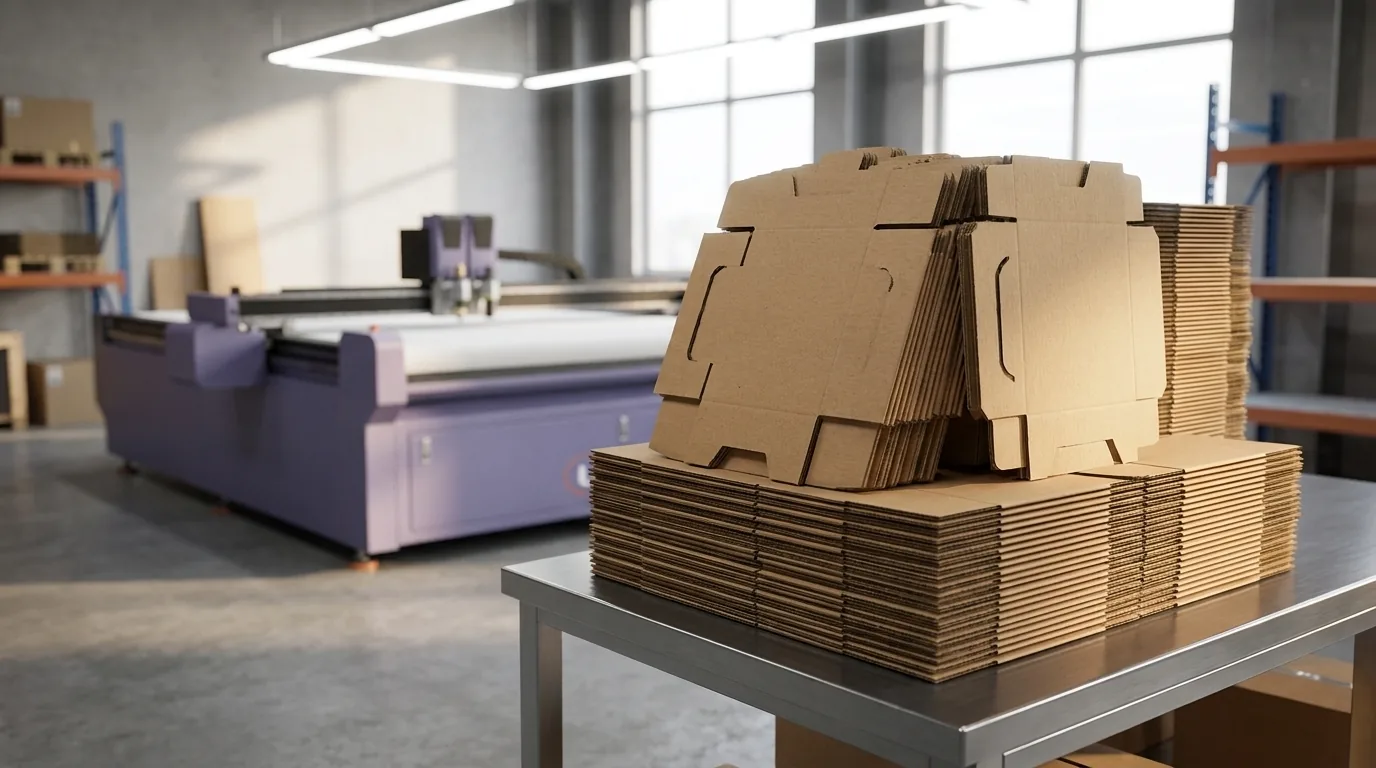
A corrugated box cutting machine is computer-controlled equipment that cuts, creases, and scores corrugated board into finished boxes, inserts, and displays — without a physical die. If you run a packaging plant, a contract converter, or a private-label distribution business, you already feel the pressure of traditional die cutting: a steel-rule die takes 7–14 days to machine and costs $300–$3,000 every time a box size changes. That model collapses the moment a customer asks for a 50-piece sample by Thursday or a one-off promotional carton.
For a complete breakdown of digital cutting technology and how to choose the right machine, read our complete digital cutting machine guide.
Board converters in the US, Germany, Brazil, and Australia keep telling our engineers the same thing: their die library is a warehouse line item, their tooling lead time is a sales bottleneck, and a 50-piece sample request is a margin-killer. I'll walk you through the exact selection and ROI framework our own sales engineers use on the floor — built on how the machine actually works, not on a brochure.
I'm a factory engineer at LDCUT, a 22-year digital cutting machine factory that has shipped to 3,000+ enterprises in 80+ countries. This isn't a reseller's catalog. Here's what's inside: how an oscillating-knife cutter works, a side-by-side vs die cutting, why "no die" rewrites your unit economics, how to spec the right model, and what distributors must verify before signing a container.
Key takeaways
- A digital corrugated box cutting machine removes the die entirely: change a box by editing a DXF file, not by ordering a $1,500 tool.
- Oscillating-knife physics slices through board up to 50 mm thick with no heat, so corrugated edges stay clean and never burn.
- LDCUT field data shows material waste down 30%+, throughput up 300%, and direct labor down 40% versus manual or platen lines.
- For runs under roughly 5,000–8,000 identical boxes, dieless cutting is almost always cheaper per unit; above that, rotary die cutting still wins on pure cycle speed.
- The corrugated cardboard cutting machine market is projected to grow from $1.5B (2024) to $2.3B (2033) at a 4.8% CAGR as short-run and on-demand packaging expand.
A 38-person contract converter outside Columbus, Ohio, put it bluntly to our rep: their five best accounts each wanted 12 box sizes for a seasonal promo, and quoting a $900 die per size would have killed the deal before it started. "We'd just stopped saying yes to small orders," he said. The first afternoon they loaded a customer's print file and cut all 12 sizes — zero tooling — they stopped turning work away. That single afternoon is the entire thesis of this guide.
What Is a Corrugated Box Cutting Machine?
A corrugated box cutting machine is a CNC flatbed or conveyor system that cuts, creases, and scores corrugated board using a computer-controlled knife — no physical die required. It reads vector files (dxf, plt, jpg, tif) and produces boxes, inserts, and retail displays on demand.
The machine is sometimes called a digital corrugated box cutter, an oscillating knife corrugated cutter, or a corrugated carton cutting machine. All describe the same class of dieless, file-driven equipment. The defining trait is simple: the geometry lives in software, not in steel.
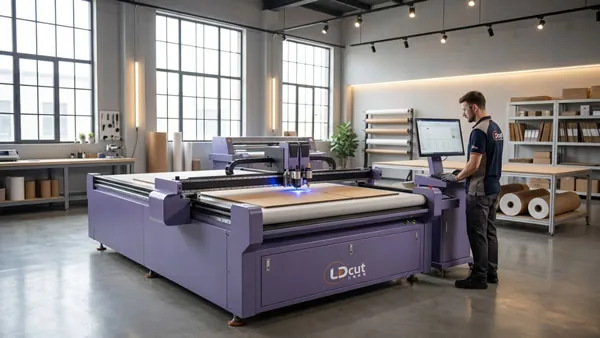
Core functions: cut, crease, half-cut, V-cut
A box is rarely just "cut." Four operations define a finished carton, and a proper machine performs all four with swappable heads:
- Full cut — the blade passes through every layer to release the blank. Done with the EOT or DCT drag knife.
- Crease — the CCT (Creasing Cutting Tool) wheel rolls a controlled score line so the board folds cleanly without cracking the liner.
- Half-cut / kiss-cut — the KCT (Kiss Cut Tool) cuts only the top liner or surface film, leaving the backing intact. Essential for peel-layer labels and multi-material composites.
- V-cut — the VCT (V-Cutting Tool) grooves a V-channel into thick board so it folds to a sharp 90° without a double wall. Used on honeycomb, display board, and heavy corrugated.
This single-machine versatility is why a cardboard box cutting machine built on the digital platform replaces what used to be three separate stations.
How Does a Corrugated Box Cutting Machine Work?
Here's the mechanism in one line: a servo-driven gantry moves a tool head over a vacuum-held sheet while a controller fires cutting, creasing, or grooving commands from a vector file. But the engineering that decides whether you win or lose a job lives deeper than that sentence.

Oscillating knife physics: why oscillation matters
The heart of a modern oscillating knife corrugated cutter is the EOT. An eccentric motor converts rotation into high-frequency vertical translation of the blade — on LDCUT's L10 and K10 platforms, that is high-frequency oscillation. If you want the deeper technical breakdown of how the eccentric drive and blade stroke scale with material density, see our guide to oscillating-knife cutting technology.
Think of it as a mechanical saw at microscopic stroke. Instead of dragging a static blade (the DCT drag knife, suited to thin 0.1–3 mm films), the oscillating blade "chews" through the flute with each cycle. Two consequences matter to you:
- No heat. There is no laser, no molten edge, no scorching. Printed board keeps its color; the cut face stays clean and fiber-intact.
- No tearing on thick stock. Because the blade never pushes the board sideways, even 50 mm of combined material cuts square, with no burrs and no secondary finishing.
This is the single biggest reason packaging engineers choose an oscillating knife over a laser for corrugated: a laser burns the kraft liner, releases particulates, and can compromise the board's fire-safe treatment.
CNC digital control and file workflow
You do not redraw a box for every machine. The ICUT control software ingests standard formats — DXF, PLT, plus JPG/TIF for camera-guided contour cutting — and auto-nests parts to maximize sheet yield. A typical workflow:
- Receive or open the customer's vector file.
- ICUT nests the blanks and assigns cut / crease / kiss-cut / V-cut by color layer.
- The gantry runs at up to 120 m/min idle travel, ±0.01 mm processing accuracy.
- Continuous feeding handles roll stock and oversized sheets without operator re-loading.
Because the geometry is a file, a box change is a click, not a purchase order.
Optical registration and auto tool setting
Printed corrugated is never placed by hand perfectly. A CCD camera at 0.025 mm resolution reads registration marks and edge-tracks the print, holding optical alignment to ≤0.1 mm — so a kiss-cut label lands exactly on the artwork. On the L10 and K10, a dual-IR auto tool setter measures blade height and sets cut depth for you. No manual Z-calibration, no test scraps. No more "why is it cutting too deep today."
Tool changes require no complex tools and are fast. All five heads (EOT, DCT, CCT, KCT, VCT) interchange in under 3 minutes, so a shop moves from carton blanks to display grooving to label kiss-cuts in a single shift.
Vacuum table and material fixing
At 120 m/min, an unsecured sheet will lift at the trailing edge and ruin a run. LDCUT uses an aircraft-grade aluminum vacuum platen with zonal suction — sections switch on only where material sits, saving pump energy and holding small off-cuts so they do not fly. Flatness is calibrated across the whole work area during pre-shipment testing (more on that below), which is why cut depth stays consistent corner to corner.
Get the technical datasheet for our oscillating-knife cutters — including EOT stroke, vacuum zones, and per-model work areas — from the LDCUT L10 digital flatbed cutter product page.
Digital Cutter vs Die Cutting Machine
This is the comparison most buyers actually need. The table below is built for the featured-snippet box — save it, print it, take it to your capital-review meeting. For the full breakdown of where each technology wins by batch size and material, read our digital vs die cutting guide.
| Factor | Digital oscillating-knife cutter | Rotary die cutter | Platen (flat-bed) die cutter |
|---|---|---|---|
| Changeover time | Minutes (edit a file) | Hours (swap & align die) | Hours to days (mount die) |
| Tooling cost | $0 (dieless) | $300–$3,000 per die | $500–$5,000+ per die |
| Minimum order | 1 piece | 500–2,000+ | 1,000–5,000+ |
| Accuracy | ±0.01 mm | ±0.2–0.5 mm | ±0.3–0.8 mm |
| Best batch size | 1–5,000 units | 5,000–500,000 | 10,000+ |
| Flexibility | Unlimited shapes, instant change | Fixed by die shape | Fixed by die shape |
| Print registration | CCD ≤0.1 mm | Manual/optical | Manual/optical |
A no die corrugated box cutting machine wins on flexibility, lead time, and small-order economics. A die line wins on raw cycle speed at massive volume.
When die cutting still wins
Run the real volumes and die cutting earns its place — if you're pushing one box size at 50,000 units a month, a rotary die amortizes tooling to near zero and out-paces any knife on cycle time. Die cutting also suits non-stop, lights-out production of a single SKU. The mistake is buying a die line first and then discovering 70% of your incoming orders are under 1,000 pieces. For mixed-box, sample-driven, and on-demand work, the digital cutter is the smarter anchor.
Why "No Die" Changes the Economics of Box Production
A no die corrugated box cutting machine removes the single biggest recurring cost in a converter's P&L. The die looks like a one-time purchase on the invoice, but on the floor it behaves like a subscription you never cancel — every size change, every 50-piece sample, every new account reopens the tooling bill.
The hidden cost of tooling
Most plants undercount tooling because accounting files it under "consumables." Add it up and the real line items are:
- Die purchase: $300–$5,000 per size, repeated for every revision.
- Die storage & maintenance: warehouse space, rust, re-sharpening, misplacement.
- Design lead time: 7–14 days before a single box ships — a sales blocker.
- Opportunity cost: orders you declined because the die was not worth quoting.
- Obsolescence: a discontinued SKU leaves you holding a $2,000 steel shape.
A corrugated carton cutting machine with no die deletes every one of these.
Quantifying the savings
Across LDCUT installations, the consistent field results versus manual or platen lines are:
- Material waste down 30%+ — software nesting packs blanks tighter than any hand layout.
- Throughput up 300% — continuous feeding and instant changeover vs. die mounting.
- Direct labor down 40% — CCD registration and auto tool setting remove manual setup.
Worked example. A converter handles 20 SKU changes per month. With a traditional die-cutting approach, assuming an average die cost of USD 800 and a 10-day lead time for each new die:
- 20 dies × USD 800 = USD 16,000/month in tooling costs
- Constant production delays while waiting for new dies
After switching to a dieless digital cutting system:
- Tooling cost drops to USD 0
- Changeovers become as simple as editing a cutting file
- Assuming monthly board costs of USD 40,000, a 30% improvement in material utilization saves approximately USD 12,000 per month
Estimated monthly savings:
- Tooling savings: USD 16,000
- Material savings: USD 12,000
- Total savings: Approximately USD 28,000 per month
For most converters, these savings are enough for the machine to pay for itself within the first year—and in many cases, even sooner.
Short-Run and On-Demand Packaging Math
Here is the unit-economics crossover every buyer should calculate.
Illustrative cost comparison:
- Traditional die cutting
- Tooling cost: USD 1,200 ÷ N units
- Production cost: Approximately USD 0.08 per box
- Dieless digital cutting
- Tooling cost: USD 0
- Production cost: Approximately USD 0.22 per box
The two cost curves intersect at approximately N ≈ 8,600 units.
- Below 8,600 units: Dieless cutting offers a lower cost per box.
- Above 8,600 units: The tooling cost is spread across enough units that traditional die cutting becomes more economical.
For the vast majority of custom packaging, branded packaging, sample production, and protective packaging—where order quantities typically remain well below 8,600 units—a cardboard box cutting machine delivers advantages in both cost efficiency and speed to market.
Example:
A packaging distributor in São Paulo analyzed the order history of its top 40 customers. The results showed that 86% of orders were under 3,000 units. After moving sample production and short-run jobs to a dieless digital cutting system, the company stopped turning away small-volume orders and increased revenue from that business segment by 22% within two quarters, without adding production staff.
Applications
The dieless platform earns its keep across three job families that die lines handle poorly.
Custom and branded packaging
Printed corrugated with exact kiss-cut and crease alignment turns a plain carton into shelf-ready branding. CCD registration keeps every cut on the artwork at ≤0.1 mm.
Sample and prototyping
Sales teams need a physical box today, not in 10 days. Load the file, cut the sample, ship it. This alone closes more custom-packaging deals than any brochure.
Protective inserts and displays
Pair corrugated with EPE/EVA foam; use V-cut for clean 90° folds on POP displays and V-groove insert trays. One machine, from protective insert to counter display.
Maintenance and Uptime
A corrugated box cutting machine is a 10-year asset. Its uptime comes from disciplined daily care and, more importantly, from a factory that proved the machine before it left.
Daily and weekly care
- Blades: inspect EOT/DCT edges; replace at first sign of burr (low-cost, fast).
- Vacuum filter: clear daily — a clogged filter drops hold-down and ruins cut depth.
- Rails: LDCUT's auto oil-supply lubricates the guides; verify the reservoir monthly.
- Dust: corrugated dust is flammable and abrasive — vacuum the bed and cabinet weekly.
Why factory pre-shipment testing matters
This is where a 22-year factory separates from a trading company. Every LDCUT machine passes a 3-stage quality check before it ships:
- Feeding & cutting-accuracy test — simulates real jobs to confirm smooth feed and zero-tolerance precision.
- Platform flatness test — high-precision instruments calibrate cut depth across the entire bed.
- 24–48 hour continuous load test — a full-load endurance run proving reliability under long, intense production.
Frequently Asked Questions
Can it cut printed corrugated without misaligning?
Yes. The CCD camera reads registration marks and edge-tracks the print at ≤0.1 mm, so creases and kiss-cuts land exactly on the artwork — even if the sheet shifted during printing.
Oscillating knife vs laser — which is better for corrugated?
For corrugated, the oscillating knife wins. A laser burns the kraft liner, discolors edges, and can breach fire-retardant treatment; the knife cuts cold, clean, and square through up to 50 mm. Laser suits thin non-corrugated substrates only.
Conclusion: three takeaways and your next step
- The die is the bottleneck, not the box. A dieless corrugated box cutting machine turns every box change into a file edit — $0 tooling, minutes not days.
- Physics beats brochures. Oscillating-knife cutting gives clean, burn-free edges through 50 mm, with ±0.01 mm accuracy and CCD registration ≤0.1 mm.
- The ROI is measurable. Field data shows waste down 30%+, throughput up 300%, labor down 40% — and most converters recover the machine inside year one.
If your die library is eating margin, the fastest path is a 30-minute engineering call. Book a 30-minute engineering call and we'll size the right LDCUT line for your box mix and market — reach out and our engineers will size the right model for your box mix and region.