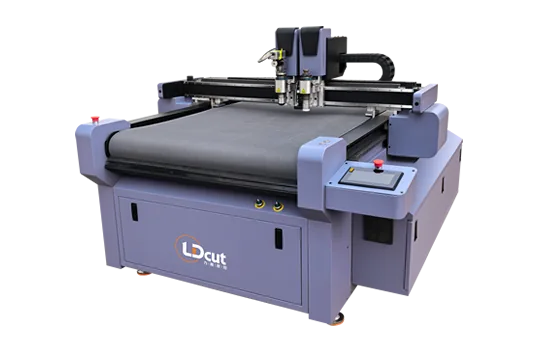
LDCUT Digital Flatbed Cutter Product Range

Explore the full LDCUT digital flatbed cutter product range — the L Series (L8/L10), K Series (K8/K10), and the G6 spindle router — built for precision, speed, and versatility across packaging, signage, and printing industries.

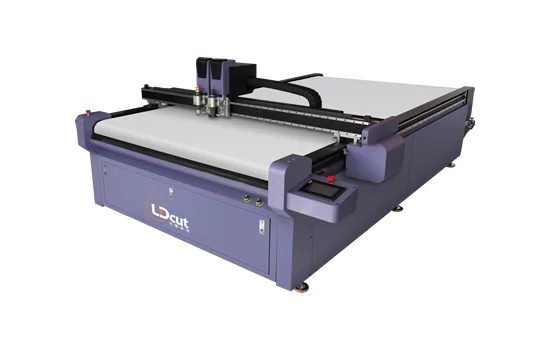
LDCUT L8 Digital Flatbed Cutter
L Series

LDCUT L8

  • Available in 4 standard sizes
  • High-precision servo drive system
  • Versatile for diverse materials
View Details
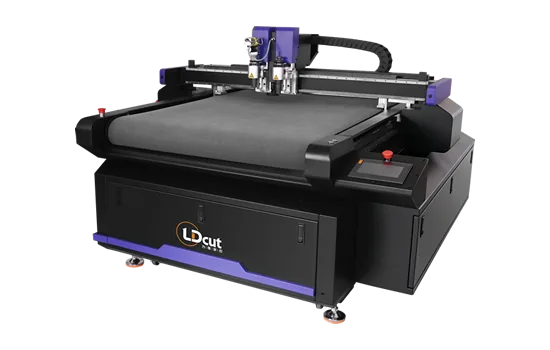
LDCUT L10 Digital Flatbed Cutter
L Series

LDCUT L10

  • Double IR Auto Tool Setter
  • Auto oil supply & lubrication
  • Industrial servo system
View Details
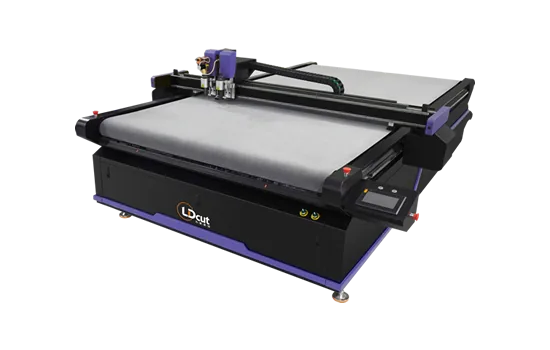
LDCUT K8 Oscillating Knife Cutter
K Series

LDCUT K8

  • Available in 4 standard sizes
  • High-precision servo drive system
  • Ideal for sampling & short runs
View Details
LDCUT K10 Oscillating Knife Cutter
K Series

LDCUT K10

  • Double IR Auto Tool Setter
  • Auto oil supply & lubrication
  • Heavy-duty static table build
View Details
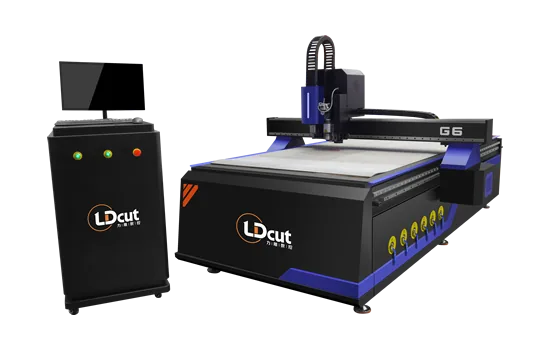
LDCUT G6 Flatbed Cutting Machine
G Series

LDCUT G6

  • Spindle 40000rpm/60000rpm
  • High-precision servo drive system
  • Versatile for diverse materials
View Details

What Is a Digital Flatbed Cutter?

A digital flatbed cutter is a CNC-driven, die-less cutting table that slices packaging, signage, foam, and composite sheets with a vibrating or drag knife instead of a physical steel die. You load a design file, the machine reads it, and a tool head cuts the shape to ±0.01 mm — no tooling cost, no weeks of lead time, and no heat-scorched edges.

Because the blade stays cold, a digital flatbed cutter handles heat-sensitive materials — PVC, vinyl, foam, and kraft cardboard — that a laser would melt or scorch. That is why converters, print finishers, and packaging distributors increasingly replace traditional die cutting with a flatbed digital cutting machine on the production floor.

Compared with a laser, a digital flatbed cutter leaves a clean, odor-free edge on foam and PVC instead of melting them or releasing fumes, and it needs no physical die the way traditional die cutting does. Compared with die cutting, it removes $5,000–$20,000 of per-design tooling and weeks of lead time. That combination is why a flatbed digital cutting machine is the default choice for short runs and custom jobs.

Choose Your LDCUT Digital Flatbed Cutter by Production Tier

LDCUT builds digital flatbed cutters in two capacity tiers plus a rigid-material specialist. Within each tier, the L Series is the flagship build (higher assembly finish and broader color customization), while the K Series is the industrial standard build — the same cutting platform, positioned differently. All five models share the same ±0.01 mm tolerance and the same interchangeable head system, so moving between them is a low-friction decision. Pick the tier that matches your daily workload, then match the platform size and tool head to your materials.

Sampling & Prototyping / Medium Volume

LDCUT L8 & K8

The entry tier for sample makers, R&D labs, and short-to-medium custom runs. Both ship with the standard EOT oscillating knife and four platform sizes up to 1600×2500 mm.

Explore LDCUT L8 →
Explore LDCUT K8 →
Higher-Automation Tier

LDCUT L10 & K10

The higher-automation tier. The Double IR Auto Tool Setter and Auto oil supply & lubrication raise day-to-day running and maintenance efficiency, on the same four platform sizes and EOT head as the L/K entry tier.

Explore LDCUT L10 →
Explore LDCUT K10 →
Rigid Materials

LDCUT G6

The spindle specialist for rigid PVC, acrylic, and composites. A 40,000/60,000 rpm spindle plus an oscillating knife on a 1300×2500 mm table.

Explore LDCUT G6 →

Choose by Material

Material decides the tool head; production volume decides the model. Get this pairing right and a single digital flatbed cutter covers most of a converter's daily work, from prototype samples to full production runs. A few quick rules:

  • Corrugated, foam board, honeycomb, cardboard: every LDCUT digital flatbed cutter handles these with the standard EOT oscillating knife.
  • Vinyl, PVC film, vehicle wrap, stickers: add the DCT drag knife for clean contour and kiss cuts.
  • Rigid PVC, acrylic, composites: the LDCUT G6 spindle router is the right machine — knife heads cannot cut dense rigid stock.

For the full material-by-material breakdown, see our Material Compatibility Guide.

LDCUT Digital Flatbed Cutter Models at a Glance

Five models, one die-less knife platform. The table below is a quick overview — for full specifications, optional tool heads, and the buyer's decision matrix, open the Digital Flatbed Cutter Machine Guide.

Model Platform Sizes Max Rapid Standard Tool Head Best For
LDCUT L8 900×1200 / 1300×1300 / 1300×2500 / 1600×2500 mm 120 m/min EOT (oscillating knife) Sampling & prototyping, medium volume
LDCUT L10 900×1200 / 1300×1300 / 1300×2500 / 1600×2500 mm 120 m/min EOT (oscillating knife) Automated, high-throughput cutting
LDCUT K8 900×1200 / 1300×1300 / 1300×2500 / 1600×2500 mm 120 m/min EOT (oscillating knife) Sampling & prototyping, medium volume
LDCUT K10 900×1200 / 1300×1300 / 1300×2500 / 1600×2500 mm 120 m/min EOT (oscillating knife) Automated, high-throughput cutting
LDCUT G6 1300×2500 mm 100 m/min Spindle 40,000–60,000 rpm + oscillating knife Rigid PVC, acrylic, composites

Why Manufacturers Choose LDCUT

A digital flatbed cutter is a capital purchase. These are the proof points behind every LDCUT machine. LDCUT has supplied digital cutting equipment since 2004, with CE and ISO certified production and a global service network that keeps your table running.

22+
Years manufacturing
3,000+
Enterprise clients
80+
Countries served
24–48h
Pre-shipment test
1-Year
Warranty

When your production line depends on the cutting table, a partner with two decades of process refinement and thousands of installed machines across 80+ countries is simply the safer choice.

Which Digital Cutter Should You Choose?

Match your application to the right LDCUT model. Need help with materials? See our Material Compatibility Guide.

Application Recommended Model
Sampling & Prototyping / Medium-volume Production LDCUT K8 / LDCUT L8
Automated Workflow / Auto oil supply & lubrication LDCUT K10 / LDCUT L10
Rigid PVC / Acrylic / Composites LDCUT G6

Not sure which fits your shop? Read the full digital cutting machine buying guide → How to choose a manufacturer →

Frequently Asked Questions About LDCUT Digital Flatbed Cutters

Do I need a spindle or a knife head?

For flexible and semi-rigid sheets — corrugated, foam, vinyl, cardboard — the standard EOT oscillating knife is enough. For rigid PVC, acrylic, and composites, you need the LDCUT G6 spindle router. Most buyers start with a knife-head flatbed digital cutting machine and add the G6 only when rigid jobs appear.

Which platform size should I choose?

Match the bed to your largest sheet. The K/L series offers four sizes from 900×1200 mm to 1600×2500 mm, so a small sample maker and a display-graphics producer can both find a fit. Bigger beds nest more parts per run and raise throughput.

How fast is a digital flatbed cutter?

The K/L series reaches 120 m/min rapid speed; the G6 spindle model runs at 100 m/min. Real cycle time depends on material thickness and cut complexity, but die-less changeover means you cut the moment the file is ready — no die, no wait.

What support comes with an LDCUT machine?

Every unit ships after a 24–48 hour pre-shipment stability test, carries a 1-year warranty, and is backed by a 22-year manufacturer with 3,000+ enterprise clients across 80+ countries. Spare parts and remote engineering support are available after installation.

What is the lead time and ROI?

Die-less cutting removes $5,000–$20,000 per-die tooling and 6–8 week waits, cutting lead time by up to 70% and material waste by 30–40%. For a shop running short runs, a digital flatbed cutter pays back fast.

Get Your Custom Solution

Fill out the form below, our professional consultants will provide customized solutions and quotes

GET BEST PRICE

Submission Successful!

Thank you for your submission. We will contact you soon with the best price.