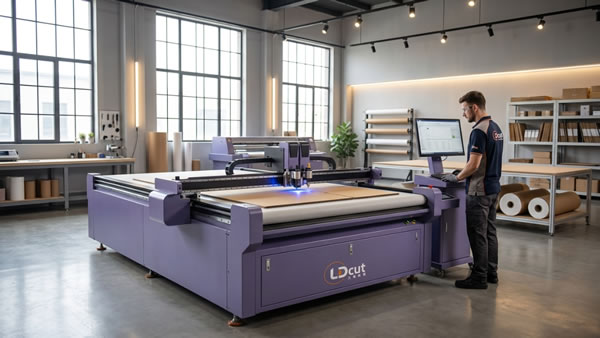
A digital flatbed cutter machine is a CNC-driven, die-less cutting table that slices packaging, signage, textile, and composite materials with a vibrating or drag knife instead of a physical die. If your shop still pays for steel-rule dies, waits weeks for tooling, or turns away short-run jobs because they are not economical, this guide is for you.
For a complete breakdown of digital cutting technology and how to choose the right machine, read our complete digital cutting machine guide.
You already know the pain. A single custom die can cost thousands of dollars and eat six to eight weeks of lead time before the first box is even cut. For prototypes, samples, and small custom batches, that math simply does not work.
By the end of this guide, you will understand exactly how a digital flatbed cutter works, which of the five tool heads you actually need, how it compares against laser and traditional die cutting, and what realistic cost and ROI look like for your business. We will walk through definitions, core components, compatible materials, real industry applications, a buyer's decision matrix, and why a 22-year manufacturer with 3,000+ global clients deserves your trust.
Here is the story that started this guide.
Mini-story #1 — The packaging plant that lost the deal over a die. In March 2024, a mid-size corrugated packaging factory in Poland received an urgent request: 200 custom retail display boxes for a trade show in 12 days. Their existing setup required a new steel-rule die, quoted at €3,400 with a 5-week lead time. The job was impossible. The sales manager nearly walked away. Then they borrowed a neighbor's digital flatbed cutter machine for a weekend, loaded the file, and cut all 200 boxes in under six hours with zero tooling. They won the client and bought their own cutter the following month.
Key Points — What You'll Learn
- A digital flatbed cutter machine uses knives instead of dies or lasers, so you skip tooling costs and avoid heat-scorched edges.
- It reads a design file and cuts to ±0.01 mm accuracy at high-frequency oscillation and 120 m/min rapid speed.
- Multiple interchangeable tool heads—including EOT, DCT, CCT, KCT, VCT, and more—cover applications ranging from foam cutting to kiss-cut labels on a single table.
- Digital die-less cutting can cut lead times by up to 70% and material waste by 30–40%.
- The global digital flatbed cutter market is on track to top USD 1.5 billion by 2032 (Market IntelliX).
What Is a Digital Flatbed Cutter Machine?
A digital flatbed cutter machine is a CNC (Computer Numerical Control) cutting table that uses oscillating and drag knives to cut sheet materials: cardboard, foam, PVC, and fabric. It reads a file, holds the sheet with a vacuum bed, and cuts to ±0.01 mm accuracy without needing a physical die.
Let's break that definition into its three defining traits:
- Digital. The machine runs on software, not a fixed steel die. You send a vector file (DXF, PDF, AI, PLT) and the cutter follows it, so a design change is instant. That software-first approach is what separates a die-less cutting machine from a traditional press.
- Flatbed. The material lies flat on a rigid table, held by vacuum suction. Unlike a roll-fed plotter, a flatbed handles thick, rigid, and awkward sheets: corrugated board up to 50 mm, honeycomb panel, foam, and rigid PVC.
- Cutter (knife, not laser or blade-die). The cutting force comes from a rapidly oscillating blade or a rotating drag knife. Because the blade stays cold, it never burns the material or releases fumes.
The result is a digital flatbed cutter that behaves like a CNC router's precise cousin. Rather than spinning a bit, it swings a blade thousands of times per minute. That distinction matters when you cut heat-sensitive films, adhesives, or foam.
How Does a Digital Flatbed Cutter Work?
If you have ever wondered how does a digital flatbed cutter work, the process is simpler than a CNC mill and far more flexible than a die press. Here is the end-to-end workflow in five steps.
- Prepare the design file. Your operator imports a file into the cutter's nesting software. The software arranges parts to maximize material use and adds registration marks.
- Load and position the material. Place the sheet on the flatbed. A powerful vacuum table clamps it flat, with no taping or fixtures needed. Conveyor-fed models auto-feed continuous rolls.
- Calibrate and select the tool head. The controller assigns the right head for each path: an oscillating knife for thick corrugated, a drag knife for thin vinyl, a creasing wheel for carton folds. Swaps take under three minutes.
- Vision registration (CCD). A CCD camera scans printed marks or material edges and auto-corrects for skew and stretch. This is why a digital flatbed cutter for packaging can cut pre-printed sheets with perfect alignment.
- Execute the cut. The gantry drives the head along X/Y axes while the knife moves on Z. Oscillation reaches high frequency; the vacuum holds the sheet; finished parts stay in place for easy picking.

Under the hood, three motion axes do the work. The X/Y axes move the cutting head across the table at up to 120 m/min rapid speed. The Z axis controls blade plunge depth, which is critical for kiss-cutting (you cut the top layer but spare the liner). The vacuum table is the unsung hero: without it, thin films would lift and drag.
A well-tuned CNC oscillating knife cutting machine repeats this cycle thousands of times with ±0.01 mm consistency. That tolerance keeps a medical-seal or electronics-film customer happy.
Key Components & 5 Common Tool Heads
The single biggest differentiator between a commodity cutter and a professional digital flatbed cutter is the tool-head system. LDCUT ships five purpose-built heads. Knowing which you need prevents overspending and under-cutting.
EOT — Oscillating Knife (thick & rigid materials)
The EOT oscillating knife is the workhorse for thick stock: corrugated, foam board, and honeycomb up to 50 mm. It vibrates the blade at high frequency to punch through dense material cleanly. If you cut shipping boxes, protective foam, or display stands, this is non-negotiable.
DCT — Drag Knife (thin films & self-adhesive)
The DCT drag knife handles thin materials from 0.1–3 mm (vehicle wrap, PVC, vinyl, stickers) with 360° rotation that follows curves without lifting. This is the head that makes a digital flatbed cutter a sign-maker's best friend.
CCT — Creasing Wheel (carton forming)
The CCT creasing wheel scores and folds cardstock for carton erection and glue-free assembly. Paired with the EOT, it produces a finished, foldable box in one pass, with no separate creasing machine needed.
KCT — Kiss-Cut & Half-Cut (labels & multi-layer)
The KCT half-cut / kiss-cut head cuts only the top layer and spares the backing paper. It is built for adhesive labels, multilayer gaskets, and any job where you must peel, not push through. Precision Z control is everything here.
VCT — V-Groove Knife (honeycomb & thick board folding)
The VCT V-groove knife mills a V channel into honeycomb panel and thick board so it bends to a clean right angle. Used for exhibition walls and industrial enclosures, it removes the need for tongue-and-groove joinery.
5 Tool Heads Quick Reference
- EOT oscillating knife → corrugated, foam, board to 50 mm
- DCT drag knife (360°) → vinyl, PVC, vehicle wrap 0.1–3 mm
- CCT creasing wheel → carton scoring & folding
- KCT kiss-cut / half-cut → labels & multi-layer, cuts top only
- VCT V-groove → honeycomb & thick board bending
What Materials Can It Cut?
A modern digital flatbed cutter is material-agnostic within the knife-cutting range. The common compatible materials include:
- Corrugated cardboard & carton: shipping boxes, retail displays, carton samples
- Foam board & EVA foam: protective inserts, packaging, cosplay
- KT board & foam-core: signage, school and event displays
- PVC & rigid plastic: tags, spacers, lightweight fabrication
- Vehicle wrap & self-adhesive vinyl: decals, stickers, contours
- Honeycomb panel: exhibition walls and lightweight structures (with VCT)
- Felt, leather, and technical textiles: gaskets, apparel prototypes
- Sandwich panel & acrylic up to a few mm: light fabrication
For thicker acrylic and dense PVC profiles, a dedicated router is the better tool. The LDCUT G6 CNC router for PVC & acrylic uses a spindle to contour-cut rigid plastic that a knife head cannot reach. The two machines are complementary, not competing.
Digital Flatbed Cutter vs Laser Cutter vs Traditional Die Cutting
This is the comparison every buyer actually needs. The table below strips it to the factors that affect your margin.
| Factor | Traditional Die Cutting | Laser Cutter | Digital Flatbed Cutter (Knife) |
|---|---|---|---|
| Tooling required | Physical steel die ($5k–$20k, 6–8 wks) | None | None (die-less) |
| Heat-affected zone | None | Yes (burn edge and heat-affected zone) | None (cold cut) |
| Edge quality | Clean, but die-limited | Sealed but scorched on some materials | Clean, no burn, no odor |
| Material compatibility | Die-dependent | Struggles with PVC (toxic fumes), foam (melts) | Broad: foam, film, and board |
| Setup / changeover | 30–60 min per die | Near-zero | Under 3 min head swap |
| Best run size | 1,000+ units | 1–5,000 | 1 to 10,000+ (true short-run) |
| Unit cost at low volume | High (die amortization) | Medium | Low (no tooling) |
The headline advantage of digital cutting machine vs laser cutting is edge quality on sensitive materials. Laser seals acrylic well, but it melts foam, releases chlorine fumes from PVC, and scorches kraft cardboard, which fails food and retail packaging. A knife cutter leaves a clean, odor-free edge on all of those.
Mini-story #2 — The sign shop that got a job returned. A vehicle-wrap shop in Texas cut a batch of reflective decals with a CO₂ laser to save time. The edges looked sealed, but the customer rejected the order: the laser had left a faint brown scorch line and a smell that would not fade in a parked car. The shop re-ran the order on a digital flatbed cutter with a DCT drag knife and shipped clean, odor-free decals with zero returns. Today that laser handles only acrylic, and every film job runs on the knife table.
Applications by Industry
The versatility of a digital flatbed cutter shows up best in real shops. Four industries, four use cases.
Packaging — Sampling Without the Die Wait
A corrugated box sample maker is the most common entry point. Brands request constant structural variations; cutting each on a die is uneconomic. A flatbed cutter turns a file into a physical carton in minutes, so your design team iterates daily instead of monthly.
Mini-story #3 — The distributor who finally said yes to small runs. A packaging distributor in the Netherlands served only orders above 5,000 units; anything smaller lost money after die costs. After adding a digital flatbed cutter for packaging, they launched an "MOQ 50" service for startups. Within two quarters, those small runs reached 22% of revenue, and several customers grew into six-figure annual accounts. Die-less flexibility became a steady pipeline of new business.
Signage & Display — Contour-Cut Vinyl and Rigid Boards
Sign shops use the DCT drag knife for vehicle wrap and the EOT for foam-core and KT board. Exhibition builders use the VCT to fold honeycomb walls on site.
Printing & Finishing — Kiss-Cut Labels
Print finishers use the KCT head to die-cut self-adhesive labels and stickers straight off the press, replacing rotary dies for short promotional runs.
Benefits for Your Business
The numbers behind a die-less cutting machine are why the market is growing. Independent analysis values the global digital flatbed cutter market at USD 850 million in 2025, projected to pass USD 1.5 billion by 2032 at an 8.5% CAGR. Knife-cutting technology alone holds 50–55% of that share.
What does that growth buy you?
- No tooling cost. Eliminating physical dies removes $5,000–$20,000 per-design expense and the 6–8 week wait.
- Lead time down up to 70%. Digital changeover is near-instant; you cut the moment the file is ready.
- Material waste down 30–40%. Nesting software packs parts tightly; one automotive supplier cut foam scrap by 28 tons a year.
- Speed & throughput. 120 m/min rapid, high-frequency oscillation, and continuous conveyor feed keep the table moving.
- Flexible customization. One file, one cut: profitable from a single prototype to a 10,000-unit run.
How to Choose the Right Digital Flatbed Cutter
Use this buyer's decision matrix before you request a quote. Rank each factor against your actual weekly workload, not the spec sheet's biggest number.
| Decision Factor | What to Check | Why It Matters |
|---|---|---|
| Working area | 1.6×1.0 m vs 2.5×1.6 m+ | Matches your largest sheet; bigger = more nesting |
| Speed | Rapid 120 m/min, high-frequency oscillation | Throughput on long runs |
| Accuracy | ±0.01 mm cutting tolerance | Fit-critical parts (gaskets, electronics) |
| Tool heads | EOT/DCT/CCT/KCT/VCT set | Material range you can serve today |
| Automation | CCD vision, conveyor feed, auto-nest | Labor savings, unattended runs |
| Support & certs | CE, ISO, 1-year warranty, 24–48 h test | De-risks the purchase |
| Track record | Years in business, client count | Proves reliability |
Cost & ROI: What to Expect
Specs are easy to copy; track record is not. LDCUT is a 22-year manufacturer with 3,000+ enterprises in 80+ countries, and those numbers are the strongest risk reducer in a capital purchase. A supplier with two decades of process refinement has fixed the failures a new brand has not yet met.
Concrete proof points that matter to a buyer:
- 22 years of flatbed-cutter manufacturing experience
- 3,000+ enterprise clients served globally
- 80+ countries with installed machines
- CE & ISO certified production
- 24–48 hour pre-shipment continuous stability test on every unit
- 1-year full-machine warranty and ongoing spare-part supply
When your production line depends on the table, a partner who has shipped thousands of units across 80+ countries is simply safer than a marketplace mystery brand.
See it cut your material before you buy. Request a free sample cutting test or a tailored quote from a 22-year manufacturer. Send your file and your stock, and get back a real cut sample plus a configured recommendation.
FAQ
What cutting accuracy can I expect?
A professional digital flatbed cutter holds ±0.01 mm cutting tolerance, with CCD vision correcting for print skew and material stretch. That tolerance is tight enough for gaskets, electronics films, and precision cartons.
Can a digital flatbed cutter cut [my material]?
If it is foam, cardboard, corrugated, KT board, PVC film, vinyl, honeycomb, felt, leather, or thin acrylic, the answer is usually yes, with the right one of the five heads. Dense thick acrylic and metal need a spindle router such as the LDCUT G6 CNC router for PVC & acrylic.
Digital cutting machine vs laser cutting: which is better?
For foam, PVC, film, and anything heat-sensitive, knife cutting wins because the blade stays cold. Laser beats knife only on thick acrylic and metal, where a sealed or fused edge is required. Many shops run both.
Conclusion
A digital flatbed cutter replaces expensive dies, long lead times, and heat-damaged edges with a software-driven knife table that cuts almost any sheet material to ±0.01 mm.
Contact LDCUT for a tailored recommendation. Send your typical files and stock, and a 22-year manufacturer with 3,000+ enterprises in 80+ countries will return a real sample cut plus a configured quote, with no tooling required and no guesswork.
Request Your Custom Solution Today
- One-on-one consultation with our engineering team: Deep understanding of your materials and production requirements
- Free sample cutting service: See LDCUT equipment performance on your materials firsthand
- Precision quotation: Optimal model and configuration based on your needs
- 24-hour response: Fast solution delivery
📞 Phone: +86 190 5951 8798
✉️ Email: Ld@Ldcut.com
🌍 Website: www.ldcut.com