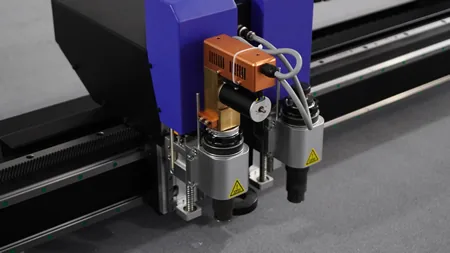
Introduction: What the Modular Tool Head System Does
On a digital flatbed cutter, the single most important technical component is not the frame or the servo drives — it is the tool head system. A cutter is only as capable as the module mounted in its carriage, so understanding what each head does and where it applies is the foundation of getting the most from the machine.
LDCUT digital cutters are built on a modular, quick-swap tool head architecture. Five modules — EOT, DCT, CCT, KCT, and VCT — mount on the same carriage and cover the full material thickness range from 0.1 mm to 50 mm at ±0.01 mm positioning accuracy. This guide is the reference for that system: what each head is, how it physically works, the materials it owns, and how to match the right head to the job.
For the full machine-and-size matrix behind these heads, see our digital flatbed cutter model guide. For the physics of the two oscillating-vs-drag cutting methods, see our oscillating knife vs drag knife comparison.
The 5-Head Modular System at a Glance
Every LDCUT K8, L8, K10, and L10 flatbed cutter ships ready for the same five quick-swap modules. The shared architecture is what makes one machine a multi-process production platform:
- EOT — Electric Oscillating Tool: high-frequency vibration knife for thick materials (up to 50 mm).
- DCT — Drag Cutting Tool: freely rotating blade for thin films and vinyl (0.1–3 mm).
- CCT — Creasing Cutting Tool: pressure wheel that scores cardboard and cardstock for clean folding.
- KCT — Kiss Cut Tool: semi-cut blade that severs the top layer while leaving the backing liner intact.
- VCT — V-Cut Tool: angled blade that cuts V-grooves into thick boards so they fold without cracking.
The platform economics are simple: all five heads swap on the same frame in under 3 minutes, with no special tools. A customer who buys one machine can run corrugated boxes in the morning, kiss-cut labels after lunch, and V-groove display boards by end of shift. Travel speed on the K/L series reaches up to 120 m/min between cuts, so head changes are the only real downtime.
EOT — Electric Oscillating Tool (Standard Thick-Material Head)
How It Works
The EOT is the workhorse of the platform. It uses high-frequency vibration cutting technology — a motor-driven blade that strokes vertically thousands of times per minute — to saw through dense, thick substrates with a smooth, burr-free edge. Unlike a drag blade, which relies on the material's own resistance to self-align, the EOT actively drives the cut, so it handles materials a drag knife physically cannot.
Ideal Materials
EOT is the correct head for thick and structural materials: KT board, foam board, corrugated paper, and other thick substrates up to 50 mm. It is the default recommendation whenever a customer's primary work involves corrugated packaging, foam conversion, or any board above 3 mm.
For the deeper actuator comparison — EOT (electric) versus POT (pneumatic oscillating) — and the full cutting-physics breakdown, read our oscillating knife vs drag knife guide. This page keeps the EOT description brief by design and defers the EOT/POT detail there.
DCT — Drag Cutting Tool (Thin-Film Head)
How It Works
The DCT is a drag cutting tool built for precision on thin materials. Its blade offers 360-degree free rotation, passively self-aligning to the direction of travel so it can trace complex patterns at speed without tearing the substrate. Where the EOT saws, the DCT glides.
Ideal Materials
DCT owns the thin, low-resistance end of the range — 0.1–3 mm — including PVC roll material, PP paper, vinyl, card paper, phenolic board, reflective board, and ABS. For signage shops cutting vinyl graphics and HTV, the DCT is the daily-driver head: fastest edge, lowest consumable cost.
CCT — Creasing Cutting Tool (Packaging Fold Head)
How It Works
The CCT is not a cutter at all — it is a professional creasing tool. A pressure wheel presses a precise score line into the material instead of severing it, so the board folds along a controlled hinge rather than cracking or delaminating.
Ideal Materials
CCT is the packaging-forming head: cardstock, grey board, corrugated board, and packaging board. On any box or carton job, the CCT runs ahead of the EOT so the cut panels fold into a clean, square carton. It is the reason an LDCUT line can produce shippable boxes in one pass rather than shipping flat-blank sheets to a separate creasing house.
KCT — Kiss Cut Tool (Label & Sticker Head)
How It Works
The KCT applies precise kiss-cut technology: the blade cuts only the surface material and stops at the backing paper, leaving the liner completely undamaged. That single behavior is what makes peel-off labels and stickers possible. For the full mechanism, material science, and application examples, see our kiss cutting technique guide.
Ideal Materials
KCT is the head for adhesive, multi-layer, label, and composite-film materials — anywhere a finished part must separate cleanly from its carrier. It serves label converters, sticker producers, and anyone laminating a printed top layer onto a protective backing.
VCT — V-Cut Tool (Thick-Board Fold Head)
How It Works
The VCT uses V-cut technology to carve a V-shaped groove into the surface of a board. By removing material only partway through the thickness, it lets the board bend sharply along the groove — folding into a display, stand, or enclosure without surface cracking.
Ideal Materials
VCT is built for thick boards that need to fold: corrugated board, honeycomb board, and similar rigid-but-foldable substrates. Pair it with the EOT and CCT on packaging and POS display work, where a single sheet must cut, score, and V-groove into a shippable, self-forming structure.
Tool Head Selection Matrix: Material → Recommended Head
Use this matrix to match a material to the right head. "Primary" is the head that does the cut; "secondary" is the module that often runs in the same job.
| Material / Job | Primary Head | Secondary Head | Why |
|---|---|---|---|
| Corrugated board | EOT | CCT, VCT | EOT severs flutes cleanly; CCT scores folds, VCT grooves thick grades |
| Foam board / EVA / PE foam | EOT | — | Vibration saws without compressing the foam |
| KT board | EOT | — | Thick, rigid — EOT default |
| Honeycomb board | EOT | VCT | EOT cuts the cells; VCT grooves for folding |
| Vinyl / PP film / thin PVC | DCT | — | 0.1–3 mm thin film — drag blade fastest, cleanest |
| Cardstock / grey board / packaging board | CCT | DCT, EOT | CCT scores the fold; DCT or EOT makes the cut |
| Labels / stickers / adhesive / multi-layer | KCT | — | Kiss cut severs top layer, liner intact |
| Thick board needing sharp fold | VCT | EOT | V-groove enables crack-free folding |
For a material-by-material deep dive beyond this matrix, see our material compatibility guide.
How the Tool Heads Map to Machine Models
The five-head system is standard across the LDCUT digital flatbed range:
- K8 & L8 — sample and small-batch production; full five-head support on a compact frame.
- K10 & L10 — automated, higher-volume production; full five-head support with CCD vision registration for print-and-cut alignment.
- G6 — built around a routing spindle for rigid materials such as acrylic and aluminum composite, paired with an oscillating module. It is positioned separately for rigid-substrate work rather than the flexible/semi-rigid five-head workflow; see the G6 product page for its spindle configuration.
The practical takeaway: every flexible-or-semi-rigid application — corrugated, foam, vinyl, labels, cartons, displays — is served by the same five quick-swap heads on one K8/L8/K10/L10 frame. The model choice is about throughput and automation, not about which heads are available.
Why the Modular System Matters
Because all five heads swap on one frame in under three minutes, a single LDCUT flatbed cutter covers the work that would otherwise require two or three separate single-purpose machines — corrugated and foam conversion, thin-film signage, carton creasing, label kiss-cutting, and thick-board V-grooving. That consolidation is what turns one platform into a multi-process production cell rather than a one-job device.
Conclusion
The LDCUT tool head system is five modules on one carriage: EOT for thick materials up to 50 mm, DCT for thin films and vinyl (0.1–3 mm), CCT for carton creasing, KCT for label kiss-cutting, and VCT for thick-board V-grooving. Together they cover 0.1–50 mm at ±0.01 mm accuracy, swap in under three minutes, and turn one flatbed cutter into a multi-process production platform.
Frequently Asked Questions
Q1: What are the five LDCUT digital cutter tool heads?
LDCUT flatbed cutters run five interchangeable modules: EOT (Electric Oscillating Tool) for thick materials up to 50 mm, DCT (Drag Cutting Tool) for thin films and vinyl from 0.1–3 mm, CCT (Creasing Cutting Tool) for cartons and cardstock, KCT (Kiss Cut Tool) for labels and stickers, and VCT (V-Cut Tool) for V-grooving thick boards. All five mount on the same tool carriage.
Q2: How quickly can tool heads be swapped?
All five LDCUT tool heads are quick-swap modules that change on the same machine frame in under 3 minutes, with no special tools. That lets a single cutter move from corrugated box production to label kiss-cutting to V-groove folding in one shift.
Q3: What is the difference between EOT and DCT?
EOT (Electric Oscillating Tool) uses high-frequency vertical vibration to saw through thick, dense materials such as corrugated board, foam, and KT board up to 50 mm. DCT (Drag Cutting Tool) drags a freely rotating blade through thin materials (0.1–3 mm) such as vinyl, PP film, and card paper for fast, clean edges. The two solve opposite ends of the thickness range — see our oscillating knife vs drag knife guide for the full physics.
Q4: Can one LDCUT machine run all five tool heads?
Yes. The K8, L8, K10, and L10 digital flatbed cutters all support the full set of five quick-swap heads (EOT, DCT, CCT, KCT, VCT) on one frame. The G6 model is built around a routing spindle for rigid materials such as acrylic and aluminum composite, paired with an oscillating module, and is positioned separately for rigid-substrate work.
Q5: Which tool head is best for labels and stickers?
For labels, stickers, and any adhesive or multi-layer material, the KCT (Kiss Cut Tool) is the right choice. It cuts only the top material layer and leaves the backing paper intact, so finished labels peel cleanly without damaging the liner. For a deeper walkthrough, read our kiss cutting technique guide.