Introduction
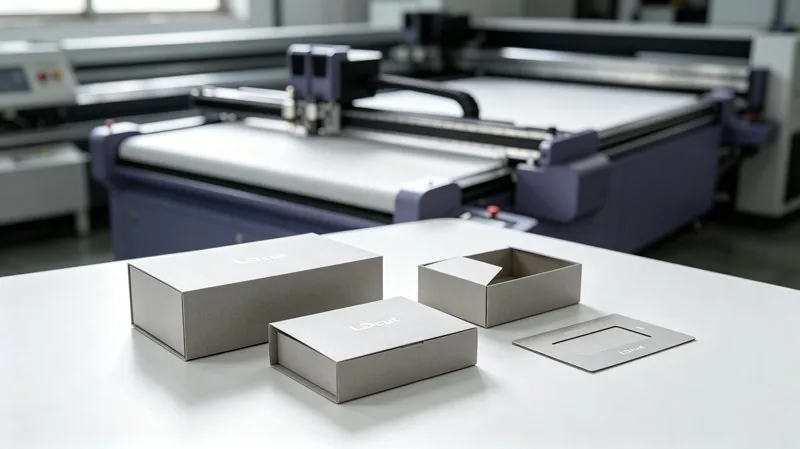
Packaging teams reach for a digital cutter when the work shifts from "can we cut this?" to "can we cut this consistently, in volume, without dies?" Cardstock and grey board are two of the most common packaging substrates, and both reward a knife-based flatbed cutter over manual blades or laser. This guide explains how LDCUT machines process these materials, which tool heads do the work, and how to pair a model to your production volume.
For a full buyer's framework across materials and budgets, start with our complete digital cutting machine guide. For the material-by-material tool map, see our material compatibility guide.
What Is Cardstock and Grey Board Cutting?
Although both are paper-based, they sit at opposite ends of the thickness range and call for different heads.
- Cardstock is a thick paper or light paperboard. On an LDCUT flatbed it is typically cut with the DCT drag knife (clean full or kiss cuts on thin stock around 0.1-3 mm) and scored with the CCT creasing head so it folds without cracking.
- Grey board (also called greyboard or chipboard) is a rigid paperboard used for rigid boxes and stiff covers. It is V-grooved with the VCT V-cut head so panels fold into sharp box walls, then creased with CCT for hinge lines.
Every LDCUT K/L series machine ships standard with the EOT oscillating knife, and the DCT, CCT, KCT, and VCT heads are selected per your material mix from the same interchangeable tool system. That means one platform moves from cardstock displays to grey board rigid boxes by swapping heads, not machines.
Tool Head Mapping
| Material | Primary Head | What it does | LDCUT head |
|---|---|---|---|
| Cardstock | DCT drag knife | Full / kiss cut thin card 0.1-3 mm, follows complex outlines | Selectable |
| Cardstock | CCT creasing | Score lines for clean folds, no surface damage | Selectable |
| Grey board | VCT V-cut | V-groove for crisp rigid-box folds | Selectable |
| Grey board | CCT creasing | Crease without cracking the surface | Selectable |
See the full head lineup and material tags on our Tool Display page.
Where Cardstock and Grey Board Cutting Is Used
These two substrates cover most structural packaging and printed display work. Common, non-fictional applications include:
Cardstock applications
- Packaging box prototypes and short-run boxes — sample a carton before committing to a die.
- Rigid and gift box wraps — creased wraps that fold cleanly around a grey board shell.
- Retail display cards and shelf talkers — kiss-cut cards with precise outlines.
- Book covers and dust jackets — scored stock that folds to the spine.
- Invitation and photo cards — detailed contour cuts without tearing.
Grey board applications
- Rigid box construction — V-grooved panels that fold into sharp, durable box walls.
- Binders and portfolio covers — stiff, creased covers with consistent angles.
- Puzzle and game boards — rigid substrates cut to shape.
- POP and display stands — structural pieces that hold form on the shelf.
- Packaging inserts and dividers — custom fitments cut from a flat sheet.
Choosing the Right LDCUT Model for Cardstock & Grey Board
LDCUT models are paired by production capacity, not by a rigid ladder. For cardstock and grey board packaging, the pairing works like this:
| Model pair | Capacity positioning | Automation advantage | Best for |
|---|---|---|---|
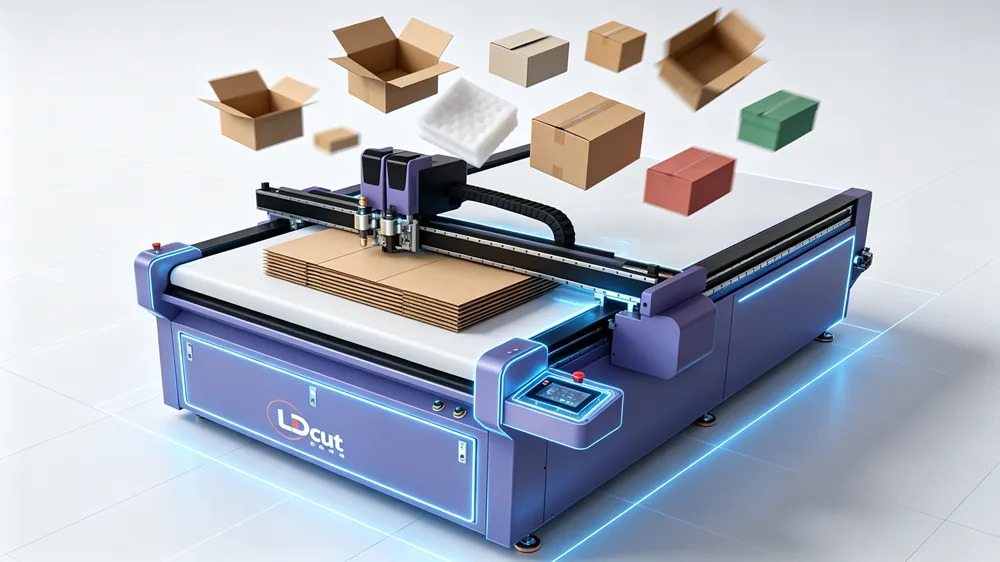
| L10 & K10 | Automated production + heavy-duty | Double IR Auto Tool Setter, Auto Lubrication system, CCD camera standard | High-volume box and card lines |
| L8 & K8 | Sampling + medium runs | CCD camera, compact footprint, same tool ecosystem | Prototype shops, short-run packaging |
Lead with the L10 and K10 when the job is automated, repeatable packaging output: the Double IR Auto Tool Setter removes manual tool-height errors between runs, the Auto Lubrication system keeps the motion system serviced during long shifts, and the standard CCD camera handles optical registration on printed sheets. Choose the K8 and L8 when the work is sampling, boutique packaging, or medium batches where a smaller footprint and faster changeovers matter more than unattended volume.
The complete five-model lineup — including the G6 spindle series for rigid plastics and acrylic — is detailed on the product page.
Knife Cutting vs. Laser for Paperboard
For cardstock and grey board, a knife-based oscillating and drag-knife cutter is the safer default than laser:
- No scorched edges: laser heat can brown or curl paper edges; a knife leaves a clean cut.
- No toxic fumes: cutting coated or printed stock avoids burning inks and releases.
- Creasing and V-grooving: only a multi-head knife platform can both cut and score/groove in one pass.
Laser still earns its place for fine engraving on rigid substrates, but for structural paperboard packaging the knife platform is the practical workhorse.
Frequently Asked Questions (FAQ)
Q1: What is the difference between cardstock and grey board cutting?
A: Cardstock is a thinner paperboard, typically handled with the DCT drag knife for clean full or kiss cuts (around 0.1-3 mm) and the CCT creasing head for fold lines. Grey board is a thicker, rigid paperboard used for rigid boxes; it is grooved with the VCT V-cut head so it folds into crisp walls, then creased with CCT. Both materials run on the same LDCUT flatbed platform with interchangeable heads.
Q2: Which tool head should I use to cut cardstock without tearing?
A: Use the DCT drag knife for thin cardstock (0.1-3 mm) because its 360-degree rotation follows complex outlines without tearing. Pair it with the CCT creasing head for fold scores. The EOT oscillating knife is standard on every LDCUT K/L series machine and handles thicker stocks and mixed materials.
Q3: Can a digital cutter make rigid boxes from grey board?
A: Yes. The VCT V-cut head creates precise V-grooves on grey board so the panel folds into sharp rigid box walls without cracking the surface, and the CCT creasing head adds fold lines. LDCUT pairs this with a CCD camera for optical positioning, keeping each grey board component aligned to its printed registration marks.
Q4: Which LDCUT model is best for packaging production?
A: For automated, high-volume packaging lines, the L10 and K10 are the right pair: they add a Double IR Auto Tool Setter, an Auto Lubrication system, and a standard CCD camera on top of the base capabilities. For sampling and medium runs, the K8 and L8 cover prototyping and shorter box batches on the same tool ecosystem.
Q5: How accurate is cardstock and grey board cutting?
A: LDCUT flatbed cutters use CCD camera optical positioning to align cuts to printed registration marks, which keeps box panels and display cards dimensionally consistent across a run. Cutting accuracy is tight enough for rigid box walls, retail display cards, and precision fold scores.
Conclusion
A purpose-built cardstock and grey board cutting machine turns packaging from a die-dependent, manual process into a flexible, repeatable workflow. Match the DCT/CCT/VCT heads to the substrate, pair the model to your volume — L10/K10 for automated production, K8/L8 for sampling and medium runs — and you cover everything from box prototypes to rigid-box lines on one platform.
If you are scoping a cardstock or grey board packaging line, speak with our engineering team. We recommend a configuration from your real material mix and order profile, and can arrange a demonstration on your samples. Request a quote today.