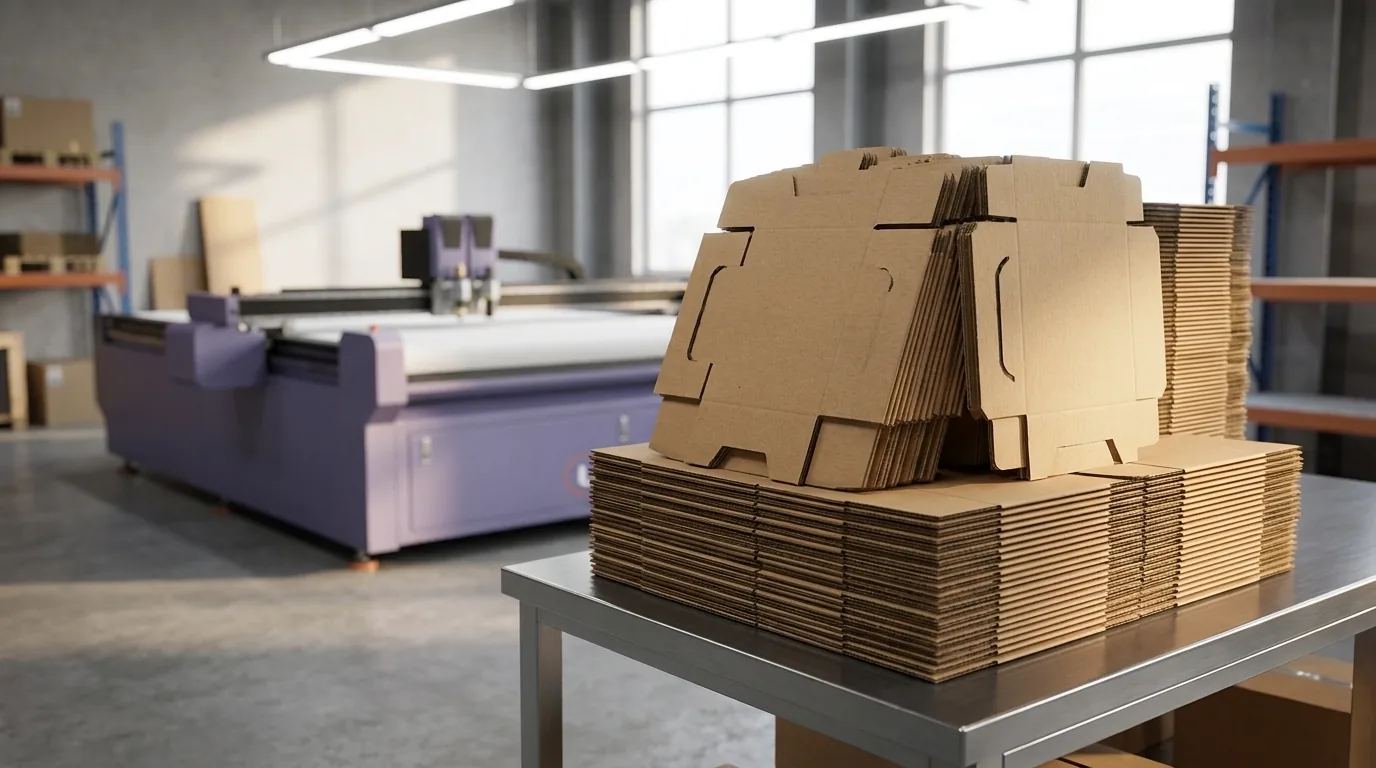
Two machines cut the same sheet of corrugated board. One does it with a steel die bolted into a hinged platen that swings down like a lid. The other does it with a knife following a CAD path, with no die anywhere in the building. They get called by the same words — "die cutting" on one side, "digital cutting" on the other — and that shared vocabulary is where most buying decisions go wrong.
A converter searching for a clamshell die cutter has a specific machine in mind: a small footprint, a hinged platen, a single operator feeding sheets by hand. Most published die cutting versus digital cutting comparisons quietly describe something else — automatic platen presses and rotary presses, machines that run tens of thousands of sheets and cost ten times as much. The advice is not wrong. It is answering a different question.
This article separates the two. It states real clamshell specifications, including the ones that do not favor a digital table, and then shows where the economics actually flip. If you already know you want die-free production, the dieless cutting machine buyer's guide covers that decision directly.
Key Takeaways
- Clamshell is one of four die-cutting architectures, and the cheapest of the four by a wide margin — a different market from automatic platen and rotary presses.
- Its bed reaches 1800 × 3200 mm on large frames, which is larger than most digital cutting tables sold today.
- Mounting a die takes 10–15 minutes. Patching it until every edge cuts clean — make-ready — can take hours. That gap, not the setup, is what a digital table removes.
- The two machines are measured in different units: sheets per hour versus meters per minute of knife travel. Any single-number comparison across them is misleading.
- Break-even is a formula you can run with your own numbers, not a fixed batch size.
Quick Answer
A clamshell die cutter presses a steel-rule die into the sheet with a hinged platen, running roughly 800–2,100 sheets per hour. A digital cutting table moves a knife along a CAD path with no die at all. Setup differs by minutes; make-ready — patching the die until every edge cuts clean — differs by hours.
What a Clamshell Die Cutter Actually Is
A clamshell die cutter is a flat-bed platen press with a hinged upper platen. The operator places a sheet on the lower bed against registration stops, and the upper platen swings down on its hinge to drive a steel-rule die through the board. One closing cycle equals one sheet. Sheets are fed by hand on older machines and by suction or friction feeders on semi-automatic versions.
The name comes from the motion, not the mechanism: the two halves close and open like a clamshell. On large frames the upper platen is driven by a twin-toggle linkage rather than a simple crank, which is how a machine with a modest footprint can develop several hundred tons of closing force.
The Four Architectures Hiding Behind One Term
"Die cutting" describes a family of processes, not a machine. The differences that matter to a buyer are how force is applied, how the sheet is fed, and what the tooling costs.
| Architecture | How force is applied | Typical run size | Die cost |
|---|---|---|---|
| Clamshell (hinged platen) | Flat platen closes on a flat bed; one sheet per cycle | Hundreds to low thousands | $1,800–$4,100 |
| Automatic platen | Same flat-to-flat geometry, sheet fed automatically | Thousands to tens of thousands | $1,800–$4,100 |
| Flatbed cylinder | Sheet passes between a flat bed and a rotating cylinder | Tens of thousands | $1,800–$4,100 |
| Rotary | Two rotating cylinders carry a curved die | High volume, long runs | $7,500–$18,000 |
Tooling prices above are for flat-bed and rotary steel-rule dies; a simpler standard RSC die runs $1,200–$2,800. The four-fold spread between the clamshell tier and the rotary tier is the reason the two should never share a recommendation.
Why the Distinction Matters When You Search
A plant comparing a used clamshell against a large automatic platen is comparing a machine that costs less than a delivery van with one that costs more than a house. Advice written for the second does not transfer. When a page tells you die cutting only makes sense above 20,000 pieces, it is telling you about a rotary or an automatic platen, and it may be entirely right — for that machine. It is not describing what a clamshell does.
Real Clamshell Specs: Size, Tonnage, Speed, Die Format
These are published ranges across large-frame clamshell builders. Individual models vary; the point is the order of magnitude on each axis, because that is what separates a real comparison from a brochure one.
| Parameter | Published range | What it means in practice |
|---|---|---|
| Bed size | 1050 × 750 mm on small frames; up to 1800 × 3200 mm on large ones | The largest frames exceed most digital cutting tables |
| Platen pressure | 1.5–3 t/dm²; up to 550 t total on twin-toggle large frames | Pressure, not knife sharpness, does the cutting |
| Speed | 800–2,100 sheets/hour; 16–28 strokes/min on mid-size frames | One stroke produces one sheet, whatever is on the die |
| Die format | 23.8 mm (0.937") wood-back steel rule standard; 30 mm (1.18") available; 3" on widemouth models | Rule height limits how thick a board the die can span |
| Material ceiling | Corrugated to 15 mm; foam board 6 mm; molded pulp 3 mm; plastic 3 mm with a heated platen | Beyond these, pressure distorts the edge before it cuts it |
| Setup | 10–15 minutes to mount and align a die | Excludes make-ready, which is the larger number |
About That Bed Size
The assumption that a clamshell is a small-format machine is wrong, and it is worth stating plainly: large clamshell frames reach 1800 × 3200 mm. Our own L10 and K10 cutting tables go to 1600 × 2500 mm. On bed area, the platen press wins.
That is not a rhetorical concession, it is the setup for the real argument. If a clamshell already covers the sheet size and already produces a finished, creased, stripped blank in one stroke, then nobody buys a digital table because of format. They buy it because of what happens between jobs — and because of what happens when the job is 200 pieces instead of 20,000. The comparison that decides the purchase is throughput per changeover, not bed area.
Tonnage Is the Physical Reason It Exists
A clamshell cuts by pressure. The platen distributes 1.5–3 tonnes per square decimeter across the whole die face at once, and on a large twin-toggle frame the total closing force reaches 550 tonnes. That is why a single stroke can drive a rule through 15 mm of double-wall corrugated and leave a square edge rather than a crushed one.
A digital cutting table works on the opposite principle. A knife with a very small contact area concentrates force along one path at a time. It needs no tonnage because it never has to compress the whole sheet. Both approaches produce a cut blank. They fail in different ways: a platen crushes when pressure is uneven or the board is too dense, and a knife tears when the material is too fibrous or the depth is set wrong.
The Cost Nobody Quotes: Setup vs Make-Ready
Ask what a changeover costs on a clamshell and the answer is usually "ten to fifteen minutes." That number is accurate and it is also the wrong number. It measures mounting the die. It does not measure making the die cut properly.
In platen die cutting these are two separate operations with two separate clocks. Setup is mechanical: unclamp the old die, lift it out, set the new one against the register, close the clamps, check alignment. Make-ready is empirical: run a sheet, look at where the rule did not cut through and where it cut too deep into the cutting plate, and correct.
What Patching Actually Is
A steel-rule die looks like a single flat plane of blade. It is not. The rule is bent, joined and set into a wood or synthetic backing by hand, and the resulting blade height varies by fractions of a millimeter across the die. On 15 mm corrugated, that variance is enough to turn a clean cut into a hanging nick.
So the operator patches. Thin paper or tape shims go behind the low spots on the die, under the rule, to raise them. Run a sheet, find the next low spot, shim again. Repeat until every edge of every part in the layout cuts exactly through — no more, because cutting into the plate shortens its life. This is make-ready, and it is skilled manual work that cannot be scheduled around.
Industry guidance on the make-ready process is candid about the range: depending on the job and its complexity, it can take several hours. Not several minutes. Several hours, on a die that took ten minutes to mount.
Why This Is the Comparison That Matters
A digital cutting table has no make-ready step. Depth is a number entered in the job file, held by a servo or pneumatic head, and it is identical for the first part and the ten-thousandth. There is no shim, no test sheet, no iteration. Loading a new job means loading a new file.
So the honest changeover comparison is not 15 minutes against 3 minutes. It is 15 minutes plus an open-ended make-ready against a file load. On a repeat job where the die is already patched and shelved, the clamshell wins that race comfortably. On a new die, a revised layout, or a board grade the die was not cut for, it can lose by hours — and the loss lands exactly on the short runs where the margin was thinnest to begin with.
Two Different Productivity Units
Clamshell capacity is quoted in sheets per hour. Digital cutting capacity is quoted in meters per minute of knife travel, sometimes millimeters per second. Placing those two figures in the same table produces a comparison that looks rigorous and means nothing, because the units measure different things.
What a Stroke Buys You
A clamshell stroke is a parallel operation. Everything on the die is cut, creased and perforated in the same instant. Nest twenty small die-cut parts across the sheet and one stroke still yields twenty parts, at the same rate as one part. Shape complexity is nearly free, as long as the die fits the bed and the tonnage covers the rule length.
Published figures land between 800 and 2,100 sheets per hour: a large frame rated 800–1,000, a mid-size hydraulic model at 1,500–2,100, and frames quoted at 16–28 strokes per minute working out to roughly 960–1,680 sheets per hour at one sheet per stroke. At these rates, and with a die already patched, a clamshell can outrun a single-head digital table on plain volume.
What a Pass Costs You
A digital cut is a serial operation. The head follows a path, and time is proportional to path length: every part outline, every crease, every perforation adds distance. A layout with twenty intricate parts takes far longer per sheet than a layout with one rectangle, even though both are the same board and the same area.
This cuts both ways. Better nesting means more parts per sheet, which lowers material cost per part, but it also lengthens the path, which raises machine time per sheet. The two effects have to be optimized together, which is what nesting software is for. A table quoted at 120 m/min is quoting idle travel between cuts, not the speed at which it cuts corrugated — that number is set by the knife, the board and the depth, and it is far lower.
The Only Fair Conversion
To compare honestly, convert both to finished parts per hour for one specific job: the same board, the same layout, the same batch size, including changeover and make-ready amortized across the run. Once both sides are in parts per hour for your job, the decision usually makes itself — and it frequently disagrees with whichever brochure you read last.
Die Cost and Format: What a Clamshell Actually Consumes
Standard clamshell tooling is 23.8 mm (0.937") wood-back steel rule, with 30 mm (1.18") available and up to 3" on widemouth models built for soft-cut work. That specification matters because it sets a floor on the board thickness a die can span and a ceiling on how much of the die can be resharpened before the rule is too short to set.
Priced against the three tooling tiers used across this site, a clamshell die sits in the flat-bed band at $1,800–$4,100 per die. A standard RSC die is cheaper at $1,200–$2,800; a rotary die is far more expensive at $7,500–$18,000. The die is durable and reusable — it can be shelved, resharpened and run again next season — which is the strongest part of the clamshell case on any job that repeats.
One capability that surprises buyers: a platen die cutter can half-cut self-adhesive stock. Manufacturer material lists include adhesives with half cut — stickers, labels and transfers — because a rule ground to a controlled height stops at the liner just as a kiss-cut knife does. Where a digital table pulls ahead is not the ability but the control: setting depth numerically at ±0.01 mm machining accuracy instead of adjusting it by shimming a rule. The kiss cutting technique guide covers how that depth control is set up and verified.
Where a Digital Cutting Table Wins
Four things, and they are all about the space between jobs rather than the job itself.
- No tooling, therefore no tooling lead time. A new shape is a new file. There is no quote to request, no die to order, no 2–5 week wait, and no minimum quantity imposed by the cost of the die.
- No make-ready. Depth is programmed, so the first sheet and the last sheet are cut to the same setting with no patching iteration.
- Nesting flexibility. Layouts can be re-nested per job to fit offcuts and mixed orders that a fixed die cannot accommodate.
- Depth control for multi-layer work. Kiss cutting, scoring and perforating are set numerically, with camera registration at 0.025 mm for printed sheets.
Material behavior across board grades, foams and plastics is covered separately in the material compatibility reference, and the heavy-duty configuration of a production table is described on the L10 automated cutting machine page.
The Break-Even Formula
Batch-size thresholds get quoted as fixed numbers — 5,000 pieces, 8,000 pieces — as if they were physics. They are arithmetic. The threshold is simply where the tooling you avoid equals the extra hourly cost of cutting digitally:
Break-even batch = die cost ÷ per-piece cost penalty of cutting digitally
where the per-piece penalty = (digital cycle time per piece − clamshell cycle time per piece) × labor rate
Run it with real numbers. A mid-range flat-bed die at $2,950 against a penalty of $0.50 per piece gives 2,950 ÷ 0.50 ≈ 5,900 pieces. A cheaper die at $1,800 against a smaller penalty of $0.30 gives 6,000 pieces; a $4,100 die against a $1.00 penalty gives 4,100. The answer moves with the die price and the labor rate, which is exactly why a published threshold is worth less than the formula behind it.
Two cautions when you run it. First, the penalty can go negative: on a complex layout a digital table may produce a part faster than a hand-fed platen, in which case there is no break-even point and the digital table wins from the first piece. Second, the formula ignores make-ready, which pushes the crossover further toward digital on any job using a new die.
Where the Clamshell Still Wins
Plenty of jobs, and it is worth being specific about which.
Thick and dense board. A clamshell handles corrugated to about 15 mm, foam board to 6 mm and most plastics to 3 mm. A knife can also cut these, but on very thick board the platen's whole-face pressure produces a squarer edge, because the material is compressed and sheared in one action rather than sliced progressively. The same applies to molded pulp, where 3 mm is already the practical limit.
Any job that repeats. Once a die is patched and shelved, its make-ready cost is sunk. Every re-run is pure production at several hundred to two thousand sheets per hour. A digital table has to re-cut every sheet forever, so on a stable, high-volume part it never catches up on machine time.
Shapes with extreme internal detail in one pass. A die can perforate, crease, emboss and cut in one stroke. A digital table performs those operations as separate tool passes, so a layout with many small features pays for each one in sequence.
Asset life. Large platen frames are engineered for a 25–30 year service life, against 5–7 years for value-oriented presses. Spread a modest purchase price across three decades and the capital cost per year gets very small — which is the argument for buying a solid used machine rather than the cheapest one available. For sample and small-batch work on the digital side, the K8 standard industrial cutter is the entry configuration.
Buying Used: What Actually Wears Out
A used clamshell can be an excellent buy, because the mechanism is simple and the frame outlives most of what is bolted to it. What fails is predictable, and each failure shows up as make-ready time rather than as a breakdown.
- The cutting plate. The sacrificial surface under the sheet takes every rule strike. A worn plate is no longer flat, so the die has to be patched unevenly to compensate, and make-ready time grows job by job. Confirm the plate can be replaced and price the part before you buy.
- Toggle and hinge wear. Clearance at the hinge or in the toggle linkage lets the platen close slightly out of parallel. The symptom is a die that cuts through on one side of the bed and hangs on the other, no matter how carefully it is patched.
- Die clamping and register. Worn clamps mean a die that shifts mid-run, which shows up as inconsistent registration rather than as a mechanical fault.
- Hydraulics and seals. On hydraulic frames, seal condition sets both cycle speed and positional repeatability. Ask for the service record, not just the hour count.
- Spare parts availability. A 25-year-old machine from a builder still supplying parts is a different asset from one whose manufacturer has closed. That single question can outweigh every other specification on the sheet.
The practical test is to bring a die. Mount it, run sheets, and time the make-ready from bare plate to clean cut. If a machine that should patch in forty minutes takes three hours, the plate or the parallelism is worn — and you have just measured the cost in the only unit that matters.
Frequently Asked Questions
Is a clamshell die cutter the same as a die cutting machine?
No. Clamshell is one specific architecture: a hinged platen that closes flat against a flat bed, one sheet at a time. Automatic platen presses, flatbed cylinder presses and rotary presses are all die cutting too, but they feed and apply force differently, run far higher volumes, and cost an order of magnitude more.
How many sheets per hour does a clamshell die cutter run?
Published figures sit between 800 and 2,100 sheets per hour. A large frame is rated around 800–1,000, a mid-size hydraulic model up to 1,500–2,100, and frames quoted at 16–28 strokes per minute work out to roughly 960–1,680 sheets per hour at one sheet per stroke. Because one stroke produces one sheet regardless of how many parts are nested, shape complexity barely changes that number.
Can a clamshell die cutter kiss cut labels?
Yes. Half-cutting self-adhesive stock is a standard platen capability, and manufacturer material lists include adhesives with half cut — stickers, labels and transfers. A digital table adds controlled depth, holding ±0.01 mm machining accuracy against the liner by setting a number rather than shimming a rule.
How thick corrugated board can a clamshell die cutter cut?
Up to about 15 mm on large frames. The same machines list foam board to 6 mm, molded pulp to 3 mm and most plastics to 3 mm with a heated platen. The limit is pressure and edge distortion rather than knife reach, which is why very thick or very dense stock usually pushes the job toward a different process.
How long does make-ready take on a clamshell die cutter?
Mounting the die takes 10–15 minutes. Make-ready — patching the die until every edge cuts exactly through without cutting into the plate — is a separate step and depends on complexity; guidance puts it anywhere from well under an hour to several hours. A digital cutting table has no make-ready step at all, because depth is set in software.
When does a digital cutting table pay off over a clamshell die cutter?
Break-even is die cost divided by the per-piece penalty of cutting digitally. A $2,950 die against a $0.50 per-piece penalty crosses at roughly 5,900 pieces. Run the same formula with your own die quote, labor rate and cycle times for your own number.
If your mix is drifting toward shorter runs and more revisions, the working question stops being which machine is faster and becomes which machine can accept a new job without a tooling purchase. That is covered end to end in our digital cutting machine guide.