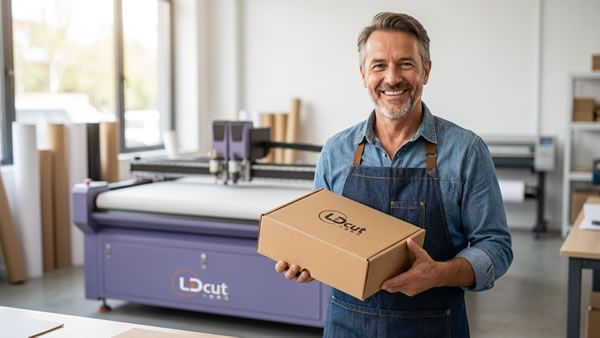
Your best customer just asked for 300 custom mailer boxes by Friday. With traditional steel-rule die cutting, that single request triggers a familiar chain reaction: a new die that costs $2,000–$15,000, a 2–5 week wait for tooling, and a minimum order that makes the job unprofitable at this volume. A dieless corrugated cutting machine breaks that chain. It cuts, creases, scores, and V-grooves cardboard and corrugated board directly from a digital CAD file — no steel die, no tooling lead time, no minimum order. This guide is for packaging converters, print finishers, and carton plants weighing digital knife cutting against conventional die cutting. We compare the real costs and show how to choose the right machine for sampling and short-run custom work. A dieless cardboard cutting machine is no longer a luxury prototype tool; for many shops it is the difference between winning the small order and quietly declining it.
For a complete breakdown of digital cutting technology and how to choose the right machine, read our complete digital cutting machine guide.
Key Takeaways
- A dieless corrugated cutting machine cuts cardboard from a digital file with no steel die, eliminating $2,000–$15,000 per-die tooling and 2–5 week waits.
- Digital flatbed cutters make sampling, short-run custom orders, and POP/display work profitable — segments where traditional die cutting loses money.
- Oscillating-knife cutting leaves clean, burr-free, fume-free edges on corrugated and coated board — something laser cutting cannot match.
- Prioritize ±0.01 mm accuracy, 3-minute tool-free changeover, CCD vision alignment at 0.025 mm, and a zoning vacuum table that protects flutes.
- Most converters recover a dieless cardboard cutting machine in 12–18 months by accepting short-run and sample jobs they once turned away.
Not sure which model fits your board and volume? Explore the LDCUT cutter lineup to see flatbed cutters built specifically for corrugated and cardboard.
What Is a Dieless Corrugated / Cardboard Cutting Machine?
A dieless corrugated cutting machine is a CNC flatbed cutter. It uses a computer-controlled oscillating knife to cut, crease, and V-groove cardboard and corrugated board directly from a digital design file, with no physical steel die. The word "dieless" simply means the shape is defined in software, not stamped by a custom tool. The same machine is often called a digital flatbed cutter, an oscillating knife cutting machine, or a digital die cutter.
And the economics are moving in its favor. Global customized packaging reached USD 43.84 billion in 2024 and is forecast to reach USD 58.96 billion by 2030, growing at a 5.06% CAGR. Paper and paperboard already account for roughly 40% of that market. A dieless cardboard cutting machine is the production tool built for exactly that demand.
How Dieless Cutting Works
The workflow is straightforward:
- Import a CAD file (DXF, PLT, AI, PDF, or a JPG/TIF with printed registration marks) into the cutter's software.
- Nest the parts so the software arranges them to maximize material use.
- Hold the sheet flat with the vacuum table.
- Cut as a gantry-mounted head moves the knife along the path.
- Change the file for the next job. There is no die to machine, store, or wait for, so the next order can be completely different.
Design changes that once meant a new $5,000+ rotary die and a month of delay now take a few mouse clicks.
The Oscillating Knife Advantage
An oscillating knife moves up and down at high frequency, tens of thousands of vibrations per minute, shearing the fibre like a very fast precision blade. Three properties make it ideal for paper-based materials:
- It does not crush the flute. A steel die presses the board; a vibration knife slices it. Corrugated keeps its structure and rigidity.
- It leaves no burr and no smoke. Mechanical cutting generates no heat, so edges stay clean and white — critical for coated and printed board.
- It is safe and low-overhead. No laser tube, no fume extraction, no fire-risk enclosure.
This is why leading converters favor an oscillating knife over laser for corrugated: laser heat burns a brown edge on coated paperboard and can melt foam cores. For more details on the difference between oscillating knife and drag knife, check out our guide on oscillating knife vs drag knife.
Dieless vs Die Cutting: A Real Cost Comparison
The honest answer is that neither technology is "better" in absolute terms. They solve different problems, so the question is which fits the job in front of you. For a comprehensive comparison, read our digital cutter vs die cutting guide.
Here is the head-to-head cost comparison:
| Factor | Traditional Die Cutting | Dieless Cutting |
|---|---|---|
| Tooling cost | $2,000–$15,000 per new die (complex rotary/matched-metal: $5,000–$20,000+) | $0 — the "die" is your CAD file |
| Lead time | 2–5 weeks typical; up to 4–8 weeks for complex dies | Same day the file is approved |
| Minimum order | Hundreds to thousands to amortize tooling | None — one box or one thousand |
| Design change | New die, new cost, new wait | New file, no cost |
| Material waste | Manual layout, more offcut | Nested layout, +30% utilization typical |
| Best for | Locked, high-volume (100k+ identical) runs | Sampling, short-run, custom, urgent |
In short: dies win on locked, high-volume runs; dieless wins on everything variable, new, small, or urgent.
Tooling Cost
Traditional die cutting starts with tooling. A simple steel-rule die may run a few hundred dollars, but the complex rotary and matched-metal dies used for serious carton work routinely cost $5,000–$20,000+ (die-cutting industry data). That $2,000–$15,000 range is a realistic mid-market figure for a new die.
A dieless corrugated cutting machine charges nothing for tooling. The "die" is the CAD file you already own.
Lead Time
Tooling lead time is the silent killer of packaging timelines. Industry data shows custom die development spanning from a few days for simple steel-rule dies to 4–8 weeks for complex rotary dies. The 2–5 week range in most converters' quotes reflects real machining and validation steps.
Dieless cutting collapses that to zero. The moment the file is approved, the machine can cut.
Flexibility & Minimum Order
This is where the model breaks for small jobs. A steel die amortizes only across volume. Below a few thousand pieces, the per-unit tooling cost makes the order margin-negative. That is precisely why most shops decline 200-box custom requests.
A dieless cardboard cutting machine has no such floor. One box or one thousand, the cost profile is identical, because there is no die to recover.
When Die Cutting Still Wins
Be skeptical of any vendor who claims digital replaces everything. For a stable, high-volume program, say 100,000+ identical cartons monthly, a steel die on a press delivers a lower per-piece cost and higher throughput. Die cutting also remains the right call for certain heavy rigid materials outside a knife's range. Use dieless for the variable, the new, the small, and the urgent; keep dies for the locked, the massive, and the mature.
Why Packaging Teams Choose Dieless Cutting
But the daily grind is where it really shows.
Faster Sampling & Approvals
Sampling is where dieless cutting earns its keep first. With a die, that sample costs tooling and weeks. With a dieless corrugated cutting machine, the sample is cut the same day the file is ready.
Mini story — Sarah's sampling turnaround. Sarah runs production at a 40-person folding-carton converter in the Midwest. Before adding a digital flatbed cutter, a new structure took 14 days to sample: 10 days for the die, then cutting and hand-finishing. A key account threatened to move a seasonal line to a competitor offering faster proofs. After switching to an oscillating-knife cutter, Sarah's team now turns a CAD file into a physical sample in under four hours. "We stopped losing proofs to speed," she said. "Now the bottleneck is the customer's own review meeting, not our shop floor."
Profitable Short-Run & Custom Orders
Short-run custom work is the fastest-growing, least-served segment for traditional die cutters. Traditional tooling makes these unprofitable; dieless makes them routine.
Mini story — Tom's 200-box win. Tom owns a 12-person custom packaging shop in Ohio. A local skincare brand asked for 200 branded mailer boxes with a custom insert. Tom's old quote path: a $3,800 rotary die plus three weeks, pushing the per-box price past what the client would pay. He almost declined. Instead, he ran the job on a digital cutter the same afternoon he received the file, delivered in three days, and booked the client's repeat quarterly run. The machine paid for that single order's tooling saving many times over across the year.
Lower Labor & Material Waste
Smart nesting software arranges parts to use the sheet efficiently, and vendors commonly cite 30%+ gains in material utilization versus manual layout. Less offcut means lower board cost per box, and cutting, creasing, and scoring in one pass drops labor per finished carton versus hand-finishing.
Curious whether your own materials cut cleanly? Request a free material test and we will run your board on a digital flatbed cutter and return physical samples.
Key Specifications That Matter for Corrugated & Cardboard
Not all digital cutters are built for board. If you run a dieless corrugated cutting machine on corrugated and cardboard every day, these five specifications decide whether a machine is a tool or a toy. For more guidance on choosing the right digital cutter for your materials, see our material compatibility guide.
Cutting Accuracy
For carton-making, a few hundredths of a millimeter separate a clean fold from a misfit lid. Look for true cutting accuracy around ±0.01 mm. Anything looser than ±0.1 mm will show as inconsistent boxes at scale.
Speed
Two numbers matter: travel speed and knife oscillation frequency. A high traverse speed, around 120 m/min on capable flatbed cutters, moves the head between cuts quickly. The oscillation frequency, typically, determines how fast the blade shears thick board.
For a concrete example of a production-grade build, see the LDCUT L10 digital flatbed cutter, which pairs a 120 m/min traverse with high-frequency oscillation and Double IR Auto Tool Setter.
Tool Heads & 3-Minute Change
The tool head is the heart of a dieless cardboard cutting machine. A versatile unit swaps heads in about three minutes with no special tools:
- EOT oscillating knife — thick materials up to 50 mm, smooth and burr-free.
- DCT drag knife — thin materials 0.1–3 mm, 360° rotation for curves.
- CCT creasing wheel — scores cartons for clean folding.
- KCT kiss-cut knife — cuts sticker face without damaging the liner. Learn more about kiss-cutting in our kiss-cutting technique guide.
- VCT V-groove knife — grooves 3–50 mm boards for rigid box folding. Discover V-grooving for honeycomb board in our honeycomb board V-grooving guide.
The LDCUT Digital Cutter offers a flexible selection of Cutting Tools, allowing users to freely configure the tool combination to match their specific applications and material requirements.
Intelligent Vision Positioning
Printed sheets are never perfectly placed. CCD vision alignment scans registration marks and auto-corrects the cut path at a resolution around 0.025 mm. One-click scanning, automatic printed-cut alignment, and auto-feed turn a finicky hand-loaded job into a repeatable process that protects your brand's edges.
Vacuum Table & Flute Handling
Corrugated is unforgiving of poor hold-down. A zoning vacuum table lets you activate only the area under the sheet, holding thin board flat without sucking warped sheets into the knife. The machine cuts without crushing the medium, and a crushed flute means a weak, returned box.
How to Choose the Right Dieless Cutting Machine
Specs tell you what a machine can do. Workflow tells you what you need.
Match the Machine to Your Workflow
Be honest about your dominant job. If you live in sampling and small custom runs, a sample-focused platform is right. If short-run production is growing, size up. Don't over-buy a high-volume beast for a sampling room, and don't under-buy a sample maker for a production floor.
Table Size & Material Range
Match the bed to your largest common sheet and your thickest board. A 50 mm cutting capacity covers most double-wall corrugated and rigid foam, and you will cut bigger than you expect within a year.
Creasing & V-Cutting for Box Making
If folding cartons are your business, creasing and V-grooving are not optional. A creasing wheel scores the fold line; a V-groove knife removes a wedge from rigid board so it bends to 90° without cracking the face. This is the difference between a box that folds crisply and one that cracks at the corner. For more tips on cutting corrugated cardboard for box making, check our complete guide.
Software & File Compatibility
Your cutter is only as flexible as its software. Confirm native support for DXF, PLT, AI, PDF, JPG, and TIF, and look for nested-layout tools that optimize material use automatically. The more formats accepted without conversion, the less prepress time you waste.
Typical Applications & Workflow
A dieless corrugated cutting machine earns its place across three everyday jobs:
Carton Sample Making
The most common entry point is carton sampling. A brand sends a dieless file; you cut and crease a physical sample the same day. The LDCUT K8 carton sample maker is built exactly for this — sample and small-batch carton work with fast changeover.
Short-Run Custom Packaging
Below the die-cut minimum, dieless owns the segment. Mailer boxes, subscription inserts, promotional cartons, and event packaging all run profitably. For higher short-run volume, the LDCUT K10 high-volume cutter adds duty cycle and Double IR Auto Tool Setter for sustained production.
POP / Display & Signage
Corrugated displays, foam inserts, and signage media cut and crease in one pass. V-grooving turns rigid board into freestanding displays. This is where a dieless cardboard cutting machine turns a print shop into a display house, opening new margin from existing customers.
LDCUT Dieless Cutting Solutions
LDCUT is a China-based manufacturer of CNC flatbed oscillating-knife cutters with 22 years of build experience and CE & ISO certification. The lineup spans sample makers to production cutters:
- L8 / L10 — flatbed cutters; the L10 adds Double IR Auto Tool Setter and automatic lubrication.
- K8 / K10 — sample and short-run focused; the K10 adds Double IR Auto Tool Setter.
- G6 — spindle milling and V-grooving for rigid boxes.
Across the range, the core specs stay consistent:
- Accuracy & speed: ±0.01 mm accuracy, 120 m/min traverse, high-frequency oscillation.
- Vision & hold-down: CCD vision at 0.025 mm and a zoning vacuum table.
- Control & tooling: full Leadshine servo control with EOT, DCT, CCT, KCT, and VCT heads swapping in under three minutes.
- Trust signals: 3,000+ companies in 80+ countries across 15+ industries, 24–48 hour pre-shipment stability testing, and a 1-year machine warranty.
Frequently Asked Questions
Q: How thick can a dieless cardboard cutting machine cut?
A: Capable oscillating-knife heads handle thick materials up to about 50 mm — covering double-wall corrugated, rigid foam board, and most display substrates. Thin drag-knife heads handle 0.1–3 mm materials including stickers and decals. Always confirm the specific head rating for your thickest board.
Q: Dieless cutting vs laser cutting: which is better for cardboard?
A: For corrugated and coated cardboard, oscillating-knife (dieless) cutting is the better fit. Laser is a thermal process; on paperboard it leaves a burnt brown edge, can melt foam cores, and requires fume extraction. A dieless cardboard cutting machine cuts cold — clean white edges, no smoke, no fire-risk enclosure. Laser still wins for some synthetics and metals where edge sealing or fine detail matters.
Q: Is a dieless cutting machine hard to learn?
A: Less than most buyers expect. The learning curve is mostly software familiarization — import file, set material, nest, cut. Most operators are productive within days, not weeks.
Q: How much maintenance does an oscillating knife cutting machine need?
A: Routine maintenance is light: blade inspection and replacement, periodic lubrication, and cleaning the vacuum table and rails. Automated lubrication on models like the L10 reduces manual service. Budget for blades as a consumable, but expect far less infrastructure than laser — no tube, optics, or extraction upkeep.
Conclusion
A dieless corrugated cutting machine is not a replacement for every steel die. But for sampling, short-run custom work, and fast approvals, it changes what your shop can say yes to. Three takeaways to carry forward:
- Kill the tooling tax. No die means no $2,000–$15,000 per-shape cost and no 2–5 week wait.
- Win the small order. Same-day samples and profitable short runs open a segment die cutting cannot serve.
- Protect the board. Oscillating-knife cutting keeps flutes intact and edges clean, which laser cannot match.
If you are evaluating a dieless cardboard cutting machine, start with a real test on your own materials.