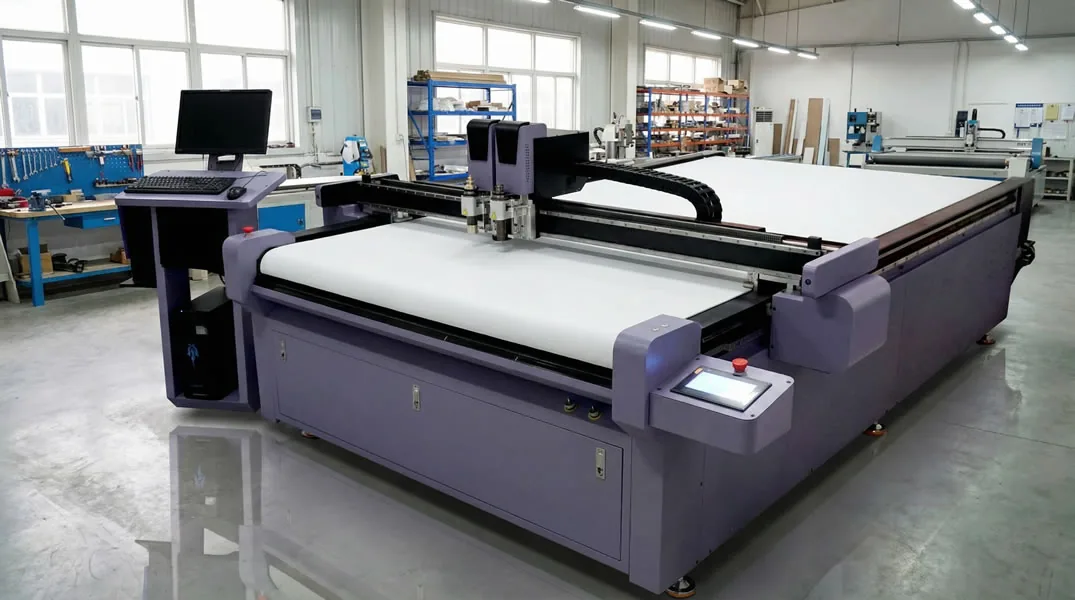
Introduction — Why Choosing the Right CNC Digital Cutting Machine is Critical for Your Business
As a distributor or agent of CNC cutting machines, you face more than just equipment selection challenges. Cross-border procurement involves complex certification compliance, spare parts logistics, after-sales response, and agency term negotiations. Any misstep can become the final straw that breaks the partnership.
For a complete breakdown of digital cutting technology and how to choose the right machine, read our complete digital cutting machine guide.
A wrong selection decision can cost you tens of thousands of dollars in procurement costs and waste 3-6 months of local market promotion time. Worse, when customer equipment fails, spare parts take 2 months to arrive, or certification documents are rejected by customs, your reputation in the local market will suffer irreparable damage. Competitors won't give you a second chance.
This article provides a channel partner perspective, outlining 9 critical factors that must be rigorously evaluated. After reading this guide, you will have a complete CNC Digital Cutting Machine selection evaluation framework to help you avoid 90% of common pitfalls.
1. Material Compatibility & Cutting Method Selection — Find the Right Solution for Your Market
Infographic: Material × Cutting Method Comparison Matrix (Fabric/Leather/Foam/Cardboard/Composites vs Oscillating knife/Drag knife/Laser/Router)
Different materials have vastly different physical properties. No single cutting method works for all scenarios. As a channel partner, you need to first understand what materials your local market's key customers work with, then determine which cutting technology to promote. For packaging-specific applications, check our packaging industry guide.
Oscillating knife — The King of Versatile Cutting
Oscillating knife is currently the most mainstream solution in the industrial cutting market. It cuts materials via high-speed up-and-down vibrating blades, with very broad applicability:
- Applicable Materials: Leather, fabric, corrugated cardboard, foam, composite materials
- Cutting Accuracy: ±0.1mm, clean edges without burrs
- Maintenance Cost: Low blade price, easy replacement, customers can do it themselves
If your local market customers focus on multi-product, small-batch production, Oscillating knife is the safest choice.
Drag knife — Cost-Effective Choice for Cardboard
Drag knife is suitable for thin cardboard and corrugated board, with low price and simple structure.
- High Cutting Efficiency: Ideal for high-volume production in packaging industry
- Limited Tool Life: Requires frequent replacement
- Vacuum Suction Essential: Otherwise material displacement will cause cutting failure
Click to learn more about other types of cutting tools
2. Cutting Area & Automation Configuration — Balance Capacity and Space
Data Table: Comparison of different specifications for Flatbed/Roll-to-roll equipment
Cutting area is not the bigger the better. You need to match based on customer factory space conditions and actual capacity requirements.
Flatbed vs Roll-to-roll — How to Choose
- Flatbed: Suitable for sheet materials (leather, foam, sheets), fast material changeover
- Roll-to-roll: Suitable for roll materials (fabric, film), high continuous production efficiency
Decision Criteria: Does the customer buy materials by sheet or by roll? Choose Flatbed for the former, Roll-to-roll for the latter.
Multi-zone Vacuum Suction System
Multi-zone vacuum is standard on large equipment. It divides the table into multiple independently controlled zones, allowing you to activate only the corresponding zones when cutting small workpieces, saving electricity and money.
- Vacuum Pump Configuration: At least 7.5kW or higher
- Zoning Logic: Customize based on customer's main workpiece sizes
- Energy Optimization: Zoned use can save 40%-60% energy compared to full operation
Automatic Feeding & Vision Alignment System
Vision alignment system uses cameras to automatically identify printed contours or positioning points on materials, especially suitable for:
- Precision cutting of printed fabrics
- Irregular edge processing of composite materials
This feature is directly reducing labor costs by 30% or more.
3. Accuracy & Speed — Core Metrics of Production Efficiency
Speed and accuracy may seem contradictory, but they are actually two sides of the same coin. When customers buy equipment, they're buying the output quantity of qualified products per unit time.
Accuracy vs Repeatability — Understanding Key Parameters
- Accuracy: Deviation of a single cut from the design dimensions
- Repeatability: Consistency of multiple cutting results
Many manufacturers only specify accuracy, not repeatability, in their promotional materials. Channel partners must request third-party test reports from suppliers when selecting equipment.
Throughput Optimization Strategy
Capacity calculation cannot only rely on equipment parameters, but also actual working conditions:
- Material Hardness: Cutting speed drops 20%-30% for hard materials
- Tool Path: Good nesting software can save 15%-20% cutting time
- Loading/Unloading Time: Automation level directly affects actual capacity
4. Software & File Compatibility — Seamlessly Integrate Your Workflow
ICUT Control Software is the core control system for LDCUT equipment, designed specifically for efficient production.
ICUT Control Software Core Advantages
Simple operation, no professional programming knowledge required. Ordinary operators can complete production tasks independently after short-term training.
Supports multiple industry-standard file formats:
- dxf, plt: Vector graphics standard formats
- jpg, tif: Raster image formats, supporting vision-guided cutting
Automated Roll Material Processing
For Roll-to-roll materials, ICUT software supports:
- Oversized file automatic cutting: No manual splitting required, software automatically handles large-format files beyond the working area
- Multi-file continuous cutting: Batch import multiple design files, automatically complete cutting in sequence
- Automatic feeding: Linked with automatic feeding system for continuous unmanned production of roll materials
This software system directly reduces operator skill requirements, minimizes human errors, and is a key component for improving production efficiency.
5. Tools, Consumables & Daily Maintenance — Control Operating Costs
Tool System Configuration
- Standard tool kit: Oscillating Tool + Drag Cutting Tool (Other cutting tools are available)
- Special tools: Dedicated tools for composite materials need separate quotation
- Tool life: Tool life also varies depending on the material
Consumables Management Strategy
Recommended consumables list for customers:
- Blades (stock 3 months by monthly consumption)
- Conveyor belts (high-frequency use parts)
- Vacuum pump oil (monthly inspection)
Preventive Maintenance Plan
- Daily cleaning: 15 minutes per day
- Weekly inspection: Guide rails, lubrication
- Monthly maintenance: Vacuum pump, electrical system
6. Spare Parts Availability & After-sales Service — Key Considerations for Channel Partners
Excellent Manufacturing, Global Service
LDCUT adheres to 5S standards management, with zero-compromise quality requirements ensuring stable performance of every machine. From R&D center to assembly workshop, from quality inspection process to global service network, every link has been carefully refined.
Comprehensive After-sales Support
- 1-year full machine warranty: Starts from CE label manufacturing date (excluding knives and conveyor belts)
- Installation support: Complete installation videos and user manuals help customers install efficiently
- 24/7 technical support: Professional engineer team provides English service, responds within 1 hour, with 24/7 emergency assistance for all production needs
- Comprehensive training: Complete training on machine operation and software use from setup to production
7. Agency Policy & Commercial Terms — Ensure Successful Partnership
When channel partners choose suppliers, they are essentially choosing partners for the next 3-5 years. The details of the terms determine the success or failure of the partnership.
Agency Cooperation Model
LDCUT provides flexible cooperation programs for global channel partners. Whether you are a regional exclusive agent or authorized dealer, you can customize the cooperation model based on your market size and resource advantages.
Support & Incentives
LDCUT values every partner and provides:
- Market protection: Reasonable regional division and customer protection policies
- Price support: Competitive agency pricing system
- Marketing resources: Product materials, promotional assets, exhibition support
- Technical training: Product knowledge, sales techniques, after-sales support training
Commercial Terms
Specific commercial terms such as agency prices, payment methods, and credit terms need to be negotiated individually based on your actual situation.
Recommendation: Communicate directly with LDCUT's channel expansion team to understand the specific contents of the agency policy. Our professional team will provide the most suitable cooperation plan based on your market conditions.
8. Total Cost of Ownership (TCO) & Return on Investment — Comprehensive Financial Analysis
Chart: TCO model and ROI calculation example
Purchasing a CNC Digital Cutting Machine is an important investment decision. Beyond the equipment price itself, you also need to consider the full lifecycle costs and returns.
Cost Components
The total cost of ownership of a CNC cutting machine includes:
- Initial investment: Equipment price, accessories, transportation, installation
- Operating costs: Labor, energy, consumables, maintenance
- Opportunity costs: Downtime, production capacity loss
Return on Investment
The investment returns from LDCUT equipment mainly come from:
- Efficiency improvement: Replacing manual labor or traditional equipment, capacity increase up to 300%
- Cost savings: Material utilization increased by 30%, labor costs reduced by 40%
- Quality stability: Improved precision, reduced defect rate
Important Note: Specific TCO and ROI calculations need to be combined with your actual production situation. It is recommended to provide material types, capacity requirements, labor costs and other data.
9. Lead Time & Installation Requirements — Successfully Launch Production
Checklist: Site preparation and installation checklist
Equipment delivery and installation are the final steps of project success. Adequate preparation ensures on-time production launch.
Installation Preparation
Before equipment arrival, customers need to complete the following preparations:
- Power configuration: Voltage and power meeting equipment requirements
- Space: Sufficient installation area and access
- Basic conditions: Floor loading capacity, ambient temperature and humidity, etc.
Installation Services
LDCUT provides complete installation support:
- Installation videos: Detailed video guidance
- User manuals: Illustrated operation guides
- Technical support: Remote guidance from professional engineers
Recommendation: For specific delivery cycles, installation requirements and support plans, please communicate in detail with LDCUT's sales team. We will provide personalized delivery plans based on your project situation.
Frequently Asked Questions (FAQ)
Q1 — How to choose the most suitable cutting method for customers?
Three-step decision method: First, check the material (choose Oscillating knife for leather/fabric, Laser cutting for synthetic fibers, Router for composites, Drag knife for corrugated cardboard); Second, check capacity requirements (choose Roll-to-roll for large rolls, Flatbed for multi-product small batches); Third, check budget (Drag knife is most economical, 5-axis router has the highest investment). There's no best, only most suitable.
Q2 — What LDCUT machine models are available, and how do I choose the right one?
LDCUT offers five models across three product series, each available in 4 standard sizes:
| Model | Series | Key Features | Best For |
|---|---|---|---|
| L8 | L Series | High-frequency oscillation, high-precision servo drive | General-purpose production |
| L10 | L Series | Double IR Auto Tool Setter, auto lubrication | Heavy-duty industrial production |
| K8 | K Series | High-precision servo drive | Sampling & short runs |
| K10 | K Series | Double IR Auto Tool Setter, heavy-duty static table | Demanding production environments |
| G6 | G Series | 40,000/60,000 rpm spindle, matrix vacuum surface, 100 m/min speed | PVC, acrylic, plexiglass |
Common specs across all models: ±0.01 mm processing accuracy, 0.025 mm camera resolution, Leadshine brushless full servo drive, imported ground racks (X/Y axes) and ball screws (Z axis).
To choose the right model, share the following with the LDCUT team:
- What materials will you cut?
- What is the largest material size (length × width)?
- What is the material thickness?
- What is your production volume (prototyping vs. mass production)?
Based on these details, LDCUT engineers will recommend the optimal model, bed size, and tool head configuration with the best cost-performance ratio.
Q3 — How does LDCUT ensure quality before shipping, and how is global delivery handled?
Before any LDCUT machine leaves the factory, it undergoes a rigorous 3-step pre-shipment quality inspection:
- Material Feeding & Cutting Accuracy Test — Real-world production simulation to verify feeding system smoothness and zero-tolerance cutting precision.
- Cutting Platform Flatness & Depth Calibration — High-precision instrument calibration to guarantee consistent cutting depth across the entire work area.
- 24–48 Hour Continuous Stability Test — Extended run testing under full-load production conditions to confirm long-term reliability before dispatch.
LDCUT ships globally to 80+ countries through a professional logistics network. Machines are packaged in standard export-grade packaging (film wrapping + fumigation-free plywood wooden case) to ensure safe transit. For delivery timelines, shipping options, and freight costs to your region, contact the LDCUT sales team directly at Ld@Ldcut.com or +86-19059518798 — they will provide a confirmed schedule and quote based on your order and destination.
Conclusion — Start Your Successful CNC Digital Cutting Machine Procurement Journey
Choosing a CNC Digital Cutting Machine is not just buying a machine, it's choosing a long-term partner.
Review of 9 key factors:
- Technical dimensions: Material compatibility, cutting methods, accuracy & speed, software integration
- Commercial dimensions: Spare parts & after-sales, agency policy, payment terms
- Operational dimensions: TCO analysis, delivery & installation
Turn these 9 factors into your customer evaluation checklist, with clear scoring criteria and bottom-line requirements for each item. This will help you maintain professionalism in fierce market competition and win long-term trust.
Next steps recommended:
- Use the evaluation framework in this article to review 2-3 main brands you currently sell
- Create a "CNC Digital Cutting Machine Selection Evaluation Form" for customer use
- When negotiating with suppliers, prioritize after-sales SLA, spare parts inventory, and training support as key terms
Ready to explore the right CNC Digital Cutting Machine for your market?
Ready to explore the right CNC Digital Cutting Machine for your market?
- Request a quote today — Our engineering team will provide customized solutions based on your specific needs
- Connect with our channel team — Discuss exclusive agency opportunities for your region
- Schedule a live demo — See LDCUT machines in action with your own materials
Minimum Order Quantity (MOQ) applies. Contact us for details.