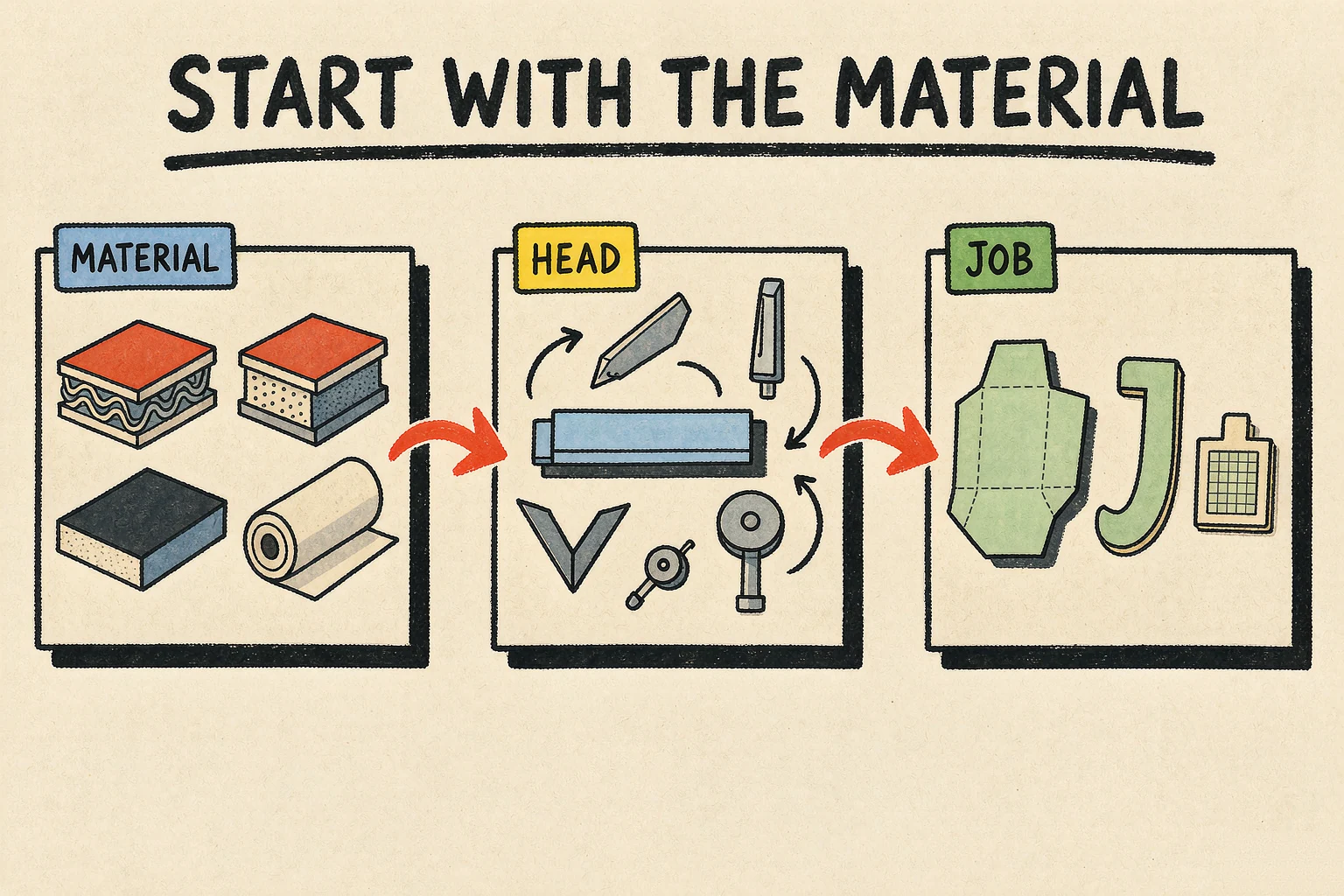
Most cutting-machine purchases go wrong at the same point: the buyer picks a machine before deciding which material and which cut type the job actually needs. A knife set up for corrugated will tear vinyl. A spindle that contours acrylic will destroy a sheet of foam board. This page works the other way round — start from the job, then read off the material, the machine, and the head.
Every entry below states what the process can and cannot do on that material. Where a job sits outside the capability, it says so.
The applications at a glance
The table is the summary. The sections after it explain the boundaries, which is where most of the real decision-making sits. The last row is not an industry — registration applies to printed work in any of the seven above, and it is covered in the CCD vision registration guide rather than in a section of its own.
| Application | Typical material | Machine | Head | Where the limit is |
|---|---|---|---|---|
| Packaging & folding cartons | Corrugated board, cardstock, grey board | K8 / L8 for samples, K10 / L10 for volume | EOT to cut, CCT to crease | Crease depth on heavy board needs a test before committing a run |
| Signage & display | Vinyl, PVC film, foam board, acrylic | K/L for sheet and roll, G6 for rigid acrylic | DCT for film, EOT for board, spindle for acrylic | Acrylic above a few millimeters is a spindle job, not a knife job |
| Foam board & KT board | Foam board, KT board, acoustic foam | K8 / L8 or K10 / L10 | EOT | Very soft foam compresses unless hold-down is dialled in |
| Honeycomb board | Honeycomb board, decorative board | K10 / L10, or G6 for panel contouring | VCT for V-grooving, spindle on the G6 | Grooving depth is set by board skin thickness, which varies by supplier |
| Cardstock & grey board | Cardstock, grey board, rigid box board | K8 / L8 or K10 / L10 | CCT to crease, EOT to cut | Corner quality on thick grey board depends on crease width, not knife sharpness |
| ABS and rigid plastic sheet | ABS, rigid PVC, phenolic board | G6 for sheet thickness, DCT on K/L for thin film | Spindle on the G6, DCT for thin stock | Thick rigid sheet needs spindle speeds the knife models do not have |
| Stickers & labels | Vinyl, PP paper, label stock on liner | K8 / L8 or K10 / L10 | KCT for kiss-cut, DCT for through-cut | Kiss-cut depth has to be reset when liner thickness changes |
| Printed panels needing registration | Pre-printed board, film, labels | Any model, camera standard on all five | Any head, with the camera in the loop | Registration holds at the marks; the far edge moves with substrate stretch |
Packaging and folding cartons
This is the application where a digital cutter replaces a die press most cleanly, because the economic argument does not depend on speed. A steel-rule die costs money before the first box is cut, and a design change costs money again. A digital machine costs a file import.
Two heads do the work. EOT cuts the blank through. CCT presses the fold lines, which is what separates a folding carton from a stack of cut rectangles. Cutting without creasing produces a box that tears along the fold and never squares up.
The limit worth knowing before you buy: crease quality depends on matching crease width to board thickness. Corrugated, cardstock, and grey board each want a different crease profile, and the same head will not do all three at the same setting. For production volume, the 10 models earn their price through the automatic tool setter, which resets depth after a head change instead of relying on the operator. Start from the packaging cutting guide for the process, or the packaging machine comparison for model selection.
Signage and display
Signage is not one material, and that is why it breaks so many purchase decisions. A shop that cuts vinyl graphics, foam board prints, and acrylic letters needs three different processes, and no single head covers them.
DCT handles the film side: vinyl, PVC roll material, PP paper, reflective board. It rotates freely through 360 degrees, which is what makes script lettering and complex contours possible without lifting the blade. EOT handles the board side: foam board, KT board, corrugated display board. Acrylic is the split point. Thin acrylic can be scored and snapped; anything structural goes to a spindle, and on LDCUT machines that means the G6 digital flatbed cutter, whose spindle runs at 40,000 or 60,000 rpm on a dual-purpose suction table with clamps.
The full process discussion is in the signage and display cutting guide.
Foam board and KT board
Foam and KT board are the most forgiving materials in the range and the most commonly botched. The cut itself is easy for EOT: a vertical oscillating stroke severs the material without dragging it. What goes wrong is hold-down. Foam board is light and closed-cell, so a vacuum that is too strong dents the surface and a vacuum that is too weak lets the sheet lift on a long cut, which shows up as a stepped edge halfway across the sheet.
Both the 8 and 10 models use a rolling felt conveyor table with zonal vacuum hold-down, so the zones can be switched to match the sheet size. Cutting speed is set by the foam density and the pattern, not by the machine ceiling. See foam board cutting and KT board cutting for the parameter discussion.
Honeycomb board
Honeycomb board is where V-grooving earns its place. VCT cuts a V-shaped channel into the surface so the board folds flat into a corner without crushing the core. Cutting straight through and butting the edges gives a weaker joint on any display or furniture application.
Two constraints govern the job. First, groove depth must be set against the skin thickness, and skin thickness varies between suppliers of nominally identical board. Second, the core is mostly air, so hold-down has to be light enough not to collapse it. On LDCUT machines VCT handles the grooving on the K and L models; where the job needs contour cutting through a rigid honeycomb panel rather than folding it, the spindle on the G6 is the correct tool and VCT is not.
Process detail is in the honeycomb V-grooving guide.
Cardstock and grey board
Rigid box making lives or dies on crease and corner. Cardstock and grey board are dense, and a crease that is too shallow cracks the coating on the fold while one that is too deep delaminates the board. CCT is designed for exactly this, and its official material list covers cardstock, grey board, corrugated board, and packaging board.
The mistake buyers make is judging this application by cut speed. Speed is irrelevant here; a rigid box panel is small and the run is short. What matters is crease consistency across the sheet, which is why the automatic tool setter on the 10 models is worth more than a higher travel speed on this job. See cardstock and grey board cutting.
ABS and rigid plastic sheet
ABS appears on two different lists, and the distinction matters. DCT lists ABS among its materials, which covers thin ABS sheet and film. Structural ABS — the kind used for signage letters, POS units, and machine guards — is a spindle job, because a drag knife on thick rigid plastic produces chatter marks and a tapered edge.
On LDCUT machines that means the G6, with the spindle at 40,000 or 60,000 rpm. The knife models can be ordered with an optional spindle, but it must be specified before production and cannot be retrofitted afterwards, which is a decision buyers regret most often. The ABS cutting guide covers the thickness boundary.
Stickers and labels
Label work is a kiss-cut problem, not a cutting problem. KCT cuts through the face material and stops at the liner, so the label stays on its backing until it is applied. Get the depth wrong by a few hundredths of a millimeter in one direction and the liner is scored; in the other direction and the face is not fully separated.
KCT is not on the standard configuration. Every knife model ships with EOT plus one head of your choice, so a label shop should order KCT as that second head. Depth is set per job, and changing to a different liner means resetting it. Where the artwork is printed and the cut must follow it, the camera closes the loop — it is standard on all five models, at 0.025 mm resolution giving 0.025 mm registration at the marks. See kiss-cutting technique and vinyl and sticker cutting.
Choosing between a knife and a spindle
The question comes up on almost every inquiry, and it has a mechanical answer rather than a commercial one.
A knife severs material along a path. It works when the material is thin relative to the blade, when the cut can start at an edge, and when the material will not compress away from the blade. A spindle removes material by rotation. It works when the stock is rigid, when the cut needs a vertical wall with controlled finish, and when the edge geometry matters more than speed.
Foam, corrugated, cardstock, vinyl, and most display board are knife work. Acrylic, thick PVC, composites, and structural ABS are spindle work. Honeycomb is both, depending on whether the job folds or contours. The material compatibility guide lists every material against every head, and the tool head reference explains what each of the five heads does.
From application to configuration
Once the application is fixed, the configuration follows three questions. Which head does the primary material need. Does the job need a second head for a second material, remembering that one machine takes EOT plus one. And does the volume justify the 10 models over the 8, which is a question about tool setting and lubrication rather than about speed.
Buyers who want the specification detail should read the accuracy statement before comparing numbers, because most published accuracy figures are not measured the same way. Buyers who want the commercial comparison should start from the digital flatbed cutter range and then the cost structure guide.
Related pages
- Digital flatbed cutter product range — all five models with full specifications
- Material compatibility guide — every material against every head
- Packaging prototyping application — the packaging workflow in detail
- Digital cutter versus die cutting — when the die still wins
- Accuracy statement — what the published figures actually measure